Townsend Nathan E, Nichols David S, Skiba Philip F, Racinais Sebastien, Périard Julien D
Athlete Health and Performance Centre, Aspetar Orthopaedic and Sports Medicine Hospital Doha, Qatar.
Department of Sports Medicine, Advocate Lutheran General Hospital Park Ridge, IL, USA.
Front Physiol. 2017 Mar 23;8:180. doi: 10.3389/fphys.2017.00180. eCollection 2017.
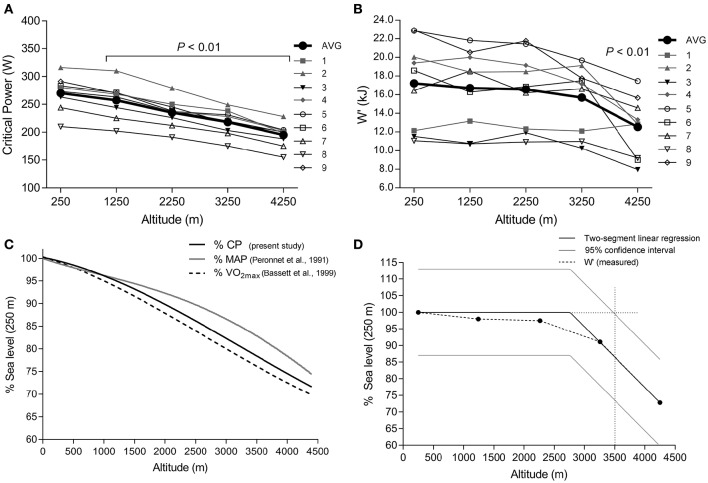
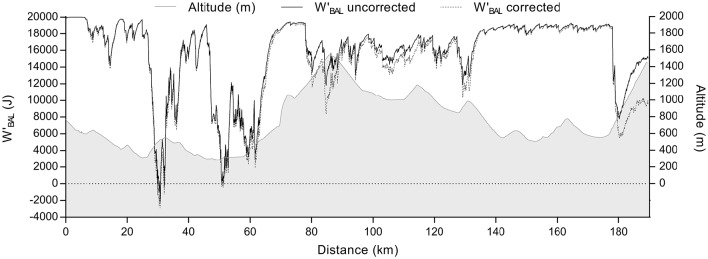
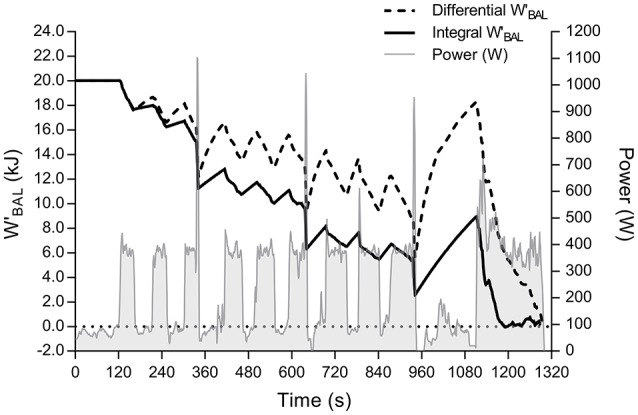
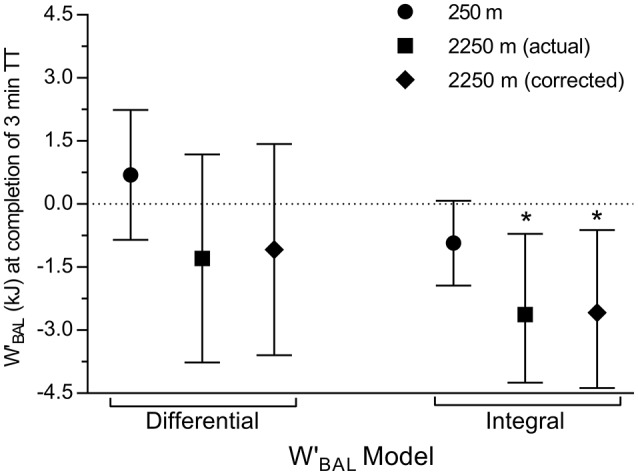
Develop a prediction equation for critical power (CP) and work above CP (W') in hypoxia for use in the work-balance ([Formula: see text]) model. Nine trained male cyclists completed cycling time trials (TT; 12, 7, and 3 min) to determine CP and W' at five altitudes (250, 1,250, 2,250, 3,250, and 4,250 m). Least squares regression was used to predict CP and W' at altitude. A high-intensity intermittent test (HIIT) was performed at 250 and 2,250 m. Actual and predicted CP and W' were used to compute W' during HIIT using differential ([Formula: see text]) and integral ([Formula: see text]) forms of the [Formula: see text] model. CP decreased at altitude ( < 0.001) as described by 3rd order polynomial function ( = 0.99). W' decreased at 4,250 m only ( < 0.001). A double-linear function characterized the effect of altitude on W' ( = 0.99). There was no significant effect of parameter input (actual vs. predicted CP and W') on modelled [Formula: see text] at 2,250 m ( = 0.24). [Formula: see text] returned higher values than [Formula: see text] throughout HIIT ( < 0.001). During HIIT, [Formula: see text] was not different to 0 kJ at completion, at 250 m (0.7 ± 2.0 kJ; = 0.33) and 2,250 m (-1.3 ± 3.5 kJ; = 0.30). However, [Formula: see text] was lower than 0 kJ at 250 m (-0.9 ± 1.3 kJ; = 0.058) and 2,250 m (-2.8 ± 2.8 kJ; = 0.02). The altitude prediction equations for CP and W' developed in this study are suitable for use with the [Formula: see text] model in acute hypoxia. This enables the application of [Formula: see text] modelling to training prescription and competition analysis at altitude.
开发一个用于预测低氧环境下临界功率(CP)和CP以上功率(W')的方程,以用于功平衡([公式:见原文])模型。九名经过训练的男性自行车运动员完成了骑行计时赛(TT;12、7和3分钟),以确定五个海拔高度(250、1250、2250、3250和4250米)下的CP和W'。采用最小二乘法回归来预测海拔高度下的CP和W'。在250米和2250米处进行了高强度间歇测试(HIIT)。使用[公式:见原文]模型的微分([公式:见原文])和积分([公式:见原文])形式,将实际和预测的CP和W'用于计算HIIT期间的W'。CP在海拔高度下降(<0.001),如三阶多项式函数所描述(=0.99)。W'仅在4250米处下降(<0.001)。双线性函数表征了海拔高度对W'的影响(=0.99)。在2250米处,参数输入(实际与预测的CP和W')对建模的[公式:见原文]没有显著影响(=0.24)。在整个HIIT过程中,[公式:见原文]返回的值高于[公式:见原文](<0.001)。在HIIT期间,在250米(0.7±2.0千焦;=0.33)和2250米(-1.3±3.5千焦;=0.30)完成时,[公式:见原文]与0千焦无差异。然而,在250米(-0.9±1.3千焦;=0.058)和2250米(-2.8±2.8千焦;=0.02)时,[公式:见原文]低于0千焦。本研究中开发的CP和W'的海拔预测方程适用于急性低氧环境下的[公式:见原文]模型。这使得[公式:见原文]模型能够应用于海拔高度的训练处方和比赛分析。