Su Weipeng, Xu Wen, Zhang Hao, Ying Zhixiong, Zhou Le, Zhang Lili, Wang Tian
College of Animal Science and Technology, Nanjing Agricultural University, Weigang 1, Nanjing, 210095, China.
Nutr Res Pract. 2017 Apr;11(2):121-129. doi: 10.4162/nrp.2017.11.2.121. Epub 2017 Mar 20.
BACKGROUND/OBJECTIVES: The study was conducted to evaluate the effects of dietary leucine supplementation on mitochondrial biogenesis and energy metabolism in the liver of normal birth weight (NBW) and intrauterine growth-retarded (IUGR) weanling piglets.
MATERIALS/METHODS: A total of sixteen pairs of NBW and IUGR piglets from sixteen sows were selected according to their birth weight. At postnatal day 14, all piglets were weaned and fed either a control diet or a leucine-supplemented diet for 21 d. Thereafter, a 2 × 2 factorial experimental design was used. Each treatment consisted of eight replications with one piglet per replication.
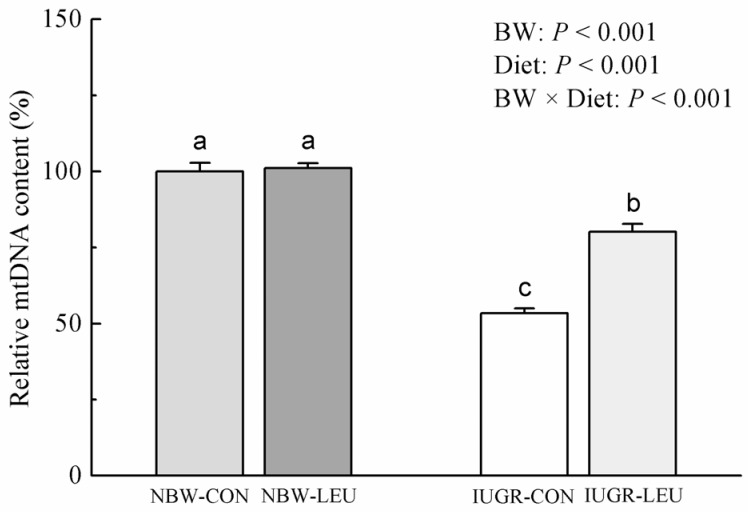
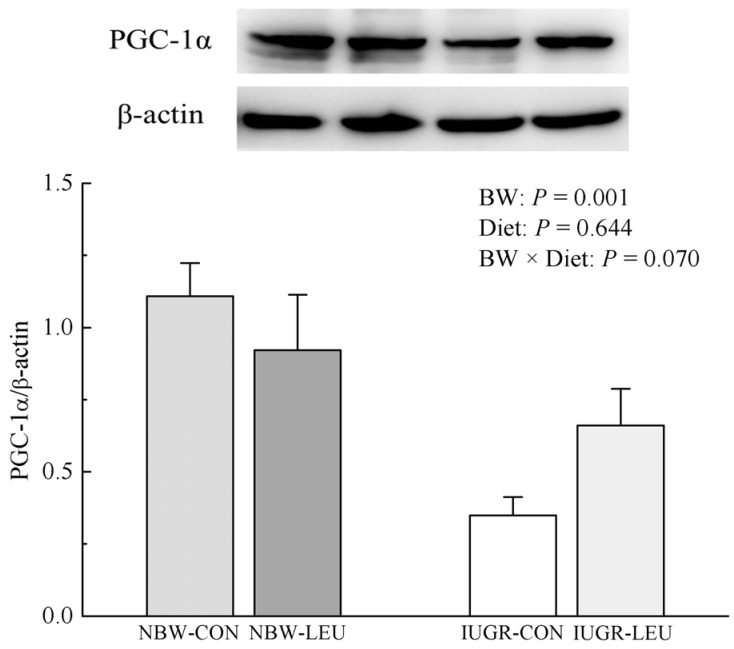
Compared with NBW piglets, IUGR piglets had a decreased ( < 0.05) hepatic adenosine triphosphate (ATP) content. Also, IUGR piglets exhibited reductions ( < 0.05) in the activities of hepatic mitochondrial pyruvate dehydrogenase (PDH), citrate synthase (CS), α-ketoglutarate dehydrogenase (α-KGDH), malate dehydrogenase (MDH), and complexes I and V, along with decreases ( < 0.05) in the concentration of mitochondrial DNA (mtDNA) and the protein expression of hepatic peroxisome proliferator-activated receptor-γ coactivator 1α (PGC-1α). Dietary leucine supplementation increased ( < 0.05) the content of ATP, and the activities of CS, α-KGDH, MDH, and complex V in the liver of piglets. Furthermore, compared to those fed a control diet, piglets given a leucine-supplemented diet exhibited increases ( < 0.05) in the mtDNA content and in the mRNA expressions of sirtuin 1, PGC-1α, nuclear respiratory factor 1, mitochondrial transcription factor A, and ATP synthase, H transporting, mitochondrial F1 complex, β polypeptide in liver.
Dietary leucine supplementation may exert beneficial effects on mitochondrial biogenesis and energy metabolism in NBW and IUGR weanling piglets.
背景/目的:本研究旨在评估日粮补充亮氨酸对正常出生体重(NBW)和宫内生长受限(IUGR)断奶仔猪肝脏线粒体生物合成及能量代谢的影响。
材料/方法:根据出生体重从16头母猪所产仔猪中选取16对NBW和IUGR仔猪。出生后第14天,所有仔猪断奶,分别饲喂对照日粮或补充亮氨酸的日粮21天。之后,采用2×2析因试验设计。每个处理有8个重复,每个重复1头仔猪。
与NBW仔猪相比,IUGR仔猪肝脏三磷酸腺苷(ATP)含量降低(P<0.05)。此外,IUGR仔猪肝脏线粒体丙酮酸脱氢酶(PDH)、柠檬酸合酶(CS)、α-酮戊二酸脱氢酶(α-KGDH)、苹果酸脱氢酶(MDH)以及复合物I和V的活性降低(P<0.05),同时线粒体DNA(mtDNA)浓度和肝脏过氧化物酶体增殖物激活受体γ共激活因子1α(PGC-1α)蛋白表达降低(P<0.05)。日粮补充亮氨酸可提高(P<0.05)仔猪肝脏ATP含量以及CS、α-KGDH、MDH和复合物V的活性。此外,与饲喂对照日粮的仔猪相比,饲喂补充亮氨酸日粮的仔猪肝脏mtDNA含量以及沉默调节蛋白1、PGC-1α、核呼吸因子1、线粒体转录因子A和ATP合酶H+转运线粒体F1复合物β多肽的mRNA表达增加(P<0.05)。
日粮补充亮氨酸可能对NBW和IUGR断奶仔猪的线粒体生物合成及能量代谢产生有益影响。