Suárez Nicolás M, Lau Betty, Kemble George M, Lee Ronzo, Mocarski Edward S, Wilkinson Gavin W G, Adler Stuart P, McVoy Michael A, Davison Andrew J
MRC-University of Glasgow Centre for Virus Research, Glasgow, UK.
3-V Biosciences, Inc., Menlo Park, CA, USA.
Virus Genes. 2017 Aug;53(4):650-655. doi: 10.1007/s11262-017-1452-0. Epub 2017 Apr 8.
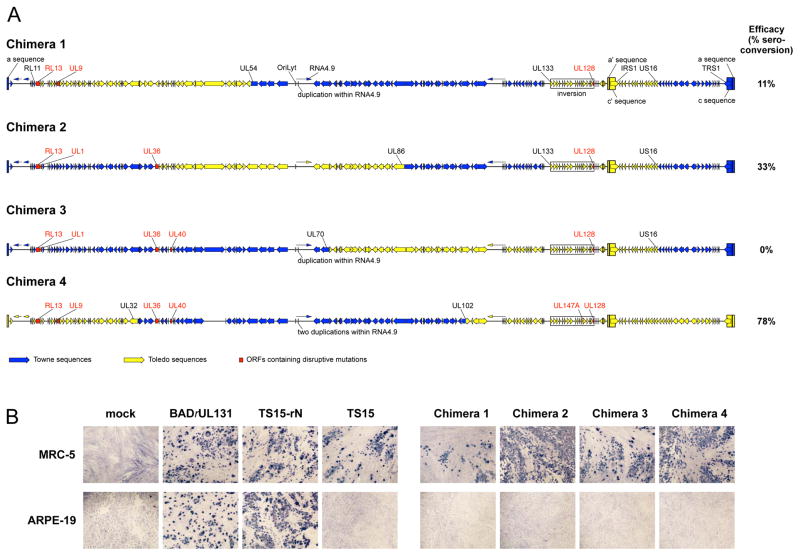
Human cytomegalovirus (HCMV) is an important opportunistic pathogen in immunocompromised patients and a major cause of congenital birth defects when acquired in utero. In the 1990s, four chimeric viruses were constructed by replacing genome segments of the high passage Towne strain with segments of the low passage Toledo strain, with the goal of obtaining live attenuated vaccine candidates that remained safe but were more immunogenic than the overly attenuated Towne vaccine. The chimeras were found to be safe when administered to HCMV-seronegative human volunteers, but to differ significantly in their ability to induce seroconversion. This suggests that chimera-specific genetic differences impacted the ability to replicate or persist in vivo and the consequent ability to induce an antibody response. To identify specific genomic breakpoints between Towne and Toledo sequences and establish whether spontaneous mutations or rearrangements had occurred during construction of the chimeras, complete genome sequences were determined. No major deletions or rearrangements were observed, although a number of unanticipated mutations were identified. However, no clear association emerged between the genetic content of the chimeras and the reported levels of vaccine-induced HCMV-specific humoral or cellular immune responses, suggesting that multiple genetic determinants are likely to impact immunogenicity. In addition to revealing the genome organization of the four vaccine candidates, this study provided an opportunity to probe the genetics of HCMV attenuation in humans. The results may be valuable in the future design of safe live or replication-defective vaccines that optimize immunogenicity and efficacy.
人巨细胞病毒(HCMV)是免疫功能低下患者重要的机会性病原体,也是孕期感染导致先天性出生缺陷的主要原因。20世纪90年代,通过用低传代托莱多株的基因组片段替换高传代汤氏株的基因组片段构建了四种嵌合病毒,目的是获得减毒活疫苗候选株,这些候选株既安全又比过度减毒的汤氏疫苗更具免疫原性。研究发现,将这些嵌合体接种给HCMV血清阴性的人类志愿者时是安全的,但它们诱导血清转化的能力有显著差异。这表明嵌合体特异性的基因差异影响了其在体内复制或持续存在的能力以及随之而来的诱导抗体反应的能力。为了确定汤氏株和托莱多株序列之间的特定基因组断点,并确定在嵌合体构建过程中是否发生了自发突变或重排,对其完整基因组序列进行了测定。虽然鉴定出了一些意外的突变,但未观察到重大缺失或重排。然而,嵌合体的基因组成与报告的疫苗诱导的HCMV特异性体液或细胞免疫反应水平之间没有明显关联,这表明多个遗传决定因素可能影响免疫原性。除了揭示四种疫苗候选株的基因组结构外,本研究还为探究人类HCMV减毒的遗传学提供了机会。这些结果可能对未来设计安全的减毒活疫苗或复制缺陷疫苗具有重要价值,这类疫苗可优化免疫原性和效力。