Kho Kai Ling, Koh Fui Xian, Hasan Lailatul Insyirah Mohd, Wong Li Ping, Kisomi Masoumeh Ghane, Bulgiba Awang, Nizam Quaza Nizamuddin Hassan, Tay Sun Tee
Department of Medical Microbiology, Faculty of Medicine, University of Malaya, 50603 Kuala Lumpur, Malaysia.
Julius Centre University of Malaya, Department of Social and Preventive Medicine, Faculty of Medicine, University of Malaya, 50603 Kuala Lumpur, Malaysia.
Emerg Microbes Infect. 2017 Apr 12;6(4):e18. doi: 10.1038/emi.2017.4.
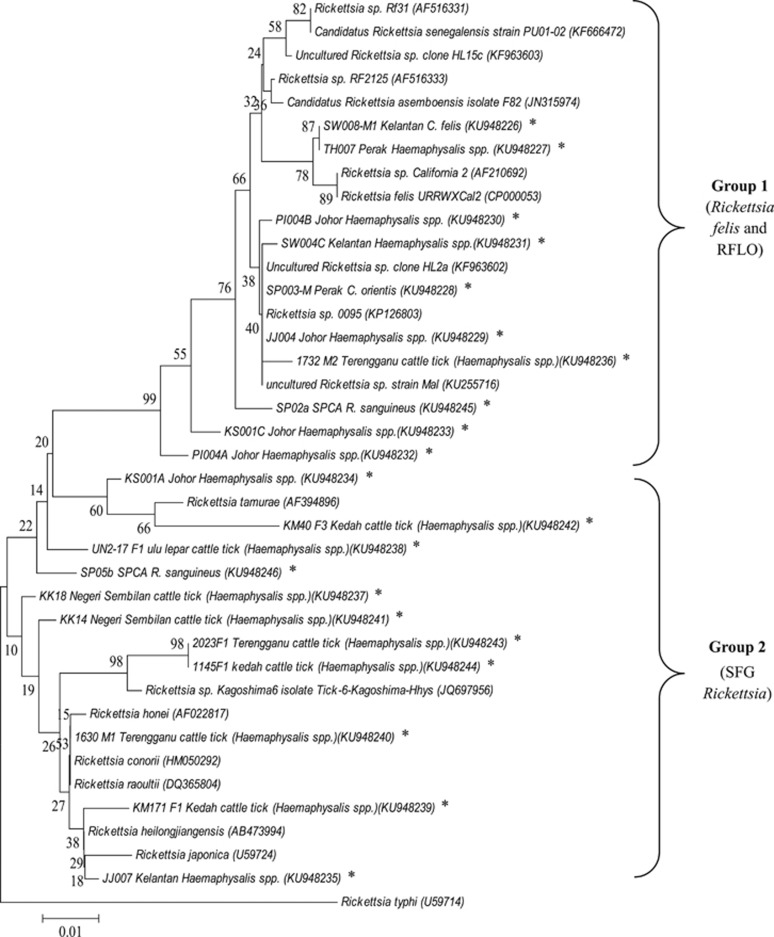
Rickettsioses are emerging zoonotic diseases that are often neglected in many countries in Southeast Asia. Rickettsial agents are transmitted to humans through exposure to infected arthropods. Limited data are available on the exposure of indigenous community and animal farm workers to the aetiological agents and arthropod vectors of rickettsioses in Peninsular Malaysia. Serological analysis of Rickettsia conorii and Rickettsia felis was performed for 102 individuals from the indigenous community at six rural villages and 87 workers from eight animal farms in Peninsular Malaysia in a cross-sectional study. The indigenous community had significantly higher seropositivity rates for R. conorii (P<0.001) and R. felis (P<0.001), as compared to blood donors from urban (n=61). Similarly, higher seropositivity rates for R. conorii (P=0.046) and R. felis (P<0.001) were noted for animal farm workers, as compared to urban blood donors. On the basis of the sequence analysis of gltA, ompA and ompB, various spotted fever group rickettsiae closely related to R. raoultii, R. heilongjiangensis, R. felis-like organisms, R. tamurae, Rickettsia sp. TCM1, R. felis, Rickettsia sp. LON13 and R. hulinensis were identified from tick/flea samples in animal farms, indigenous villages and urban areas. This study describes rickettsial seropositivity of the Malaysian indigenous community and animal farm workers, and provides molecular evidence regarding the presence of rickettsial agents in ticks/fleas infesting domestic animals in Peninsular Malaysia.
立克次体病是新出现的人畜共患病,在东南亚许多国家常被忽视。立克次体病原体通过接触受感染的节肢动物传播给人类。关于马来西亚半岛土著社区和动物农场工人接触立克次体病病原体和节肢动物媒介的数据有限。在一项横断面研究中,对来自马来西亚半岛六个乡村的102名土著社区个体和八个动物农场的87名工人进行了康氏立克次体和猫立克次体的血清学分析。与城市献血者(n = 61)相比,土著社区康氏立克次体(P < 0.001)和猫立克次体(P < 0.001)的血清阳性率显著更高。同样,与城市献血者相比,动物农场工人康氏立克次体(P = 0.046)和猫立克次体(P < 0.001)的血清阳性率也更高。基于gltA、ompA和ompB的序列分析,从动物农场、土著村庄和城市地区的蜱/跳蚤样本中鉴定出了与拉乌尔立克次体、黑龙江立克次体、猫立克次体样生物、田村立克次体、立克次体属TCM1、猫立克次体、立克次体属LON13和虎林立克次体密切相关的各种斑点热群立克次体。本研究描述了马来西亚土著社区和动物农场工人的立克次体血清阳性情况,并提供了关于马来西亚半岛寄生于家畜的蜱/跳蚤中存在立克次体病原体的分子证据。