Kho Kai Ling, Koh Fui Xian, Tay Sun Tee
Department of Medical Microbiology, Faculty of Medicine, University of Malaya, Lembah Pantai, 50603, Kuala Lumpur, Malaysia.
Parasit Vectors. 2015 Feb 19;8:112. doi: 10.1186/s13071-015-0719-3.
Amblyomma ticks parasitize a wide range of animals in tropical regions. This study describes the identification of Amblyomma ticks from wild snakes in Malaysia and the detection of potential human pathogens such as Rickettsia, Anaplasma, Ehrlichia and bartonellae in the ticks.
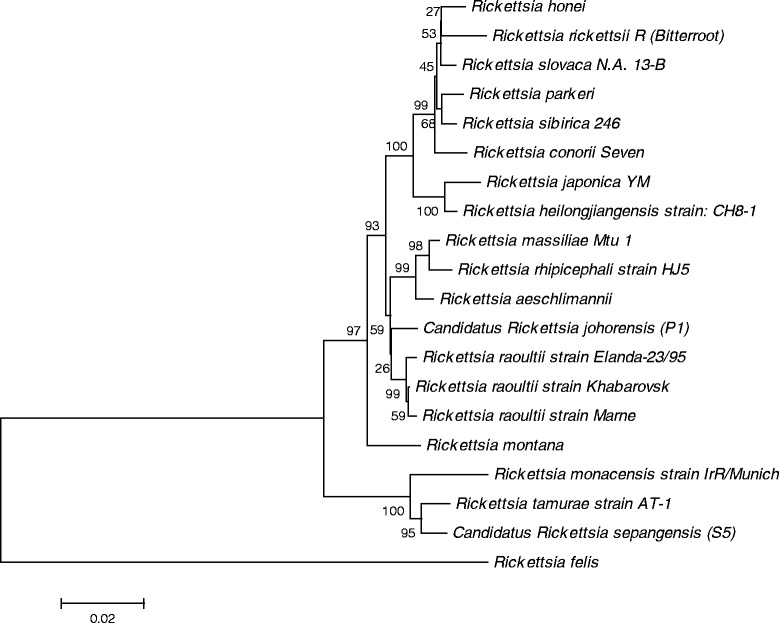
Twenty one adult ticks (twelve A. varanense and nine Amblyomma helvolum ticks) identified from seven Python molurus snakes in Sepang and a pool of six A. helvolum ticks from a Naja sumatrana snake in Johore, Malaysia were investigated in this study. Amplification of the citrate synthase (gltA), 190-kDa surface antigen gene (ompA), 135-kDa surface antigen (ompB) and surface cell antigen (sca4) genes followed by sequence analysis confirmed the presence of two potential novel spotted fever group rickettsiae in the ticks. Candidatus Rickettsia sepangensis from an engorged A. varanense tick demonstrated high sequence similarity to Rickettsia tamurae; while Candidatus Rickettsia johorensis from two samples (individual and pooled) of A. helvolum and two A. varanense ticks were closely related to Rickettsia raoultii. Anaplasma and Ehrlichia DNA were detected from seven and two ticks, respectively. No bartonellae was detected from any of the ticks.
The finding in this study suggests that Amblyomma ticks parasitizing wild snakes may serve as reservoir hosts and carriers for rickettsioses, anaplasmosis and ehrlichiosis in this region.
热带地区的钝缘蜱寄生于多种动物。本研究描述了从马来西亚野生蛇身上鉴定出的钝缘蜱,并检测了蜱中潜在的人类病原体,如立克次体、无形体、埃立克体和巴尔通体。
本研究对从雪兰莪的7条网纹蟒身上鉴定出的21只成年蜱(12只瓦氏钝缘蜱和9只淡黄钝缘蜱)以及从马来西亚柔佛州的1条苏门答腊眼镜蛇身上采集的6只淡黄钝缘蜱组成的混合样本进行了调查。通过对柠檬酸合酶(gltA)、190 kDa表面抗原基因(ompA)、135 kDa表面抗原(ompB)和表面细胞抗原(sca4)基因进行扩增并测序分析,证实蜱中存在两种潜在的新型斑点热群立克次体。来自饱血瓦氏钝缘蜱的新立克次体“雪兰莪立克次体”与田村立克次体具有高度序列相似性;而来自淡黄钝缘蜱的两个样本(单个和混合)以及两只瓦氏钝缘蜱的新立克次体“柔佛立克次体”与拉乌尔立克次体密切相关。分别从7只和2只蜱中检测到无形体和埃立克体DNA。所有蜱中均未检测到巴尔通体。
本研究结果表明,寄生于野生蛇的钝缘蜱可能是该地区立克次体病、无形体病和埃立克体病的储存宿主和传播媒介。