Chen Xiao-Yi, Xu San-Zhong, Wang Xuan-Wei, Yang Xian-Yan, Ma Liang, Zhang Lei, Yang Guo-Jing, Yang Fan, Wang Lin-Hong, Zhang Xin-Li, Ting Kang, Gao Chang-You, Mou Xiao-Zhou, Gou Zhong-Ru, Zou Hai
Clinical Research Institute, Zhejiang Provincial People's Hospital, Hangzhou 310014, China.
The First Affiliated Hospital, School of Medicine of Zhejiang University, Hangzhou 310009, China.
Oncotarget. 2017 May 30;8(22):36578-36590. doi: 10.18632/oncotarget.16618.
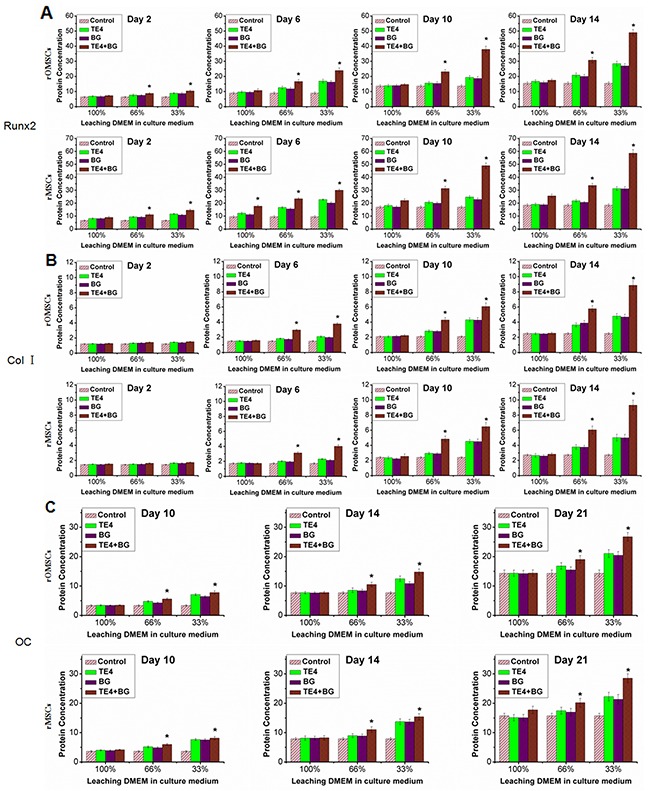
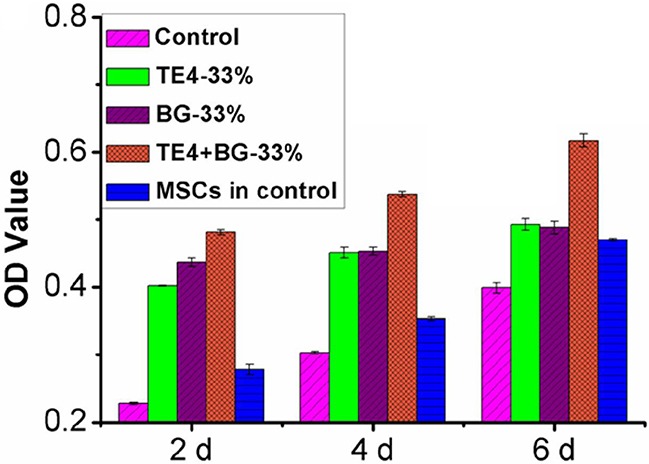
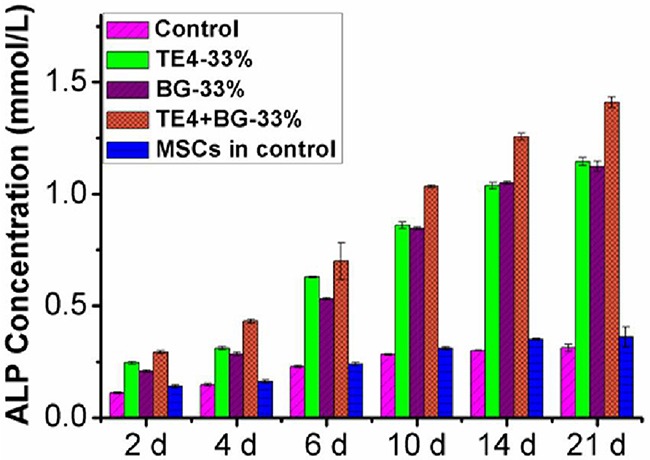
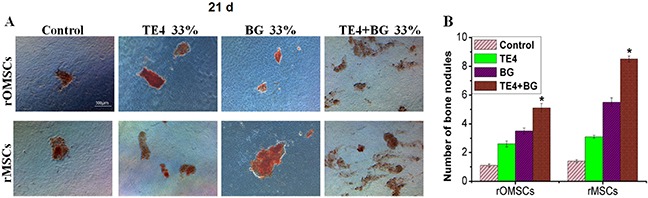
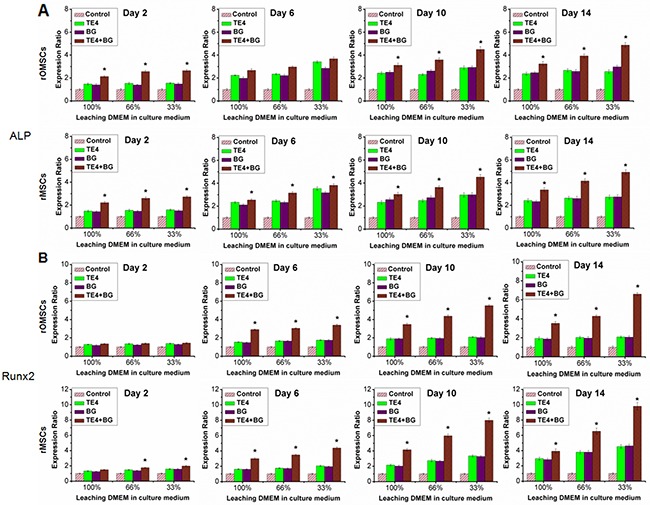
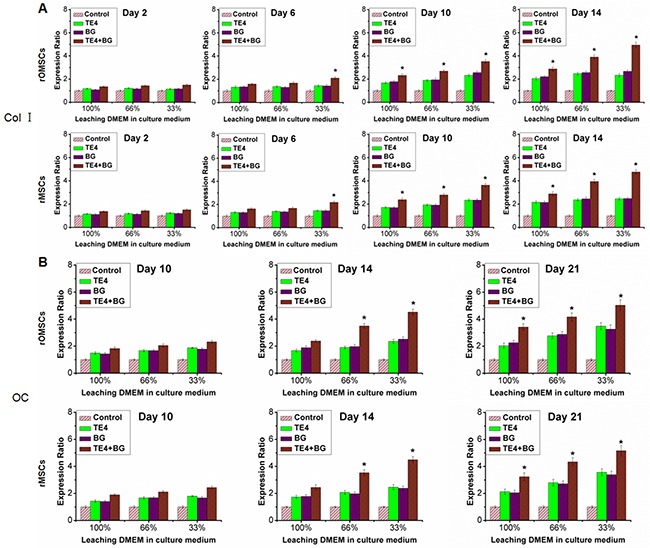
Osteoporosis is a disease characterized by structural deterioration of bone tissue, leading to skeletal fragility with increased fracture risk. Calcium phosphates (CaPs) are widely used in bone tissue engineering strategies as they have similarities to bone apatite except for the absence of trace elements (TEs) in the CaPs. Bioactive glasses (BGs) have also been used successfully in clinic for craniomaxillofacial and dental applications during the last two decades due to their excellent potential for bonding with bone and inducing osteoblastic differentiation. In this study, we evaluated the osteogenic effects of the ionic dissolution products of the quaternary Si-Sr-Zn-Mg-codoped CaP (TEs-CaP) or 45S5 Bioglass® (45S5 BG), both as mixtures and separately, on rat bone marrow-derived mesenchymal stem cells (rOMSCs & rMSCs) from osteoporotic and normal animals, using an MTT test and Alizarin Red S staining. The materials enhanced cell proliferation and osteogenic differentiation, especially the combination of the BG and TEs-CaP. Analysis by quantitative PCR and ELISA indicated that the expression of osteogenic-specific genes and proteins were elevated. These investigations suggest that the TEs-CaP and 45S5 BG operate synergistically to create an extracellular environment that promotes proliferation and terminal osteogenic differentiation of both osteoporotic and normal rMSCs.
骨质疏松症是一种以骨组织结构恶化为特征的疾病,会导致骨骼脆弱,骨折风险增加。磷酸钙(CaPs)因其与骨磷灰石相似,但不含微量元素(TEs),而被广泛用于骨组织工程策略中。在过去二十年中,生物活性玻璃(BGs)因其与骨结合及诱导成骨细胞分化的卓越潜力,也已成功应用于临床颅颌面和牙科领域。在本研究中,我们使用MTT试验和茜素红S染色,评估了季铵化Si-Sr-Zn-Mg共掺杂CaP(TEs-CaP)或45S5生物活性玻璃(45S5 BG)的离子溶解产物作为混合物及单独使用时,对骨质疏松症和正常动物来源的大鼠骨髓间充质干细胞(rOMSCs和rMSCs)的成骨作用。这些材料增强了细胞增殖和成骨分化,尤其是BG和TEs-CaP的组合。定量PCR和ELISA分析表明,成骨特异性基因和蛋白质的表达有所升高。这些研究表明,TEs-CaP和45S5 BG协同作用,营造了一个促进骨质疏松症和正常rMSCs增殖及终末成骨分化的细胞外环境。