Weichenberger Markus, Bauer Martin, Kühler Robert, Hensel Johannes, Forlim Caroline Garcia, Ihlenfeld Albrecht, Ittermann Bernd, Gallinat Jürgen, Koch Christian, Kühn Simone
Department of Psychiatry and Psychotherapy, Charité-Universitätsmedizin Berlin, Berlin, Germany.
Physikalisch-Technische Bundesanstalt (PTB), Braunschweig and Berlin, Germany.
PLoS One. 2017 Apr 12;12(4):e0174420. doi: 10.1371/journal.pone.0174420. eCollection 2017.
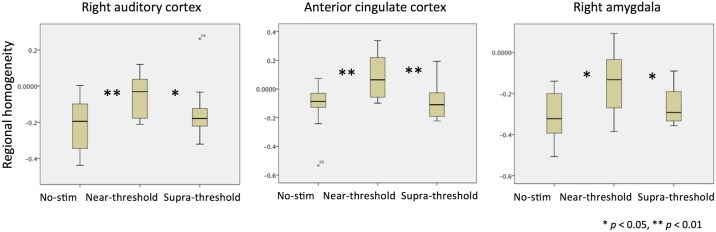
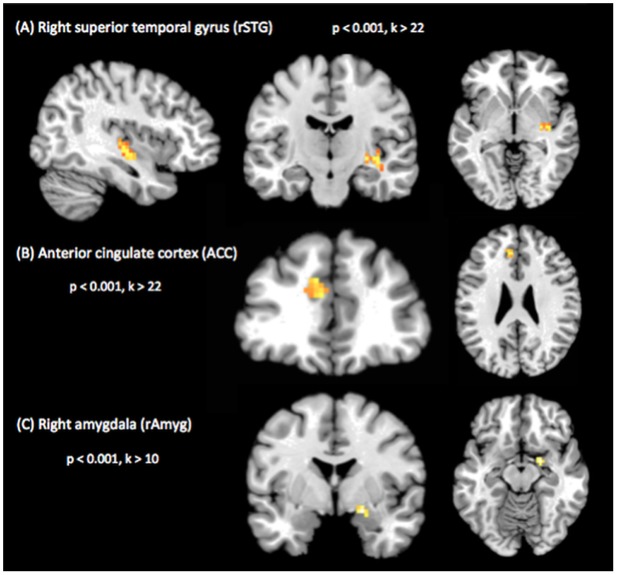
In the present study, the brain's response towards near- and supra-threshold infrasound (IS) stimulation (sound frequency < 20 Hz) was investigated under resting-state fMRI conditions. The study involved two consecutive sessions. In the first session, 14 healthy participants underwent a hearing threshold-as well as a categorical loudness scaling measurement in which the individual loudness perception for IS was assessed across different sound pressure levels (SPL). In the second session, these participants underwent three resting-state acquisitions, one without auditory stimulation (no-tone), one with a monaurally presented 12-Hz IS tone (near-threshold) and one with a similar tone above the individual hearing threshold corresponding to a 'medium loud' hearing sensation (supra-threshold). Data analysis mainly focused on local connectivity measures by means of regional homogeneity (ReHo), but also involved independent component analysis (ICA) to investigate inter-regional connectivity. ReHo analysis revealed significantly higher local connectivity in right superior temporal gyrus (STG) adjacent to primary auditory cortex, in anterior cingulate cortex (ACC) and, when allowing smaller cluster sizes, also in the right amygdala (rAmyg) during the near-threshold, compared to both the supra-threshold and the no-tone condition. Additional independent component analysis (ICA) revealed large-scale changes of functional connectivity, reflected in a stronger activation of the right amygdala (rAmyg) in the opposite contrast (no-tone > near-threshold) as well as the right superior frontal gyrus (rSFG) during the near-threshold condition. In summary, this study is the first to demonstrate that infrasound near the hearing threshold may induce changes of neural activity across several brain regions, some of which are known to be involved in auditory processing, while others are regarded as keyplayers in emotional and autonomic control. These findings thus allow us to speculate on how continuous exposure to (sub-)liminal IS could exert a pathogenic influence on the organism, yet further (especially longitudinal) studies are required in order to substantialize these findings.
在本研究中,在静息态功能磁共振成像(fMRI)条件下,研究了大脑对近阈和阈上次声(IS)刺激(声频<20 Hz)的反应。该研究包括两个连续的阶段。在第一阶段,14名健康参与者接受了听力阈值以及分类响度标度测量,其中在不同声压级(SPL)下评估了个体对次声的响度感知。在第二阶段,这些参与者进行了三次静息态采集,一次无听觉刺激(无音调),一次单耳呈现12 Hz次声音调(近阈),一次呈现高于个体听力阈值且对应“中等响度”听觉感受的类似音调(阈上)。数据分析主要通过区域一致性(ReHo)关注局部连接性测量,但也涉及独立成分分析(ICA)以研究区域间连接性。ReHo分析显示,与阈上和无音调条件相比,在近阈条件下,紧邻初级听觉皮层的右侧颞上回(STG)、前扣带回皮层(ACC)以及(允许较小聚类大小的情况下)右侧杏仁核(rAmyg)的局部连接性显著更高。额外的独立成分分析(ICA)揭示了功能连接性的大规模变化,表现为在相反对比(无音调>近阈)中右侧杏仁核(rAmyg)以及在近阈条件下右侧额上回(rSFG)更强的激活。总之,本研究首次表明,接近听力阈值次声可能会在多个脑区诱发神经活动变化,其中一些脑区已知参与听觉处理,而其他脑区则被视为情绪和自主控制的关键参与者。因此,这些发现使我们能够推测持续暴露于(亚)阈下次声如何对机体产生致病影响,但需要进一步(尤其是纵向)研究以证实这些发现。