Nahum Mor, Van Vleet Thomas M, Sohal Vikaas S, Mirzabekov Julie J, Rao Vikram R, Wallace Deanna L, Lee Morgan B, Dawes Heather, Stark-Inbar Alit, Jordan Joshua Thomas, Biagianti Bruno, Merzenich Michael, Chang Edward F
School of OT, Faculty of Medicine, Hebrew University, Jerusalem, Israel.
Posit Science Corporation, San Francisco, CA, United States.
JMIR Mhealth Uhealth. 2017 Apr 12;5(4):e44. doi: 10.2196/mhealth.6544.
Mood disorders are dynamic disorders characterized by multimodal symptoms. Clinical assessment of symptoms is currently limited to relatively sparse, routine clinic visits, requiring retrospective recollection of symptoms present in the weeks preceding the visit. Novel advances in mobile tools now support ecological momentary assessment of mood, conducted frequently using mobile devices, outside the clinical setting. Such mood assessment may help circumvent problems associated with infrequent reporting and better characterize the dynamic presentation of mood symptoms, informing the delivery of novel treatment options.
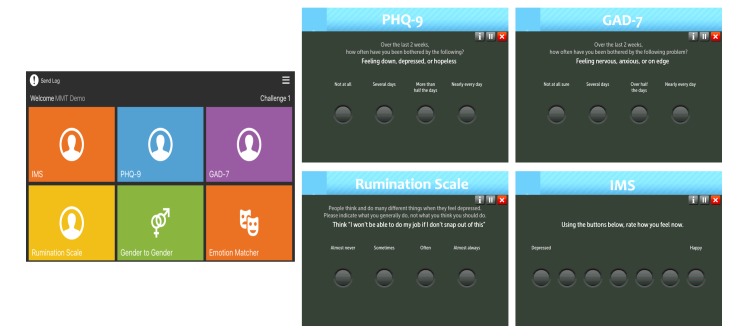
The aim of our study was to validate the Immediate Mood Scaler (IMS), a newly developed, iPad-deliverable 22-item self-report tool designed to capture current mood states.
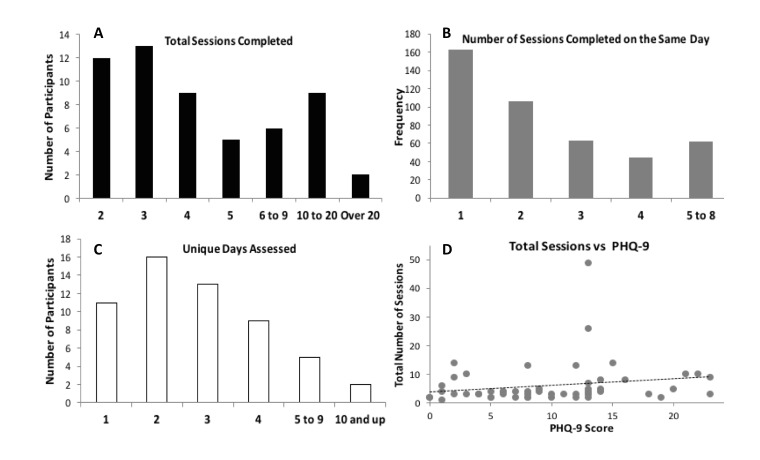
A total of 110 individuals completed standardized questionnaires (Patient Health Questionnaire, 9-item [PHQ-9]; generalized anxiety disorder, 7-Item [GAD-7]; and rumination scale) and IMS at baseline. Of the total, 56 completed at least one additional session of IMS, and 17 completed one additional administration of PHQ-9 and GAD-7. We conducted exploratory Principal Axis Factor Analysis to assess dimensionality of IMS, and computed zero-order correlations to investigate associations between IMS and standardized scales. Linear Mixed Model (LMM) was used to assess IMS stability across time and to test predictability of PHQ-9 and GAD-7 score by IMS.
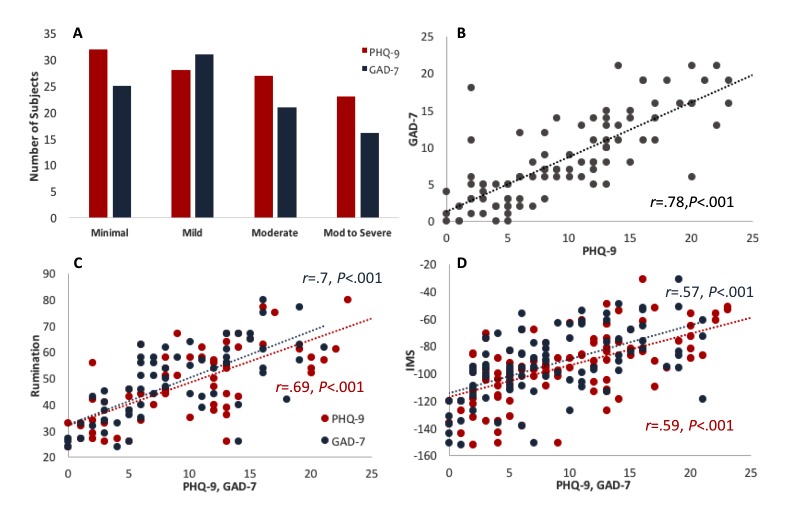
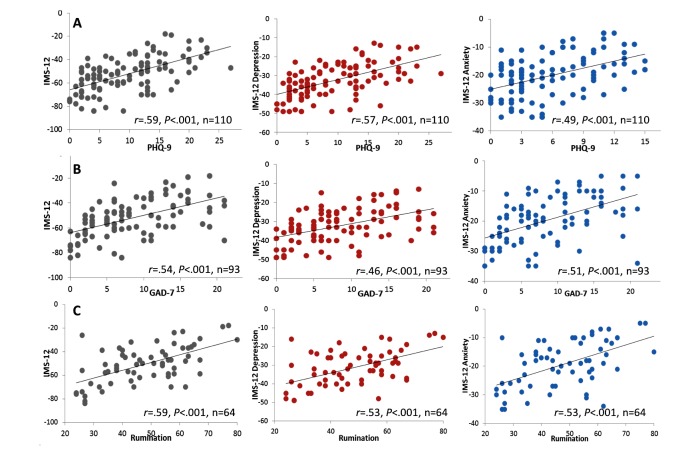
Strong correlations were found between standard mood scales and the IMS at baseline (r=.57-.59, P<.001). A factor analysis revealed a 12-item IMS ("IMS-12") with two factors: a "depression" factor and an "anxiety" factor. IMS-12 depression subscale was more strongly correlated with PHQ-9 than with GAD-7 (z=1.88, P=.03), but the reverse pattern was not found for IMS-12 anxiety subscale. IMS-12 showed less stability over time compared with PHQ-9 and GAD-7 (.65 vs .91), potentially reflecting more sensitivity to mood dynamics. In addition, IMS-12 ratings indicated that individuals with mild to moderate depression had greater mood fluctuations compared with individuals with severe depression (.42 vs .79; P=.04). Finally, IMS-12 significantly contributed to the prediction of subsequent PHQ-9 (beta=1.03, P=.02) and GAD-7 scores (beta =.93, P=.01).
Collectively, these data suggest that the 12-item IMS (IMS-12) is a valid tool to assess momentary mood symptoms related to anxiety and depression. Although IMS-12 shows good correlation with standardized scales, it further captures mood fluctuations better and significantly adds to the prediction of the scales. Results are discussed in the context of providing continuous symptom quantification that may inform novel treatment options and support personalized treatment plans.
情绪障碍是具有多模式症状的动态性疾病。目前对症状的临床评估仅限于相对较少的常规门诊就诊,这需要回顾就诊前几周出现的症状。移动工具的新进展现在支持对情绪进行生态瞬时评估,这种评估经常在临床环境之外使用移动设备进行。这种情绪评估可能有助于规避与报告不频繁相关的问题,并更好地描述情绪症状的动态表现,为新治疗方案的提供提供依据。
我们研究的目的是验证即时情绪量表(IMS),这是一种新开发的、可通过iPad提供的22项自我报告工具,旨在捕捉当前情绪状态。
共有110名个体在基线时完成了标准化问卷(患者健康问卷,9项[PHQ-9];广泛性焦虑障碍,7项[GAD-7];以及反刍量表)和IMS。其中,56人至少完成了一次额外的IMS评估,17人完成了一次额外的PHQ-9和GAD-7评估。我们进行了探索性主成分因子分析以评估IMS的维度,并计算零阶相关性以研究IMS与标准化量表之间的关联。使用线性混合模型(LMM)评估IMS随时间的稳定性,并测试IMS对PHQ-9和GAD-7分数的预测能力。
在基线时,标准情绪量表与IMS之间发现了强相关性(r = 0.57 - 0.59,P < 0.001)。因子分析揭示了一个12项的IMS(“IMS-12”),有两个因子:一个“抑郁”因子和一个“焦虑”因子。IMS-12抑郁子量表与PHQ-9的相关性比与GAD-7的相关性更强(z = 1.88,P = 0.03),但IMS-12焦虑子量表未发现相反的模式。与PHQ-9和GAD-7相比,IMS-12随时间的稳定性较低(0.65对0.91),这可能反映了对情绪动态变化更敏感。此外,IMS-12评分表明,与重度抑郁症患者相比,轻度至中度抑郁症患者的情绪波动更大(0.42对0.79;P = 0.04)。最后,IMS-12对后续PHQ-9(β = 1.03,P = 0.02)和GAD-7分数(β = 0.93,P = 0.01)的预测有显著贡献。
总体而言,这些数据表明12项IMS(IMS-12)是评估与焦虑和抑郁相关的瞬时情绪症状的有效工具。虽然IMS-12与标准化量表显示出良好的相关性,但它能更好地捕捉情绪波动,并显著增强了对这些量表的预测能力。在提供可能为新治疗方案提供依据并支持个性化治疗计划的连续症状量化的背景下讨论了结果。