Handly L Naomi, Wollman Roy
Department of Chemistry and Biochemistry, University of California, Los Angeles, Los Angeles, CA 90095.
Institute for Quantitative and Computational Biosciences, University of California, Los Angeles, Los Angeles, CA 90095.
Mol Biol Cell. 2017 Jun 1;28(11):1457-1466. doi: 10.1091/mbc.E16-10-0695. Epub 2017 Apr 12.
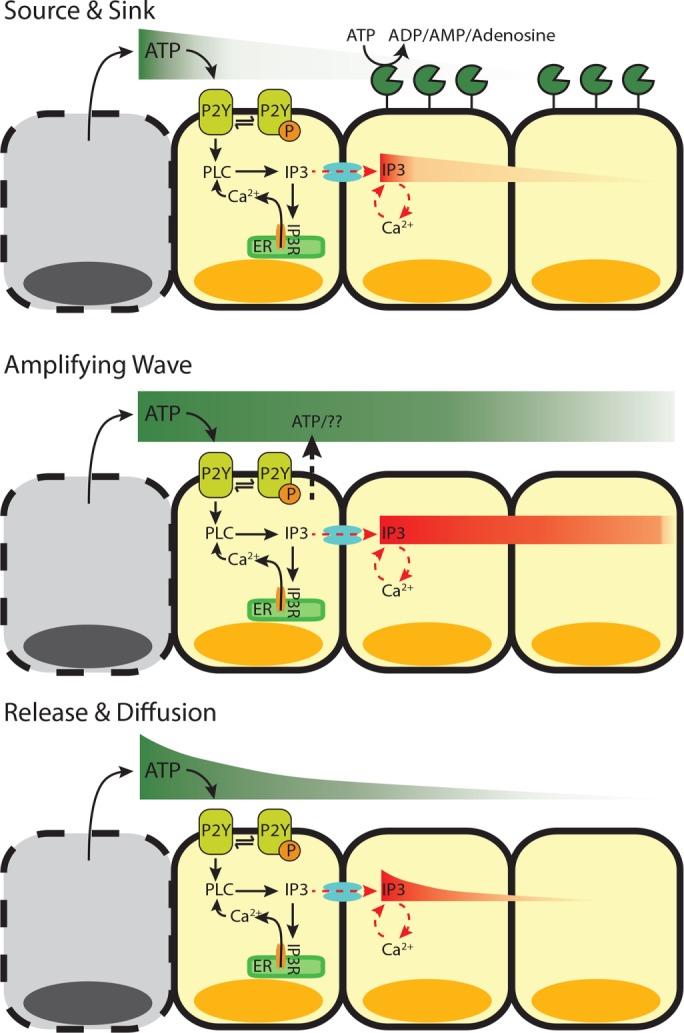
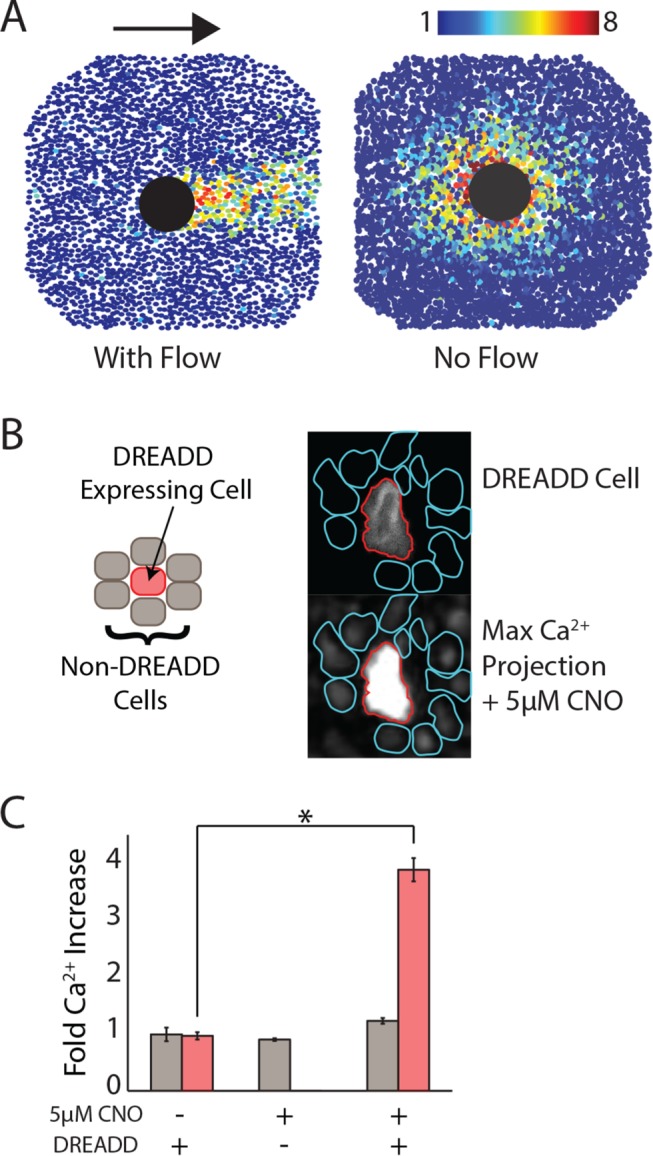
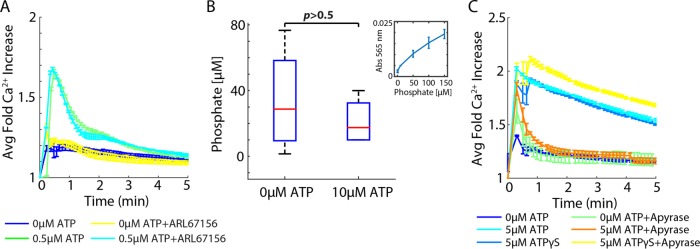
Damage-associated molecular patterns (DAMPs) are critical mediators of information concerning tissue damage from damaged cells to neighboring healthy cells. ATP acts as an effective DAMP when released into extracellular space from damaged cells. Extracellular ATP receptors monitor tissue damage and activate a Ca wave in the surrounding healthy cells. How the Ca wave propagates through cells after a wound is unclear. Ca wave activation can occur extracellularly via external receptors or intracellularly through GAP junctions. Three potential mechanisms to propagate the Ca wave are source and sink, amplifying wave, and release and diffusion. Both source and sink and amplifying wave regulate ATP levels using hydrolysis or secretion, respectively, whereas release and diffusion relies on dilution. Here we systematically test these hypotheses using a microfluidics assay to mechanically wound an epithelial monolayer in combination with direct manipulation of ATP hydrolysis and release. We show that a release and diffusion model sufficiently explains Ca-wave propagation after an epithelial wound. A release and diffusion model combines the benefits of fast activation at short length scales with a self-limiting response to prevent unnecessary inflammatory responses harmful to the organism.
损伤相关分子模式(DAMPs)是受损细胞向邻近健康细胞传递组织损伤信息的关键介质。当从受损细胞释放到细胞外空间时,ATP作为一种有效的DAMP发挥作用。细胞外ATP受体监测组织损伤并在周围健康细胞中激活钙波。伤口形成后钙波如何在细胞间传播尚不清楚。钙波激活可通过细胞外的外部受体或细胞内的间隙连接发生。传播钙波的三种潜在机制是源汇机制、放大波机制以及释放和扩散机制。源汇机制和放大波机制分别通过水解或分泌来调节ATP水平,而释放和扩散机制则依赖于稀释。在这里,我们使用微流控分析系统地测试了这些假设,通过机械损伤上皮单层细胞,并结合直接操纵ATP水解和释放来进行研究。我们发现,释放和扩散模型足以解释上皮伤口后的钙波传播。释放和扩散模型结合了短长度尺度下快速激活的优点以及自我限制反应,以防止对生物体有害的不必要炎症反应。