Malamood Mark, Roberts Aaron, Kataria Rahul, Parkman Henry P, Schey Ron
Department of Internal Medicine.
Department of Gastroenterology, Temple University Hospital, Philadelphia, PA, USA.
Drug Des Devel Ther. 2017 Mar 30;11:1035-1041. doi: 10.2147/DDDT.S125743. eCollection 2017.
Gastroparesis symptoms can be severe and debilitating. Many patients do not respond to currently available treatments. Mirtazapine has been shown in case reports to reduce symptoms in gastroparesis.
To assess the efficacy and safety of mirtazapine in gastroparetic patients.
Adults with gastroparesis and poorly controlled symptoms were eligible. Participants were prescribed mirtazapine 15 mg PO qhs. Questionnaires containing the gastrointestinal cardinal symptom index (GCSI) and the clinical patient grading assessment scale (CPGAS) were completed by patients' pretreatment, at 2 weeks, and at 4 weeks. Primary end point was nausea and vomiting response to mirtazapine using the GCSI. Secondary end point was nausea and vomiting severity assessment using the CPGAS. -values were calculated using the paired two-tailed Student's -test. Intention to treat analysis was used.
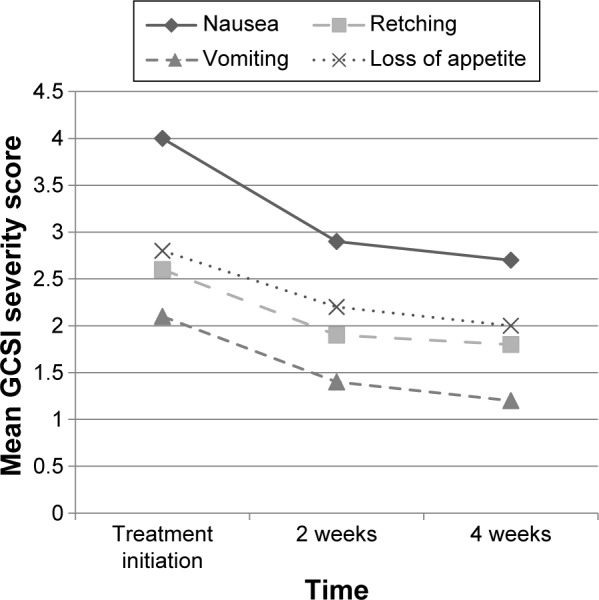
A total of 30 patients aged 19-86 years were enrolled. Of those, 24 patients (80%) completed 4 weeks of therapy. There were statistically significant improvements in nausea, vomiting, retching, and perceived loss of appetite at 2 and 4 weeks (all -values <0.05) compared with pretreatment. There was a statistically significant improvement in the CPGAS score at week 2 (=0.003) and week 4 (<0.001). Of the total patients, 14 (46.7%) experienced adverse effects from mirtazapine and due to this, 6 patients stopped therapy.
Mirtazapine significantly improved both nausea and vomiting in gastroparetics after 2 and 4 weeks of treatment. Side effects led to treatment self-cessation in a fifth of patients. From these data, we conclude that mirtazapine improves nausea and vomiting, among other symptoms, in patients with gastroparesis and might be useful in select patients.
胃轻瘫症状可能严重且使人衰弱。许多患者对目前可用的治疗方法没有反应。病例报告显示米氮平可减轻胃轻瘫症状。
评估米氮平对胃轻瘫患者的疗效和安全性。
符合条件的为患有胃轻瘫且症状控制不佳的成年人。参与者口服米氮平15毫克,每晚一次。患者在治疗前、2周和4周时完成包含胃肠道主要症状指数(GCSI)和临床患者分级评估量表(CPGAS)的问卷。主要终点是使用GCSI评估米氮平对恶心和呕吐的反应。次要终点是使用CPGAS评估恶心和呕吐的严重程度。使用配对双尾学生t检验计算P值。采用意向性治疗分析。
共纳入30例年龄在19至86岁之间的患者。其中,24例患者(80%)完成了4周的治疗。与治疗前相比,在2周和4周时,恶心、呕吐、干呕和食欲减退均有统计学意义上的显著改善(所有P值<0.05)。在第2周(P = 0.003)和第4周(P<0.001)时,CPGAS评分有统计学意义上的显著改善。在所有患者中,有14例(46.7%)出现了米氮平的不良反应,因此,6例患者停止了治疗。
治疗2周和4周后,米氮平显著改善了胃轻瘫患者的恶心和呕吐症状。副作用导致五分之一的患者自行停止治疗。根据这些数据,我们得出结论,米氮平可改善胃轻瘫患者的恶心和呕吐等症状,可能对部分患者有用。