Bhaumik Suniti, Basu Rajatava
Division of Anatomic Pathology, Department of Pathology, University of Alabama at Birmingham (UAB), Birmingham, AL, USA.
Division of Molecular and Cellular Pathology, Department of Pathology, University of Alabama at Birmingham (UAB), Birmingham, AL, USA.
Front Immunol. 2017 Mar 31;8:254. doi: 10.3389/fimmu.2017.00254. eCollection 2017.
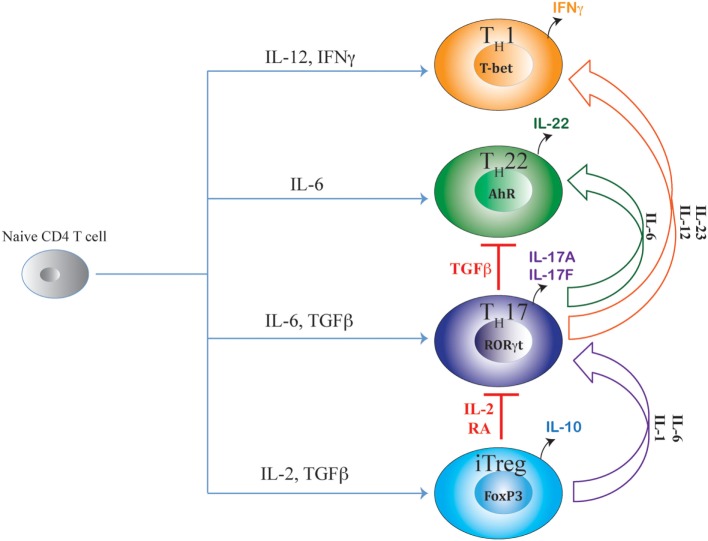
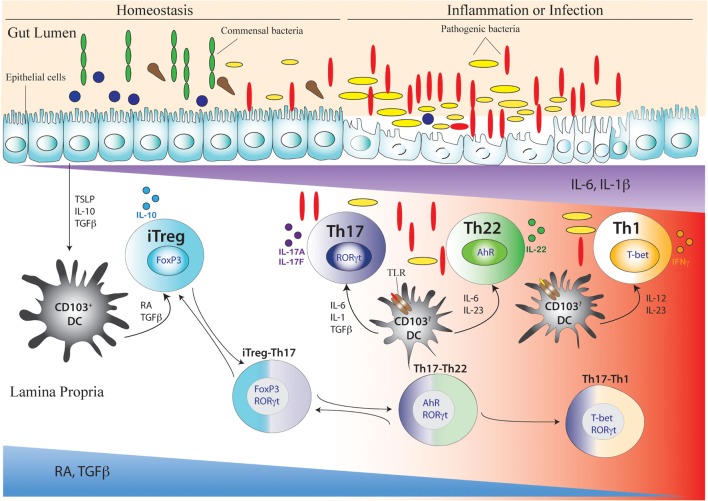
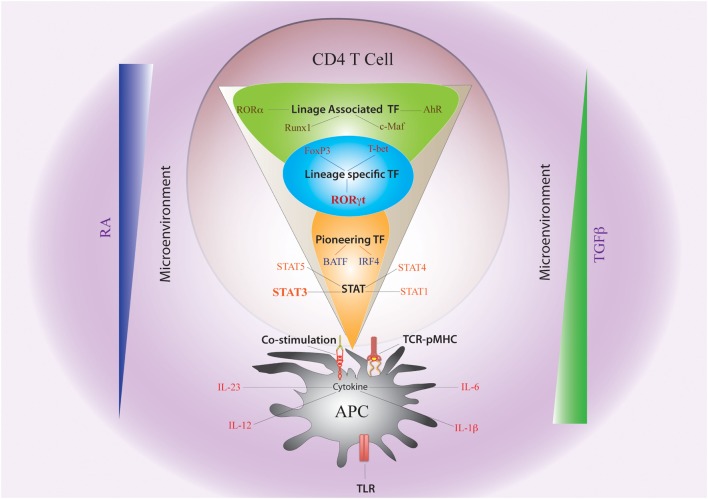
After emerging from the thymus, naive CD4 T cells circulate through secondary lymphoid tissues, including gut-associated lymphoid tissue of the intestine. The activation of naïve CD4 T cells by antigen-presenting cells offering cognate antigen initiate differentiation programs that lead to the development of highly specialized T helper (Th) cell lineages. Although initially believed that developmental programing of effector T cells such as T helper 1 (Th1) or T helper 2 (Th2) resulted in irreversible commitment to a fixed fate, subsequent studies have demonstrated greater flexibility, or plasticity, in effector T cell stability than originally conceived. This is particularly so for the Th17 subset, differentiation of which is a highly dynamic process with overlapping developmental axes with inducible regulatory T (iTreg), T helper 22 (Th22), and Th1 cells. Accordingly, intermediary stages of Th17 cells are found in various tissues, which co-express lineage-specific transcription factor(s) or cytokine(s) of developmentally related CD4 T cell subsets. A highly specialized tissue like that of the intestine, which harbors the largest immune compartment of the body, adds several layers of complexity to the intricate process of Th differentiation. Due to constant exposure to millions of commensal microbes and periodic exposure to pathogens, the intestinal mucosa maintains a delicate balance between regulatory and effector T cells. It is becoming increasingly clear that equilibrium between tolerogenic and inflammatory axes is maintained in the intestine by shuttling the flexible genetic programming of a developing CD4 T cell along the developmental axis of iTreg, Th17, Th22, and Th1 subsets. Currently, Th17 plasticity remains an unresolved concern in the field of clinical research as targeting Th17 cells to cure immune-mediated disease might also target its related subsets. In this review, we discuss the expanding sphere of Th17 plasticity through its shared developmental axes with related cellular subsets such as Th22, Th1, and iTreg in the context of intestinal inflammation and also examine the molecular and epigenetic features of Th17 cells that mediate these overlapping developmental programs.
幼稚CD4 T细胞从胸腺中出来后,会在二级淋巴组织中循环,包括肠道的肠道相关淋巴组织。抗原呈递细胞提供同源抗原激活幼稚CD4 T细胞,启动分化程序,导致高度专业化的辅助性T(Th)细胞谱系的发育。尽管最初认为效应T细胞如辅助性T细胞1(Th1)或辅助性T细胞2(Th2)的发育编程会导致对固定命运的不可逆承诺,但随后的研究表明,效应T细胞稳定性比最初设想的具有更大的灵活性或可塑性。对于Th17亚群尤其如此,其分化是一个高度动态的过程,与诱导性调节性T(iTreg)、辅助性T细胞22(Th22)和Th1细胞具有重叠的发育轴。因此,在各种组织中发现了Th17细胞的中间阶段,这些组织共同表达发育相关CD4 T细胞亚群的谱系特异性转录因子或细胞因子。像肠道这样高度专业化的组织,拥有体内最大的免疫区室,给复杂的Th分化过程增加了几层复杂性。由于持续接触数百万种共生微生物并定期接触病原体,肠道黏膜在调节性和效应性T细胞之间保持着微妙的平衡。越来越清楚的是,通过沿着iTreg、Th17、Th22和Th1亚群的发育轴穿梭发育中的CD4 T细胞的灵活基因编程,肠道中维持了致耐受性和炎症轴之间的平衡。目前,Th17可塑性仍然是临床研究领域中一个未解决的问题,因为靶向Th17细胞治疗免疫介导的疾病可能也会靶向其相关亚群。在这篇综述中,我们在肠道炎症的背景下,通过Th17与相关细胞亚群如Th22、Th1和iTreg的共同发育轴,讨论Th17可塑性不断扩大的范围,并研究介导这些重叠发育程序的Th17细胞的分子和表观遗传特征。