Qureshi Muhammad Naveed Iqbal, Oh Jooyoung, Min Beomjun, Jo Hang Joon, Lee Boreom
Department of Biomedical Science and Engineering, Institute of Integrated Technology, Gwangju Institute of Science and TechnologyGwangju, South Korea.
Department of Neuropsychiatry, Seoul National University HospitalSeoul, South Korea.
Front Hum Neurosci. 2017 Apr 4;11:157. doi: 10.3389/fnhum.2017.00157. eCollection 2017.
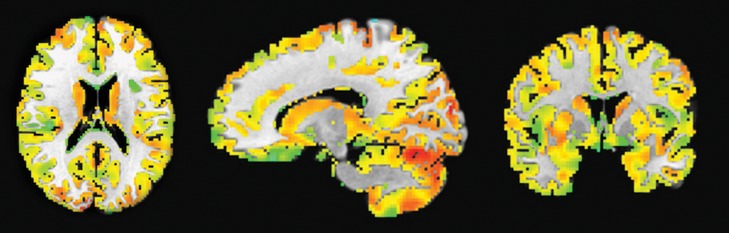
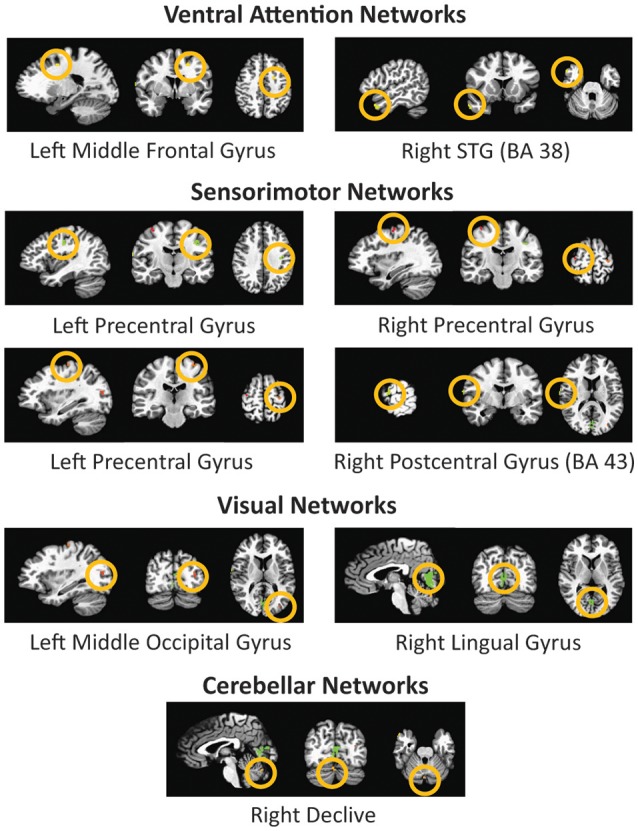
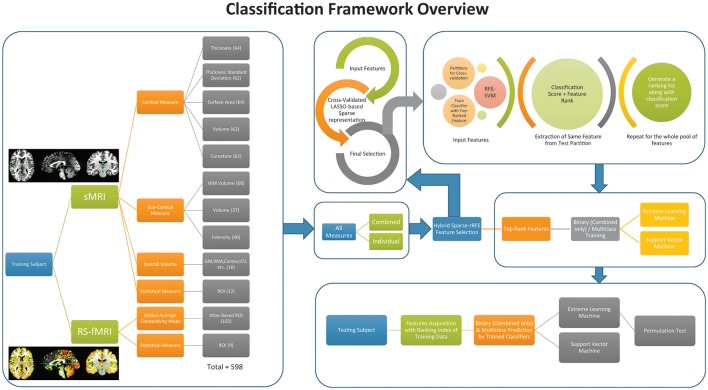
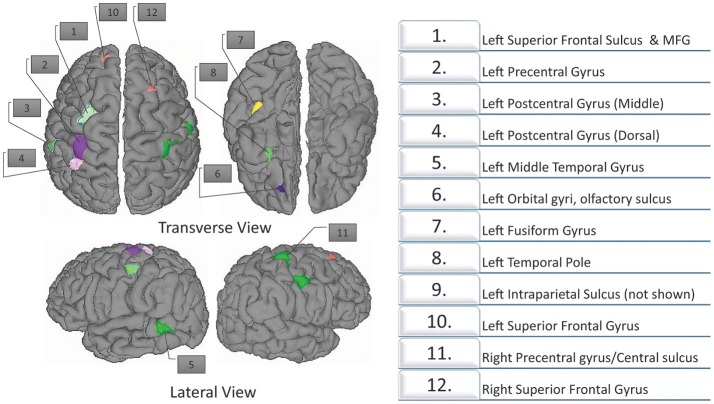
Structural and functional MRI unveil many hidden properties of the human brain. We performed this multi-class classification study on selected subjects from the publically available attention deficit hyperactivity disorder ADHD-200 dataset of patients and healthy children. The dataset has three groups, namely, ADHD inattentive, ADHD combined, and typically developing. We calculated the global averaged functional connectivity maps across the whole cortex to extract anatomical atlas parcellation based features from the resting-state fMRI (rs-fMRI) data and cortical parcellation based features from the structural MRI (sMRI) data. In addition, the preprocessed image volumes from both of these modalities followed an ANOVA analysis separately using all the voxels. This study utilized the average measure from the most significant regions acquired from ANOVA as features for classification in addition to the multi-modal and multi-measure features of structural and functional MRI data. We extracted most discriminative features by hierarchical sparse feature elimination and selection algorithm. These features include cortical thickness, image intensity, volume, cortical thickness standard deviation, surface area, and ANOVA based features respectively. An extreme learning machine performed both the binary and multi-class classifications in comparison with support vector machines. This article reports prediction accuracy of both unimodal and multi-modal features from test data. We achieved 76.190% ( < 0.0001) classification accuracy in multi-class settings as well as 92.857% ( < 0.0001) classification accuracy in binary settings. In addition, we found ANOVA-based significant regions of the brain that also play a vital role in the classification of ADHD. Thus, from a clinical perspective, this multi-modal group analysis approach with multi-measure features may improve the accuracy of the ADHD differential diagnosis.
结构和功能磁共振成像揭示了人类大脑的许多隐藏特性。我们对公开可用的注意力缺陷多动障碍(ADHD)-200数据集(包括患者和健康儿童)中的选定受试者进行了这项多类别分类研究。该数据集有三组,即注意力不集中型ADHD、混合型ADHD和发育正常型。我们计算了整个皮层的全局平均功能连接图,以从静息态功能磁共振成像(rs-fMRI)数据中提取基于解剖图谱分割的特征,并从结构磁共振成像(sMRI)数据中提取基于皮层分割的特征。此外,对这两种模态的预处理图像体积分别使用所有体素进行方差分析。除了结构和功能磁共振成像数据的多模态和多测量特征外,本研究还利用方差分析获得的最显著区域的平均测量值作为分类特征。我们通过分层稀疏特征消除和选择算法提取了最具判别力的特征。这些特征分别包括皮层厚度、图像强度、体积、皮层厚度标准差、表面积和基于方差分析的特征。与支持向量机相比,极限学习机执行了二分类和多分类。本文报告了测试数据中单模态和多模态特征的预测准确率。我们在多类别设置中实现了76.190%(<0.0001)的分类准确率,在二分类设置中实现了92.857%(<0.0001)的分类准确率。此外,我们发现基于方差分析的大脑显著区域在ADHD分类中也起着至关重要的作用。因此,从临床角度来看,这种具有多测量特征的多模态组分析方法可能会提高ADHD鉴别诊断的准确性。