Ordnung Madeleine, Hoff Maike, Kaminski Elisabeth, Villringer Arno, Ragert Patrick
Department of Neurology, Max Planck Institute for Human Cognitive and Brain SciencesLeipzig, Germany.
Mind and Brain Institute, Charité and Humboldt UniversityBerlin, Germany.
Front Hum Neurosci. 2017 Apr 4;11:160. doi: 10.3389/fnhum.2017.00160. eCollection 2017.
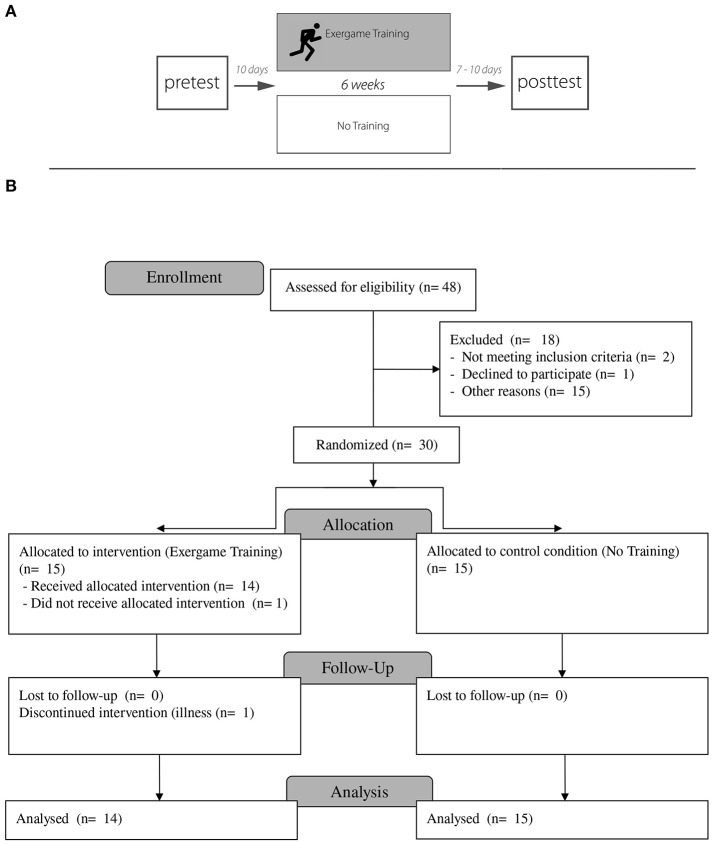
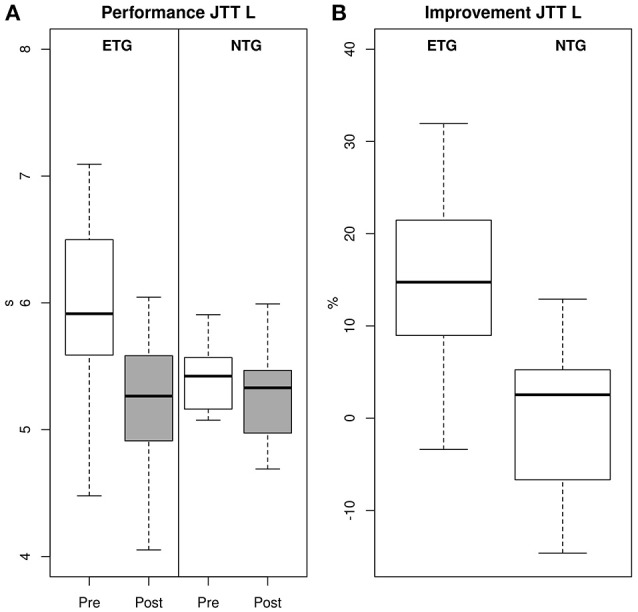
Several studies investigating the relationship between physical activity and cognition showed that exercise interventions might have beneficial effects on working memory, executive functions as well as motor fitness in old adults. Recently, movement based video games (exergames) have been introduced to have the capability to improve cognitive function in older adults. Healthy aging is associated with a loss of cognitive, as well as sensorimotor functions. During exergaming, participants are required to perform physical activities while being simultaneously surrounded by a cognitively challenging environment. However, only little is known about the impact of exergame training interventions on a broad range of motor, sensory, and cognitive skills. Therefore, the present study aims at investigating the effects of an exergame training over 6 weeks on cognitive, motor, and sensory functions in healthy old participants. For this purpose, 30 neurologically healthy older adults were randomly assigned to either an experimental (ETG, = 15, 1 h training, twice a week) or a control group (NTG, = 15, no training). Several cognitive tests were performed before and after exergaming in order to capture potential training-induced effects on processing speed as well as on executive functions. To measure the impact of exergaming on sensorimotor performance, a test battery consisting of pinch and grip force of the hand, tactile acuity, eye-hand coordination, flexibility, reaction time, coordination, and static balance were additionally performed. While we observed significant improvements in the trained exergame (mainly in tasks that required a high load of coordinative abilities), these gains did not result in differential performance improvements when comparing ETG and NTG. The only exergaming-induced difference was a superior behavioral gain in fine motor skills of the left hand in ETG compared to NTG. In an exploratory analysis, within-group comparison revealed improvements in sensorimotor and cognitive tasks (ETG) while NTG only showed an improvement in a static balance test. Taken together, the present study indicates that even though exergames might improve gaming performance, our behavioral assessment was probably not sensitive enough to capture exergaming-induced improvements. Hence, we suggest to use more tailored outcome measures in future studies to assess potential exergaming-induced changes.
多项研究调查了体育活动与认知之间的关系,结果表明运动干预可能对老年人的工作记忆、执行功能以及运动能力有益。最近,基于运动的电子游戏(健身游戏)已被引入,其具有改善老年人认知功能的能力。健康老龄化与认知以及感觉运动功能的丧失有关。在玩健身游戏期间,参与者需要进行体育活动,同时置身于具有认知挑战性的环境中。然而,关于健身游戏训练干预对广泛的运动、感觉和认知技能的影响,人们所知甚少。因此,本研究旨在调查为期6周的健身游戏训练对健康老年参与者的认知、运动和感觉功能的影响。为此,30名神经健康的老年人被随机分为实验组(ETG,n = 15,每周训练2次,每次1小时)或对照组(NTG,n = 15,不进行训练)。在进行健身游戏前后进行了多项认知测试,以捕捉潜在的训练对处理速度以及执行功能的影响。为了测量健身游戏对感觉运动表现的影响,还另外进行了一组测试,包括手部捏力和握力、触觉敏锐度、眼手协调、灵活性、反应时间、协调性和静态平衡。虽然我们观察到在训练的健身游戏中(主要是在需要高协调能力负荷的任务中)有显著改善,但在比较ETG和NTG时,这些改善并没有导致表现上的差异。唯一由健身游戏引起的差异是,与NTG相比,ETG中左手的精细运动技能有更好的行为改善。在一项探索性分析中,组内比较显示感觉运动和认知任务(ETG)有所改善,而NTG仅在静态平衡测试中有改善。综上所述,本研究表明,尽管健身游戏可能会提高游戏表现,但我们的行为评估可能不够敏感,无法捕捉到健身游戏引起的改善。因此,我们建议在未来的研究中使用更具针对性的结果指标来评估潜在的健身游戏引起的变化。