Kentie Rosemarie, Marquez-Ferrando Rocío, Figuerola Jordi, Gangoso Laura, Hooijmeijer Jos C E W, Loonstra A H Jelle, Robin Frédéric, Sarasa Mathieu, Senner Nathan, Valkema Haije, Verhoeven Mo A, Piersma Theunis
Conservation Ecology Group Groningen Institute for Evolutionary Life Sciences (GELIFES) University of Groningen Groningen The Netherlands.
Present address: Department of Zoology University of Oxford Oxford OX1 3PS UK.
Ecol Evol. 2017 Mar 21;7(8):2812-2820. doi: 10.1002/ece3.2879. eCollection 2017 Apr.
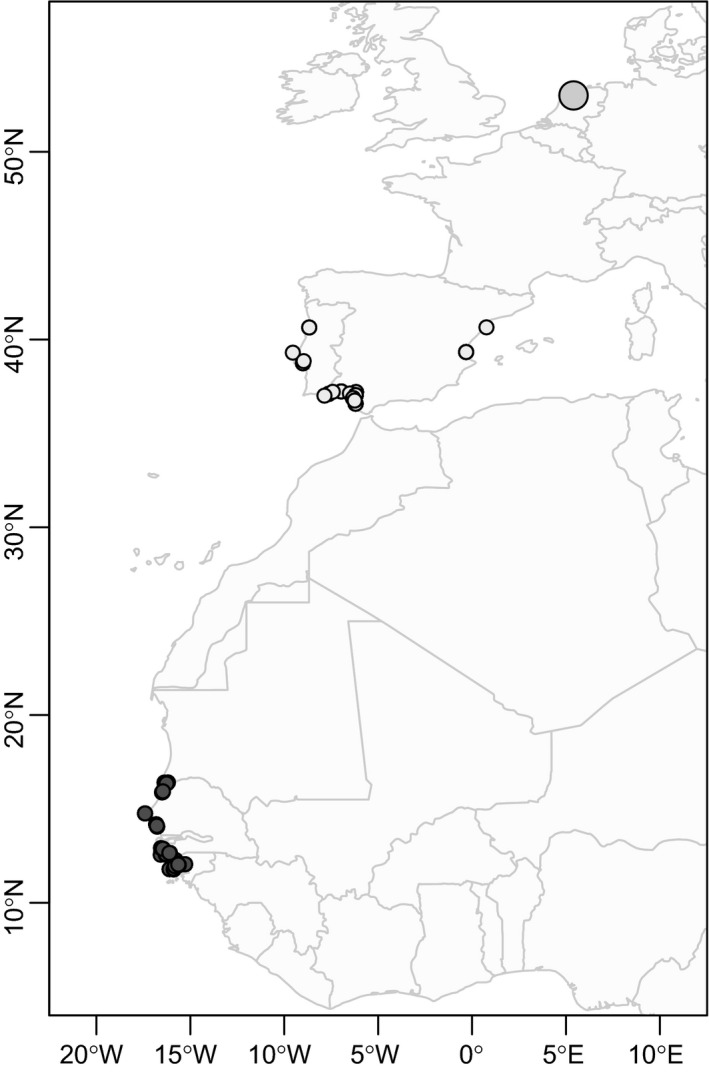
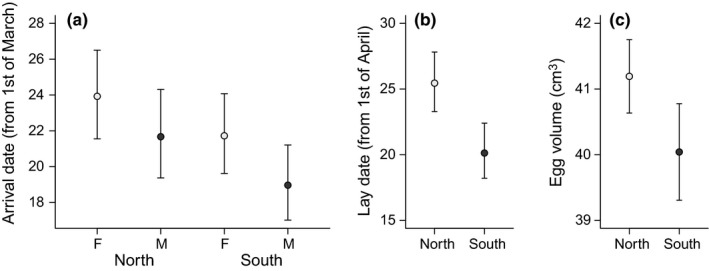
Migrating long distances requires time and energy, and may interact with an individual's performance during breeding. These seasonal interactions in migratory animals are best described in populations with disjunct nonbreeding distributions. The black-tailed godwit (), which breeds in agricultural grasslands in Western Europe, has such a disjunct nonbreeding distribution: The majority spend the nonbreeding season in West Africa, while a growing number winters north of the Sahara on the Iberian Peninsula. To test whether crossing the Sahara has an effect on breeding season phenology and reproductive parameters, we examined differences in the timing of arrival, breeding habitat quality, lay date, egg volume, and daily nest survival among godwits (154 females and 157 males), individually marked in a breeding area in the Netherlands for which wintering destination was known on the basis of resightings. We also examined whether individual repeatability in arrival date differed between birds wintering north or south of the Sahara. Contrary to expectation, godwits wintering south of the Sahara arrived two days earlier and initiated their clutch six days earlier than godwits wintering north of the Sahara. Arrival date was equally repeatable for both groups, and egg volume larger in birds wintering north of the Sahara. Despite these differences, we found no association between wintering location and the quality of breeding habitat or nest survival. This suggests that the crossing of an important ecological barrier and doubling of the migration distance, twice a year, do not have clear negative reproductive consequences for some long-distance migrants.
长距离迁徙需要时间和精力,并且可能会影响个体在繁殖期间的表现。在具有不连续非繁殖分布的种群中,迁徙动物的这些季节性相互作用得到了最好的描述。黑尾塍鹬在西欧的农业草原繁殖,具有这样一种不连续的非繁殖分布:大多数个体在西非度过非繁殖季节,而越来越多的个体在伊比利亚半岛撒哈拉以北地区越冬。为了测试穿越撒哈拉沙漠是否会对繁殖季节物候和繁殖参数产生影响,我们研究了在荷兰一个繁殖区被单独标记的黑尾塍鹬(154只雌性和157只雄性)在到达时间、繁殖栖息地质量、产卵日期、卵体积和每日巢存活率方面的差异,这些黑尾塍鹬的越冬目的地可根据重新观察得知。我们还研究了在撒哈拉沙漠以北或以南越冬的鸟类在到达日期上的个体重复性是否存在差异。与预期相反,在撒哈拉沙漠以南越冬的黑尾塍鹬比在撒哈拉沙漠以北越冬的黑尾塍鹬早两天到达,并且早六天开始产卵。两组的到达日期重复性相同,而在撒哈拉沙漠以北越冬的鸟类卵体积更大。尽管存在这些差异,但我们没有发现越冬地点与繁殖栖息地质量或巢存活率之间存在关联。这表明,对于一些长途迁徙者来说,穿越一个重要的生态屏障以及每年两次使迁徙距离翻倍,并没有明显的负面繁殖后果。