Jordan Matthew J, Aagaard Per, Herzog Walter
Human Performance Laboratory, The University of Calgary, Calgary, AB, Canada.
Department of Sports Science and Clinical Biomechanics, SDU Muscle Research Cluster (SMRC), University of Southern Denmark, Odense M, Denmark.
Open Access J Sports Med. 2017 Mar 30;8:71-83. doi: 10.2147/OAJSM.S106699. eCollection 2017.
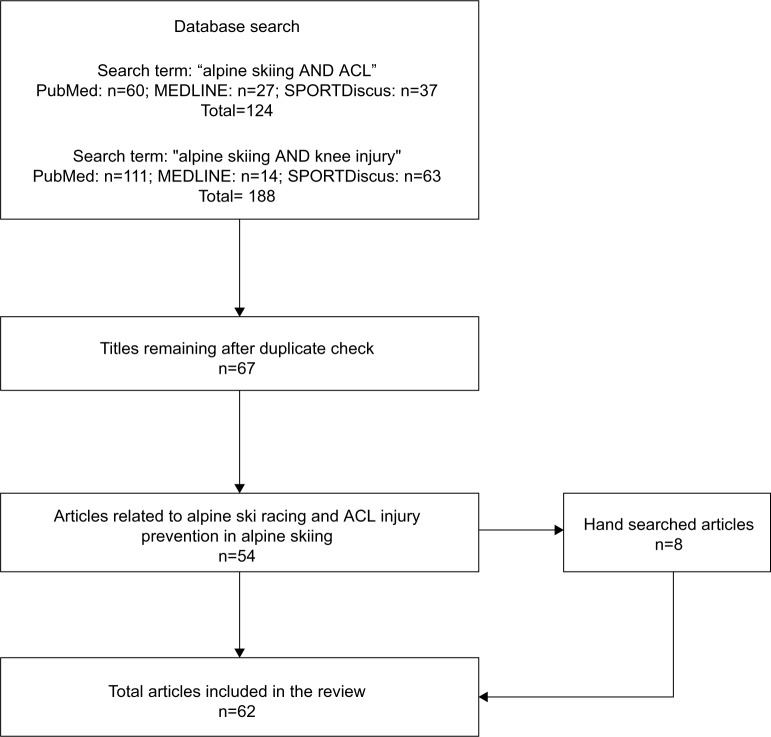
The purpose of the present review was to: 1) provide an overview of the current understanding on the epidemiology, etiology, risk factors, and prevention methods for anterior cruciate ligament (ACL) injury in alpine ski racing; and 2) provide an overview of what is known pertaining to ACL reinjury and return to sport after ACL injury in alpine ski racing. Given that most of the scientific studies on ACL injuries in alpine ski racing have been descriptive, and that very few studies contributed higher level scientific evidence, a nonsystematic narrative review was employed. Three scholarly databases were searched for articles on ACL injury or knee injury in alpine ski racing. Studies were classified according to their relevance in relation to epidemiology, etiology, risk factors, and return to sport/reinjury prevention. Alpine ski racers (skiers) were found to be at high risk for knee injuries, and ACL tears were the most frequent diagnosis. Three primary ACL injury mechanism were identified that involved tibial internal rotation and anteriorly directed shear forces from ski equipment and the environment. While trunk muscle strength imbalance and genetics were found to be predictive of ACL injuries in development-level skiers, there was limited scientific data on ACL injury risk factors among elite skiers. Based on expert opinion, research on injury risk factors should focus on equipment design, course settings/speed, and athlete factors (eg, fitness). While skiers seem to make a successful recovery following ACL injury, there may be persistent neuromuscular deficits. Future research efforts should be directed toward prospective studies on ACL injury/reinjury prevention in both male and female skiers and toward the effects of knee injury on long-term health outcomes, such as the early development of osteoarthritis. International collaborations may be necessary to generate sufficient statistical power for ACL injury/reinjury prevention research in alpine ski racing.
1)概述目前对高山滑雪比赛中前交叉韧带(ACL)损伤的流行病学、病因、危险因素及预防方法的认识;2)概述高山滑雪比赛中ACL损伤后再损伤及恢复运动方面的已知情况。鉴于关于高山滑雪比赛中ACL损伤的大多数科学研究都是描述性的,且很少有研究提供更高级别的科学证据,因此采用了非系统性的叙述性综述。在三个学术数据库中搜索关于高山滑雪比赛中ACL损伤或膝关节损伤的文章。根据研究与流行病学、病因、危险因素以及恢复运动/预防再损伤的相关性进行分类。发现高山滑雪运动员(滑雪者)膝关节损伤风险较高,ACL撕裂是最常见的诊断结果。确定了三种主要的ACL损伤机制,涉及胫骨内旋以及来自滑雪装备和环境的向前剪切力。虽然发现躯干肌肉力量失衡和遗传因素可预测发展水平滑雪者的ACL损伤,但关于精英滑雪者ACL损伤危险因素的科学数据有限。基于专家意见,损伤危险因素的研究应聚焦于装备设计、赛道设置/速度以及运动员因素(如身体素质)。虽然滑雪者ACL损伤后似乎能成功恢复,但可能存在持续神经肌肉功能缺陷。未来的研究工作应针对男女滑雪者ACL损伤/再损伤预防的前瞻性研究,以及膝关节损伤对长期健康结果(如骨关节炎早期发展)的影响。可能需要开展国际合作,以便为高山滑雪比赛中ACL损伤/再损伤预防研究提供足够的统计效力。