Chipchura Danielle A, Freyberg Zachary, Edwards Corey, Leckband Susan G, McCarthy Michael J
VA San Diego Healthcare System, Mental Health Service, San Diego, CA, United States.
Department of Psychiatry and Cell Biology, University of Pittsburgh, Pittsburgh, PA, United States.
Front Psychiatry. 2018 Oct 11;9:494. doi: 10.3389/fpsyt.2018.00494. eCollection 2018.
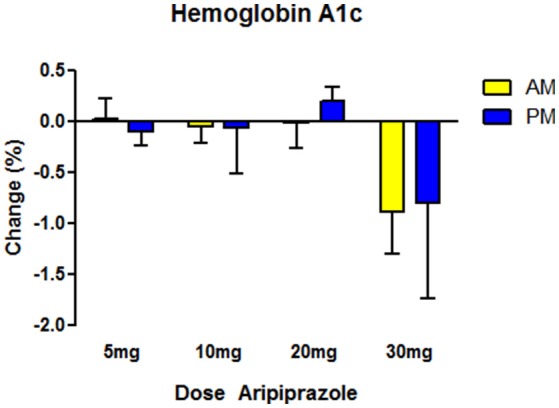
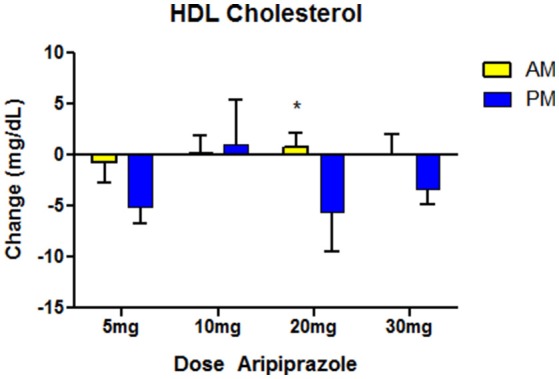
Antipsychotic drugs cause metabolic abnormalities through a mechanism that involves antagonism of D dopamine receptors (DR). Under healthy conditions, insulin release follows a circadian rhythm and is low at night, and in pancreatic beta-cells, DRs negatively regulate insulin release. Since they are sedating, many antipsychotics are dosed at night. However, the resulting reduction in overnight DR activity may disrupt 24 h rhythms in insulin release, potentially exacerbating metabolic dysfunction. We examined retrospective clinical data from patients treated over approximately 1 year with the antipsychotic drug aripiprazole (ARPZ), a D2R partial agonist. To identify effects of timing on metabolic risk, we found cases treated with ARPZ either in the morning ( = 90) or at bedtime ( = 53), and compared hemoglobin A1c, and six secondary metabolic parameters across the two groups. After controlling for demographic and clinical factors, patients treated with ARPZ at night had a significant decrease in HDL cholesterol, while in patients who took ARPZ in the morning had no change. There was a non-significant trend toward higher serum triglycerides in the patients treated with ARPZ at night vs. morning. There were no group differences in hemoglobin A1c, BMI, total cholesterol, LDL cholesterol, or blood pressure. Patients taking APPZ at night developed a worse lipid profile, with lower HDL cholesterol and a trend toward higher triglycerides. These changes may pose additional metabolic risk factors compared to those who take ARPZ in the morning. Interventions based on drug timing may reduce some of the adverse metabolic consequences of antipsychotic drugs.
抗精神病药物通过涉及拮抗 D2 多巴胺受体(DR)的机制导致代谢异常。在健康状态下,胰岛素释放遵循昼夜节律,夜间水平较低,并且在胰腺β细胞中,DR 对胰岛素释放起负调节作用。由于许多抗精神病药物具有镇静作用,通常在夜间给药。然而,夜间 DR 活性的降低可能会扰乱胰岛素释放的 24 小时节律,从而可能加剧代谢功能障碍。我们研究了使用抗精神病药物阿立哌唑(ARPZ,一种 D2R 部分激动剂)治疗约 1 年的患者的回顾性临床数据。为了确定给药时间对代谢风险的影响,我们找到了早晨(n = 90)或睡前(n = 53)接受 ARPZ 治疗的病例,并比较了两组之间的糖化血红蛋白以及六个次要代谢参数。在控制了人口统计学和临床因素后,夜间接受 ARPZ 治疗的患者高密度脂蛋白胆固醇显著降低,而早晨服用 ARPZ 的患者则没有变化。与早晨接受 ARPZ 治疗的患者相比,夜间接受 ARPZ 治疗的患者血清甘油三酯有升高的趋势,但无统计学意义。在糖化血红蛋白、体重指数、总胆固醇、低密度脂蛋白胆固醇或血压方面,两组之间没有差异。夜间服用 APPZ 的患者血脂情况较差,高密度脂蛋白胆固醇较低且甘油三酯有升高趋势。与早晨服用 ARPZ 的患者相比,这些变化可能会带来额外的代谢风险因素。基于药物给药时间的干预措施可能会减少抗精神病药物的一些不良代谢后果。