
喂养方式对昼夜节律的影响:对衰老和寿命的启示。
Effect of feeding regimens on circadian rhythms: implications for aging and longevity.
作者信息
Froy Oren, Miskin Ruth
机构信息
Institute of Biochemistry, Food Science and Nutrition, Robert H. Smith Faculty of Agriculture, Food and Environment, The Hebrew University of Jerusalem, Rehovot 76100, Israel.
出版信息
Aging (Albany NY). 2010 Dec 11;2(1):7-27. doi: 10.18632/aging.100116.
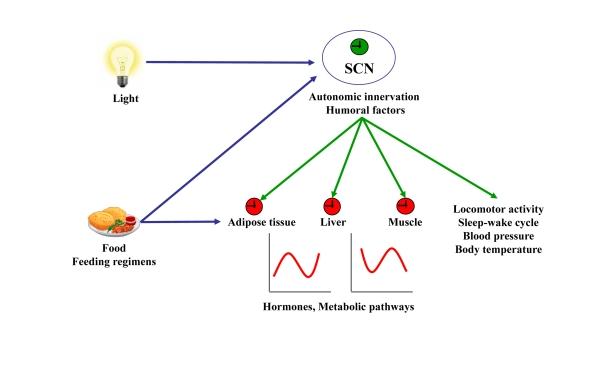
Increased longevity and improved health can be achieved in mammals by two feeding regimens, caloric restriction (CR), which limits the amount of daily calorie intake, and intermittent fasting (IF), which allows the food to be available ad libitum every other day. The precise mechanisms mediating these beneficial effects are still unresolved. Resetting the circadian clock is another intervention that can lead to increased life span and well being, while clock disruption is associated with aging and morbidity. Currently, a large body of evidence links circadian rhythms with metabolism and feeding regimens. In particular, CR, and possibly also IF, can entrain the master clock located in the suprachiasmatic nuclei (SCN) of the brain hypothalamus. These findings raise the hypothesis that the beneficial effects exerted by these feeding regimens could be mediated, at least in part, through resetting of the circadian clock, thus leading to synchrony in metabolism and physiology. This hypothesis is reinforced by a transgenic mouse model showing spontaneously reduced eating alongside robust circadian rhythms and increased life span. This review will summarize recent findings concerning the relationships between feeding regimens, circadian rhythms, and metabolism with implications for ageing attenuation and life span extension.
通过两种喂养方式可以实现哺乳动物的寿命延长和健康改善,即热量限制(CR),它限制每日卡路里摄入量,以及间歇性禁食(IF),它允许每隔一天随意进食。介导这些有益效果的确切机制仍未得到解决。重置生物钟是另一种可以延长寿命和增进健康的干预措施,而生物钟紊乱与衰老和发病相关。目前,大量证据将昼夜节律与新陈代谢和喂养方式联系起来。特别是,热量限制以及可能还有间歇性禁食,可以调节位于大脑下丘脑视交叉上核(SCN)的主生物钟。这些发现提出了一个假设,即这些喂养方式所产生的有益效果可能至少部分是通过重置生物钟来介导的,从而导致新陈代谢和生理机能的同步。一个转基因小鼠模型强化了这一假设,该模型显示自发进食减少,同时具有稳健的昼夜节律和延长的寿命。本综述将总结关于喂养方式、昼夜节律和新陈代谢之间关系的最新发现,及其对衰老减缓及寿命延长的影响。



 Zotero 插件