Pereira Adrienne, Green Eva G T, Visintin Emilio Paolo
Laboratory of Social Psychology, Institute of Psychology, Faculty of Social and Political Sciences, University of Lausanne,Lausanne, Switzerland.
Front Psychol. 2017 Apr 10;8:477. doi: 10.3389/fpsyg.2017.00477. eCollection 2017.
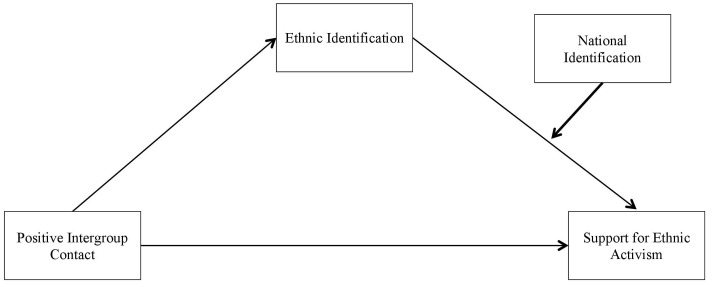
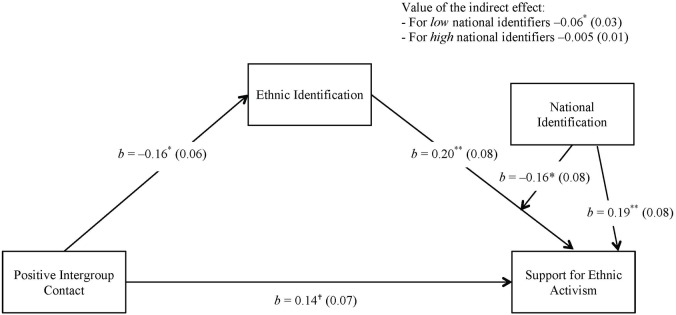
Positive intergroup contact with socially and economically advantaged national majorities has been shown to reduce ethnic identification among minorities, thereby undermining ethnic minority activism. This finding implies that ethnic identity is the relevant social identity driving ethnic minorities' struggle for equality. We argue that the study of the "sedating" effect of positive intergroup contact for minorities should be more nuanced. The existence of multiple and sometimes interplaying social identities can foster a reinterpretation of the meaning of "ethnic" activism. This study therefore examines how the interplay of ethnic and national identities shapes the sedating effect of contact on minority activism. We expect national identification to buffer the sedated activism resulting from reduced ethnic identification. That is, the mediation from intergroup contact to reduced ethnic activism through weakened ethnic identification is expected to be moderated by national identification. With survey data from Bulgaria, we investigated support for ethnic activism among Bulgarian Roma ( = 320) as a function of their contact with the national majority as well as their degree of ethnic and national identification. The predicted moderated mediation was revealed: a negative indirect relationship between contact and activism through decreased ethnic identification occurred among Roma with low national identification, whereas no sedating effect occurred among Roma identifying strongly as members of the Bulgarian nation. We discuss the meaning of national identification for the Roma minority, who experience harsh discrimination in countries where they have been historically settled, as well as convergence of these findings with work on dual identification. We highlight the role of interacting social identities in mobilizing resources for activism and the importance of adopting a critical view on ethnic discourse when studying activism in both traditional and immigrant minorities.
与社会和经济上占优势的民族多数群体进行积极的群体间接触已被证明会降低少数群体的族群认同,从而削弱少数群体的激进主义。这一发现意味着族群认同是推动少数群体争取平等斗争的相关社会认同。我们认为,对于少数群体而言,积极的群体间接触的“镇静”效应的研究应该更加细致入微。多种社会认同的存在,有时还会相互作用,这可能会促使人们重新解读“族群”激进主义的含义。因此,本研究考察了族群认同和国家认同的相互作用如何塑造接触对少数群体激进主义的镇静效应。我们预计国家认同会缓冲因族群认同降低而导致的激进主义减弱。也就是说,通过削弱族群认同,从群体间接触到族群激进主义减弱的中介作用预计会受到国家认同的调节。利用来自保加利亚的调查数据,我们调查了保加利亚罗姆人(= 320)对族群激进主义的支持程度,这是他们与民族多数群体接触以及他们的族群认同和国家认同程度的函数。研究揭示了预期的调节中介作用:在国家认同度低的罗姆人中,通过降低族群认同,接触与激进主义之间存在负向间接关系,而在强烈认同自己是保加利亚民族成员的罗姆人中则没有镇静效应。我们讨论了国家认同对罗姆少数群体的意义,罗姆人在其历史定居的国家遭受着严重的歧视,以及这些发现与双重认同研究的趋同性。我们强调了相互作用的社会认同在为激进主义动员资源方面发挥的作用,以及在研究传统少数群体和移民少数群体的激进主义时,对族群话语持批判性观点的重要性。