• 文献检索
  • 文档翻译
  • 深度研究
  • 学术资讯
  • Suppr Zotero 插件Zotero 插件
  • 邀请有礼
  • 套餐&价格
  • 历史记录
应用&插件
Suppr Zotero 插件Zotero 插件浏览器插件Mac 客户端Windows 客户端微信小程序
定价
高级版会员购买积分包购买API积分包
服务
文献检索文档翻译深度研究API 文档MCP 服务
关于我们
关于 Suppr公司介绍联系我们用户协议隐私条款
关注我们

Suppr 超能文献

核心技术专利:CN118964589B侵权必究
粤ICP备2023148730 号-1Suppr @ 2026

文献检索

告别复杂PubMed语法,用中文像聊天一样搜索,搜遍4000万医学文献。AI智能推荐,让科研检索更轻松。

立即免费搜索

文件翻译

保留排版,准确专业,支持PDF/Word/PPT等文件格式,支持 12+语言互译。

免费翻译文档

深度研究

AI帮你快速写综述,25分钟生成高质量综述,智能提取关键信息,辅助科研写作。

立即免费体验

基于机器学习的腕部传感器步态检测:老年人和帕金森病患者日常生活研究。

Gait Detection from a Wrist-Worn Sensor Using Machine Learning Methods: A Daily Living Study in Older Adults and People with Parkinson's Disease.

机构信息

Center for the Study of Movement, Cognition and Mobility, Neurological Institute, Tel Aviv Sourasky Medical Center, Tel Aviv 6492416, Israel.

Sagol School of Neuroscience, Tel Aviv University, Tel Aviv 6997801, Israel.

出版信息

Sensors (Basel). 2022 Sep 19;22(18):7094. doi: 10.3390/s22187094.

DOI:10.3390/s22187094
PMID:36146441
原文链接:https://pmc.ncbi.nlm.nih.gov/articles/PMC9502704/
Abstract

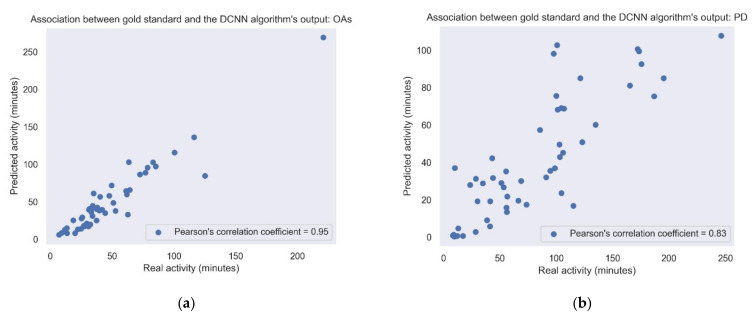
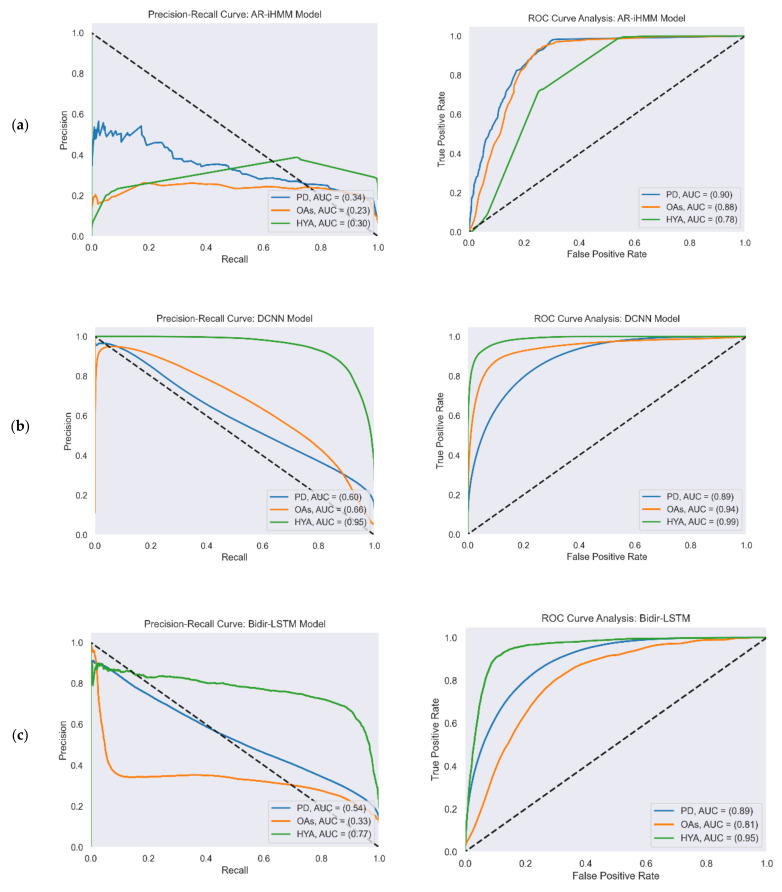
Remote assessment of the gait of older adults (OAs) during daily living using wrist-worn sensors has the potential to augment clinical care and mobility research. However, hand movements can degrade gait detection from wrist-sensor recordings. To address this challenge, we developed an anomaly detection algorithm and compared its performance to four previously published gait detection algorithms. Multiday accelerometer recordings from a wrist-worn and lower-back sensor (i.e., the “gold-standard” reference) were obtained in 30 OAs, 60% with Parkinson’s disease (PD). The area under the receiver operator curve (AUC) and the area under the precision−recall curve (AUPRC) were used to evaluate the performance of the algorithms. The anomaly detection algorithm obtained AUCs of 0.80 and 0.74 for OAs and PD, respectively, but AUPRCs of 0.23 and 0.31 for OAs and PD, respectively. The best performing detection algorithm, a deep convolutional neural network (DCNN), exhibited high AUCs (i.e., 0.94 for OAs and 0.89 for PD) but lower AUPRCs (i.e., 0.66 for OAs and 0.60 for PD), indicating trade-offs between precision and recall. When choosing a classification threshold of 0.9 (i.e., opting for high precision) for the DCNN algorithm, strong correlations (r > 0.8) were observed between daily living walking time estimates based on the lower-back (reference) sensor and the wrist sensor. Further, gait quality measures were significantly different in OAs and PD compared to healthy adults. These results demonstrate that daily living gait can be quantified using a wrist-worn sensor.

摘要

使用腕戴式传感器对老年人(OAs)在日常生活中的步态进行远程评估,有可能增强临床护理和移动性研究。然而,手部运动会降低腕部传感器记录的步态检测精度。为了解决这一挑战,我们开发了一种异常检测算法,并将其性能与之前发表的四种步态检测算法进行了比较。在 30 名 OAs 中(60%患有帕金森病(PD)),使用腕戴式和下背部传感器(即“金标准”参考)获得了多天的加速度计记录。使用接收器操作曲线下面积(AUC)和精度-召回曲线下面积(AUPRC)评估算法的性能。异常检测算法分别获得了 0.80 和 0.74 的 AUC,分别为 OAs 和 PD,但分别为 0.23 和 0.31 的 AUPRC,OAs 和 PD。表现最佳的检测算法,即深度卷积神经网络(DCNN),表现出较高的 AUC(即,OAs 为 0.94,PD 为 0.89),但较低的 AUPRC(即,OAs 为 0.66,PD 为 0.60),表明精度和召回率之间存在权衡。当为 DCNN 算法选择分类阈值为 0.9(即选择高精度)时,基于下背部(参考)传感器和腕部传感器的日常生活行走时间估计之间观察到很强的相关性(r>0.8)。此外,与健康成年人相比,OAs 和 PD 的步态质量测量值有显著差异。这些结果表明,日常生活中的步态可以使用腕戴式传感器进行量化。
https://cdn.ncbi.nlm.nih.gov/pmc/blobs/c8c6/9502704/33c9036689a4/sensors-22-07094-g005.jpg
https://cdn.ncbi.nlm.nih.gov/pmc/blobs/c8c6/9502704/ad161cf347a0/sensors-22-07094-g001.jpg
https://cdn.ncbi.nlm.nih.gov/pmc/blobs/c8c6/9502704/ae938d83ba44/sensors-22-07094-g002.jpg
https://cdn.ncbi.nlm.nih.gov/pmc/blobs/c8c6/9502704/fee5e1b4f9a2/sensors-22-07094-g003.jpg
https://cdn.ncbi.nlm.nih.gov/pmc/blobs/c8c6/9502704/4a1899807d34/sensors-22-07094-g004a.jpg
https://cdn.ncbi.nlm.nih.gov/pmc/blobs/c8c6/9502704/33c9036689a4/sensors-22-07094-g005.jpg
https://cdn.ncbi.nlm.nih.gov/pmc/blobs/c8c6/9502704/ad161cf347a0/sensors-22-07094-g001.jpg
https://cdn.ncbi.nlm.nih.gov/pmc/blobs/c8c6/9502704/ae938d83ba44/sensors-22-07094-g002.jpg
https://cdn.ncbi.nlm.nih.gov/pmc/blobs/c8c6/9502704/fee5e1b4f9a2/sensors-22-07094-g003.jpg
https://cdn.ncbi.nlm.nih.gov/pmc/blobs/c8c6/9502704/4a1899807d34/sensors-22-07094-g004a.jpg
https://cdn.ncbi.nlm.nih.gov/pmc/blobs/c8c6/9502704/33c9036689a4/sensors-22-07094-g005.jpg

相似文献

1
Gait Detection from a Wrist-Worn Sensor Using Machine Learning Methods: A Daily Living Study in Older Adults and People with Parkinson's Disease.基于机器学习的腕部传感器步态检测:老年人和帕金森病患者日常生活研究。
Sensors (Basel). 2022 Sep 19;22(18):7094. doi: 10.3390/s22187094.
2
Real-World Gait Detection Using a Wrist-Worn Inertial Sensor: Validation Study.使用腕戴式惯性传感器的真实步态检测:验证研究
JMIR Form Res. 2024 May 1;8:e50035. doi: 10.2196/50035.
3
Machine learning-based motor assessment of Parkinson's disease using postural sway, gait and lifestyle features on crowdsourced smartphone data.基于机器学习的帕金森病运动评估,使用众包智能手机数据的姿势摆动、步态和生活方式特征。
Biomed Phys Eng Express. 2020 Mar 4;6(3):035005. doi: 10.1088/2057-1976/ab39a8.
4
Detecting Sensitive Mobility Features for Parkinson's Disease Stages Via Machine Learning.基于机器学习的帕金森病阶段敏感运动特征检测。
Mov Disord. 2021 Sep;36(9):2144-2155. doi: 10.1002/mds.28631. Epub 2021 May 6.
5
Self-supervised learning of wrist-worn daily living accelerometer data improves the automated detection of gait in older adults.基于腕戴日常活动加速度计数据的自监督学习可提高老年人步态的自动检测。
Sci Rep. 2024 Sep 6;14(1):20854. doi: 10.1038/s41598-024-71491-3.
6
Objective characterization of daily living transitions in patients with Parkinson's disease using a single body-fixed sensor.使用单一身体固定传感器对帕金森病患者日常生活转变进行客观表征。
J Neurol. 2016 Aug;263(8):1544-51. doi: 10.1007/s00415-016-8164-6. Epub 2016 May 23.
7
Detection of Gait Abnormalities for Fall Risk Assessment Using Wrist-Worn Inertial Sensors and Deep Learning.使用腕戴惯性传感器和深度学习技术进行步态异常检测以评估跌倒风险。
Sensors (Basel). 2020 Sep 19;20(18):5373. doi: 10.3390/s20185373.
8
Detecting Parkinson's Disease from Wrist-Worn Accelerometry in the U.K. Biobank.从英国生物银行的腕部加速度计检测帕金森病。
Sensors (Basel). 2021 Mar 14;21(6):2047. doi: 10.3390/s21062047.
9
Validation of a Step Detection Algorithm during Straight Walking and Turning in Patients with Parkinson's Disease and Older Adults Using an Inertial Measurement Unit at the Lower Back.使用下背部惯性测量单元对帕金森病患者和老年人在直线行走和转弯过程中的步幅检测算法进行验证。
Front Neurol. 2017 Sep 4;8:457. doi: 10.3389/fneur.2017.00457. eCollection 2017.
10
Automated Gait Detection in Older Adults during Daily-Living using Self-Supervised Learning of Wrist-Worn Accelerometer Data: Development and Validation of ElderNet.使用腕部佩戴式加速度计数据的自监督学习在老年人日常生活中进行自动步态检测:ElderNet的开发与验证
Res Sq. 2024 Mar 15:rs.3.rs-4102403. doi: 10.21203/rs.3.rs-4102403/v1.

引用本文的文献

1
Continuous Assessment of Daily-Living Gait Using Self-Supervised Learning of Wrist-Worn Accelerometer Data.利用腕部佩戴式加速度计数据的自监督学习对日常生活步态进行持续评估。
medRxiv. 2025 May 21:2025.05.21.25328061. doi: 10.1101/2025.05.21.25328061.
2
Quantifying arm swing in Parkinson's disease: a method accounting for arm activities during free-living gait.帕金森病中手臂摆动的量化:一种考虑自由生活步态期间手臂活动的方法。
J Neuroeng Rehabil. 2025 Feb 26;22(1):37. doi: 10.1186/s12984-025-01578-z.
3
Advances in applying somatosensory interaction technology in geriatric care: A bibliometric analysis.

本文引用的文献

1
Virtual exam for Parkinson's disease enables frequent and reliable remote measurements of motor function.帕金森病的虚拟检查可实现对运动功能的频繁且可靠的远程测量。
NPJ Digit Med. 2022 May 23;5(1):65. doi: 10.1038/s41746-022-00607-8.
2
SciKit Digital Health: Python Package for Streamlined Wearable Inertial Sensor Data Processing.SciKit 数字健康:用于简化可穿戴惯性传感器数据处理的 Python 包。
JMIR Mhealth Uhealth. 2022 Apr 21;10(4):e36762. doi: 10.2196/36762.
3
Free-Living Gait Cadence Measured by Wearable Accelerometer: A Promising Alternative to Traditional Measures of Mobility for Assessing Fall Risk.
体感交互技术在老年护理中的应用进展:一项文献计量分析
Int J Nurs Sci. 2024 Oct 12;11(5):571-577. doi: 10.1016/j.ijnss.2024.10.009. eCollection 2024 Nov.
4
Self-supervised learning of wrist-worn daily living accelerometer data improves the automated detection of gait in older adults.基于腕戴日常活动加速度计数据的自监督学习可提高老年人步态的自动检测。
Sci Rep. 2024 Sep 6;14(1):20854. doi: 10.1038/s41598-024-71491-3.
5
In-Clinic and Natural Gait Observations master protocol (I-CAN-GO) to validate gait using a lumbar accelerometer.基于腰部加速度计验证步态的临床与自然步态观察主方案(I-CAN-GO)
Sci Rep. 2024 Aug 29;14(1):20128. doi: 10.1038/s41598-024-67675-6.
6
Assessing the clinical utility of inertial sensors for home monitoring in Parkinson's disease: a comprehensive review.评估惯性传感器在帕金森病家庭监测中的临床应用:一项综合综述。
NPJ Parkinsons Dis. 2024 Aug 20;10(1):161. doi: 10.1038/s41531-024-00755-6.
7
Real-World Gait Detection Using a Wrist-Worn Inertial Sensor: Validation Study.使用腕戴式惯性传感器的真实步态检测:验证研究
JMIR Form Res. 2024 May 1;8:e50035. doi: 10.2196/50035.
8
Automated Gait Detection in Older Adults during Daily-Living using Self-Supervised Learning of Wrist-Worn Accelerometer Data: Development and Validation of ElderNet.使用腕部佩戴式加速度计数据的自监督学习在老年人日常生活中进行自动步态检测:ElderNet的开发与验证
Res Sq. 2024 Mar 15:rs.3.rs-4102403. doi: 10.21203/rs.3.rs-4102403/v1.
9
Assisted technology in Parkinson's disease gait: what's up?帕金森病步态中的辅助技术:怎么了?
Arq Neuropsiquiatr. 2024 Jun;82(6):1-10. doi: 10.1055/s-0043-1777782. Epub 2024 Feb 23.
10
Can Gait Characteristics Be Represented by Physical Activity Measured with Wrist-Worn Accelerometers?腕部佩戴加速度计测量的身体活动能否代表步态特征?
Sensors (Basel). 2023 Oct 18;23(20):8542. doi: 10.3390/s23208542.
可穿戴加速度计测量的自由行走步态节奏:评估跌倒风险的传统移动性测量的有前途的替代方法。
J Gerontol A Biol Sci Med Sci. 2023 May 11;78(5):802-810. doi: 10.1093/gerona/glac013.
4
Validation of open-source step-counting algorithms for wrist-worn tri-axial accelerometers in cardiovascular patients.腕戴三轴加速度计开源计步算法在心血管病患者中验证。
Gait Posture. 2022 Feb;92:206-211. doi: 10.1016/j.gaitpost.2021.11.035. Epub 2021 Nov 27.
5
Quantification of Daily-Living Gait Quantity and Quality Using a Wrist-Worn Accelerometer in Huntington's Disease.使用腕部佩戴式加速度计对亨廷顿舞蹈症患者的日常生活步态数量和质量进行量化
Front Neurol. 2021 Oct 27;12:719442. doi: 10.3389/fneur.2021.719442. eCollection 2021.
6
LSTM and GRU Neural Networks as Models of Dynamical Processes Used in Predictive Control: A Comparison of Models Developed for Two Chemical Reactors.长短期记忆神经网络和门控循环单元神经网络作为预测控制中动态过程的模型:为两个化学反应器开发的模型的比较。
Sensors (Basel). 2021 Aug 20;21(16):5625. doi: 10.3390/s21165625.
7
Estimation of free-living walking cadence from wrist-worn sensor accelerometry data and its association with SF-36 quality of life scores.基于腕戴传感器加速度计数据估算自由行走的步频及其与 SF-36 生活质量评分的相关性。
Physiol Meas. 2021 Jun 29;42(6). doi: 10.1088/1361-6579/ac067b.
8
Smartwatch inertial sensors continuously monitor real-world motor fluctuations in Parkinson's disease.智能手表惯性传感器可连续监测帕金森病患者的现实世界运动波动。
Sci Transl Med. 2021 Feb 3;13(579). doi: 10.1126/scitranslmed.abd7865.
9
The Impact of Environment on Gait Assessment: Considerations from Real-World Gait Analysis in Dementia Subtypes.环境对步态评估的影响:从痴呆亚型的真实世界步态分析中得到的启示。
Sensors (Basel). 2021 Jan 26;21(3):813. doi: 10.3390/s21030813.
10
Sensor-Based and Patient-Based Assessment of Daily-Living Physical Activity in People with Parkinson's Disease: Do Motor Subtypes Play a Role?基于传感器和患者的帕金森病患者日常活动体力评估:运动亚型是否起作用?
Sensors (Basel). 2020 Dec 8;20(24):7015. doi: 10.3390/s20247015.