Alame-Emane Amel Kévin, Pierre-Audigier Catherine, Aboumegone-Biyogo Oriane Cordelia, Nzoghe-Mveang Amandine, Cadet-Daniel Véronique, Sola Christophe, Djoba-Siawaya Joël Fleury, Gicquel Brigitte, Takiff Howard E
Unité de Génétique Mycobacterienne, Institut Pasteur, Paris, France.
Unité de Recherche et de Diagnostics Spécialisés, Laboratoire National de Santé Publique, Libreville, Gabon.
J Clin Microbiol. 2017 Jul;55(7):2105-2115. doi: 10.1128/JCM.02257-16. Epub 2017 Apr 26.
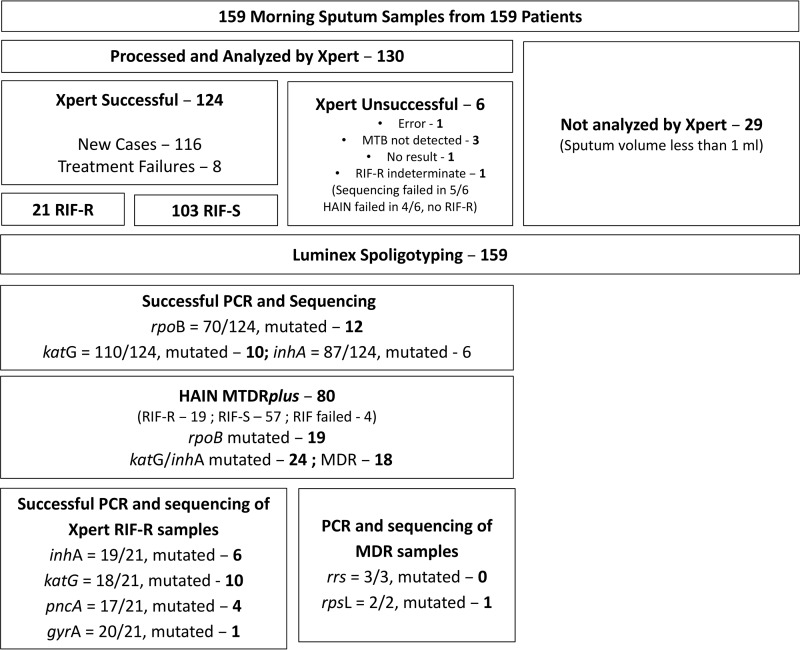
Multidrug-resistant (MDR) and extensively drug resistant (XDR) strains of pose major problems for global health. The GeneXpert MTB/RIF (Xpert) assay rapidly detects resistance to rifampin (RIF), but for detection of the additional resistance that defines MDR-TB (MDR tuberculosis) and XDR-TB, and for molecular epidemiology, specimen cultures and a biosafe infrastructure are generally required. We sought to determine whether the remnants of sputa prepared for the Xpert assay could be used directly to find mutations associated with drug resistance and to study molecular epidemiology, thus providing precise characterization of MDR-TB cases in countries lacking biosafety level 3 (BSL3) facilities for cultures. After sputa were processed and run on the Xpert instrument, the leftovers of the samples prepared for the Xpert assay were used for PCR amplification and sequencing or for a line probe assay to detect mutations associated with resistance to additional drugs, as well as for molecular epidemiology with spoligotyping and selective mycobacterial interspersed repetitive-unit-variable-number tandem-repeat (MIRU-VNTR) typing. Of 130 sputum samples from Gabon tested with the Xpert assay, 124 yielded interpretable results; 21 (17%) of these were determined to be RIF Amplification and sequencing or a line probe assay of the Xpert remnants confirmed 18/21 samples as MDR, corresponding to 12/116 (9.5%) new and 6/8 (75%) previously treated TB patients. Spoligotyping and MIRU typing with hypervariable loci identified an MDR Beijing strain present in five samples. We conclude that the remnants of samples processed for the Xpert assay can be used in PCRs to find mutations associated with the resistance to the additional drugs that defines MDR and XDR-TB and to study molecular epidemiology without the need for culturing or a biosafe infrastructure.
耐多药(MDR)和广泛耐药(XDR)菌株给全球健康带来了重大问题。GeneXpert MTB/RIF(Xpert)检测可快速检测对利福平(RIF)的耐药性,但对于定义耐多药结核病(MDR-TB)和广泛耐药结核病(XDR-TB)的其他耐药性检测以及分子流行病学研究,通常需要进行标本培养和具备生物安全设施。我们试图确定为Xpert检测准备的痰液残余物是否可直接用于寻找与耐药性相关的突变并研究分子流行病学,从而在缺乏用于培养的生物安全3级(BSL3)设施的国家中对MDR-TB病例进行精确特征分析。在痰液经过处理并在Xpert仪器上检测后,为Xpert检测准备的样本残余物用于PCR扩增和测序,或用于线性探针检测以检测与对其他药物耐药性相关的突变,以及用于 spoligotyping 和选择性分枝杆菌散布重复单位可变数目串联重复序列(MIRU-VNTR)分型的分子流行病学研究。在加蓬用Xpert检测的130份痰液样本中,124份产生了可解释的结果;其中21份(17%)被确定为利福平耐药。对Xpert残余物进行扩增和测序或线性探针检测,确认18/21份样本为耐多药,分别对应12/116(9.5%)新诊断的和6/8(75%)既往治疗过的结核病患者。使用高变位点的spoligotyping和MIRU分型鉴定出五份样本中存在耐多药北京菌株。我们得出结论,为Xpert检测处理的样本残余物可用于PCR,以寻找与定义MDR和XDR-TB的其他药物耐药性相关的突变,并研究分子流行病学,而无需进行培养或具备生物安全设施。