Nebigil Canan G
CNRS-University of Strasbourg, UMR 7242, Illkirch, France.
Front Cardiovasc Med. 2017 Apr 12;4:20. doi: 10.3389/fcvm.2017.00020. eCollection 2017.
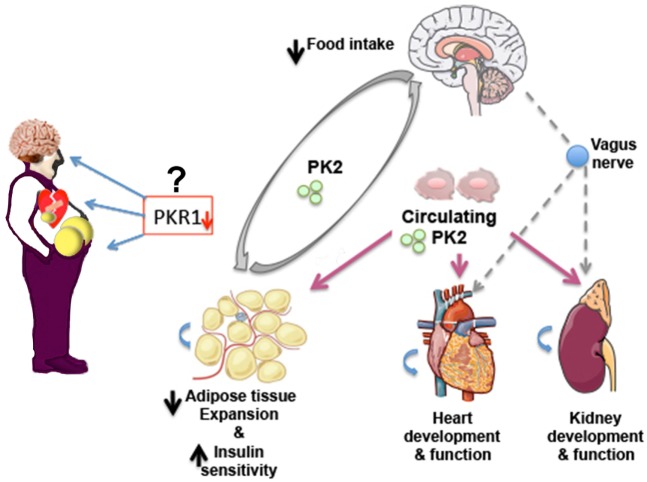
Obesity is a fast growing epidemic event worldwide. Fatness is associated with a number of comorbidities, including cardiovascular diseases (CVDs). Although obesity can be heredity in 30-70% cases, the environmental contributions also play an important role in the increasing prevalence of obesity. The relationship between development of obesity and CVD is poorly characterized. Obesity and CVD can also be resulted from a common mechanism such as metabolic, inflammatory, and neurohormonal changes. Prokineticins are defined as cytokines (immunoregulatory proteins), adipokines (adipocyte-secreted hormone), angiogenic (increasing vessel formation), or aneroxic (lowering food intake) hormones. Prokineticin-mediated signaling plays a key role in the development of obesity and CVD. Two forms of prokineticins exist in circulation and in various tissues including the brain, heart, kidney, and adipose. Prokineticins act on the two G protein-coupled receptors, namely, PKR1 and PKR2. Prokineticin-2 (PK2) PKR1 receptor controls food intake and prevents adipose tissue expansion. The anti-adipocyte effect of PKR1 signaling is due to suppression of preadipocyte proliferation and differentiation capacity into adipocytes. PK2/PKR1 signaling promotes transcapillary passages of insulin and increases insulin sensitivity. It also plays an important role in the heart and kidney development and functions. Here, we discuss PK2 as a new adipocytokine in the association between obesity and CVD. We also highlight targeting PKR1 can be a new approach to treat obesity and CVD.
肥胖是全球范围内迅速增长的流行疾病。肥胖与多种合并症相关,包括心血管疾病(CVDs)。尽管在30%-70%的病例中肥胖可能具有遗传性,但环境因素在肥胖患病率上升中也起着重要作用。肥胖与CVD发展之间的关系尚未得到充分描述。肥胖和CVD也可能由诸如代谢、炎症和神经激素变化等共同机制引起。促动力蛋白被定义为细胞因子(免疫调节蛋白)、脂肪因子(脂肪细胞分泌的激素)、血管生成因子(增加血管形成)或厌食因子(降低食物摄入量)。促动力蛋白介导的信号传导在肥胖和CVD的发展中起关键作用。促动力蛋白有两种形式存在于循环系统以及包括大脑、心脏、肾脏和脂肪组织在内的各种组织中。促动力蛋白作用于两种G蛋白偶联受体,即PKR1和PKR2。促动力蛋白-2(PK2)/PKR1受体控制食物摄入并防止脂肪组织扩张。PKR1信号传导的抗脂肪细胞作用是由于抑制前脂肪细胞增殖以及向脂肪细胞分化的能力。PK2/PKR1信号传导促进胰岛素跨毛细血管转运并提高胰岛素敏感性。它在心脏和肾脏的发育及功能中也起重要作用。在此,我们讨论PK2作为肥胖与CVD关联中的一种新脂肪细胞因子。我们还强调靶向PKR1可能是治疗肥胖和CVD的一种新方法。