Wang Yi-Wen, Lin Ting-Yun, Peng Ching-Hsiu, Huang Jui-Lin, Hung Szu-Chun
Division of Family Medicine, Taipei Tzu Chi Hospital, Buddhist Tzu Chi Medical Foundation, and School of Medicine, Tzu Chi University, Hualien 970, Taiwan.
Division of Nephrology, Taipei Tzu Chi Hospital, Buddhist Tzu Chi Medical Foundation, and School of Medicine, Tzu Chi University, Hualien 970, Taiwan.
Nutrients. 2017 Apr 27;9(5):434. doi: 10.3390/nu9050434.
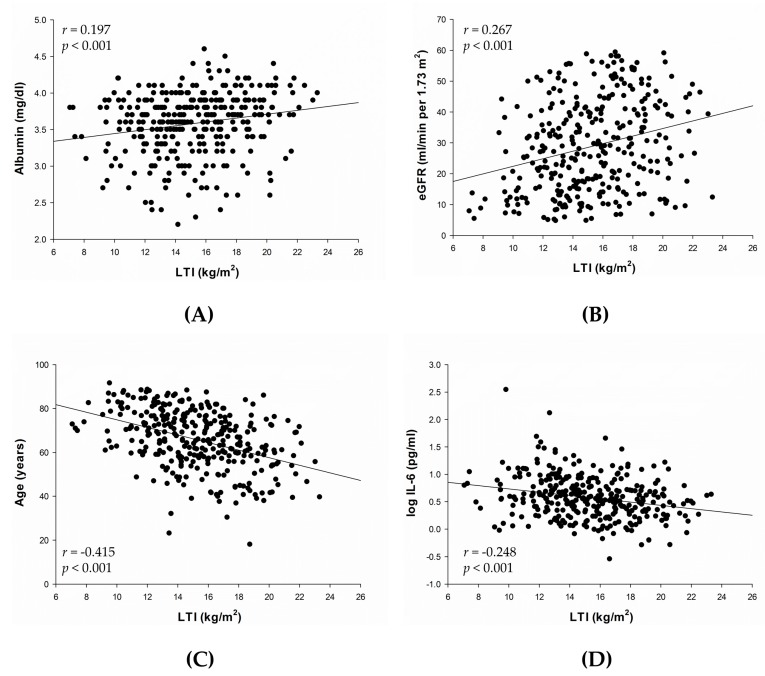
Muscle wasting is common and is associated with increased morbidity and mortality in patients with chronic kidney disease (CKD). However, factors associated with decreased muscle mass in CKD patients are seldom reported. We performed a cross-sectional study of 326 patients (age 65.8 ± 13.3 years) with stage 3-5 CKD who were not yet on dialysis. Muscle mass was determined using the Body Composition Monitor (BCM), a multifrequency bioimpedance spectroscopy device, and was expressed as the lean tissue index (LTI, lean tissue mass/height²). An LTI of less than 10% of the normal value (low LTI) indicates muscle wasting. Patients with low LTI ( = 40) tended to be diabetic, had significantly higher fat tissue index, urine protein creatinine ratio, and interleukin-6 and tumor necrosis factor-α levels, but had significantly lower serum albumin and hemoglobin levels compared with those with normal LTI. In multivariate linear regression analysis, age, sex, cardiovascular disease, and interleukin-6 were independently associated with LTI. Additionally, diabetes mellitus remained an independent predictor of muscle wasting according to low LTI by multivariate logistic regression analysis. We conclude that LTI has important clinical correlations. Determination of LTI may aid in clinical assessment by helping to identify muscle wasting among patients with stage 3-5 CKD.
肌肉萎缩在慢性肾脏病(CKD)患者中很常见,并且与发病率和死亡率增加相关。然而,很少有报道提及CKD患者肌肉量减少的相关因素。我们对326例尚未接受透析的3-5期CKD患者(年龄65.8±13.3岁)进行了一项横断面研究。使用人体成分监测仪(BCM)(一种多频生物电阻抗光谱设备)测定肌肉量,并将其表示为瘦组织指数(LTI,瘦组织质量/身高²)。LTI低于正常值的10%(低LTI)表明存在肌肉萎缩。与正常LTI患者相比,低LTI患者(n = 40)往往患有糖尿病,脂肪组织指数、尿蛋白肌酐比值、白细胞介素-6和肿瘤坏死因子-α水平显著更高,但血清白蛋白和血红蛋白水平显著更低。在多变量线性回归分析中,年龄、性别、心血管疾病和白细胞介素-6与LTI独立相关。此外,根据多变量逻辑回归分析,糖尿病仍然是低LTI所致肌肉萎缩的独立预测因素。我们得出结论,LTI具有重要的临床相关性。测定LTI可能有助于通过识别3-5期CKD患者中的肌肉萎缩来进行临床评估。