Guo Yin, Liu Li Juan, Tang Ping, Lv Yan Yun, Feng Yi, Xu Liang, Jonas Jost B
Beijing Institute of Ophthalmology, Beijing Key Laboratory of Ophthalmology and Visual Sciences, Beijing Tongren Eye Center, Beijing Tongren Hospital, Capital Medical University, Beijing, China.
Tongren Eye Care Center, Beijing Tongren Hospital, Capital Medical University, Beijing, China.
PLoS One. 2017 Apr 27;12(4):e0175921. doi: 10.1371/journal.pone.0175921. eCollection 2017.
To investigate factors associated with ocular axial elongation and myopia progression during a 4-year follow-up in primary school children in Beijing.
This school-based study included 382 grade-1 children at baseline in 2011 (age:6.3±0.4 years) with 305 (79.8%) returning for the follow-up examination in 2015. At baseline and in yearly follow-up examinations, the children underwent a comprehensive eye examination including auto-refractometry, ocular biometry with measurement of axial length, and fundus photography. The parents underwent a standardized interview.
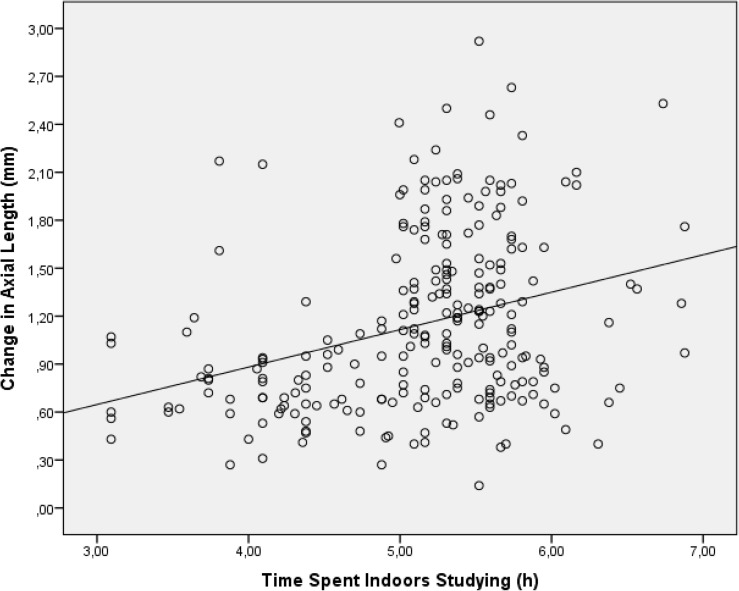
During the study period, the mean axial length elongated by 1.15±0.56mm in boys and 1.10±0.63mm in girls. At baseline and at the end of follow-up, axial length was significantly (P<0.001) longer in boys, with no difference (P = 0.50) between genders in axial elongation. In multivariate analysis, greater axial elongation was associated (regression coefficient r2:0.15) with less time spent outdoors (P = 0.004; standardized coefficient beta: -0.22), more time spent indoors with studying (P = 0.02; beta: 0.18) and paternal myopia (P = 0.03; beta: 0.16). Larger increases in the axial length/anterior corneal curvature (AL/CC) ratio were associated (r2:0.09) with less time spent outdoors (PP = 0.003; beta: -0.22) and maternal myopia (PP = 0.02; beta: 0.18).
Myopic axial elongation during a 4-year follow-up was associated with shorter time spent outdoors and longer time spent indoors studying and with parental myopia. Other factors such as level of paternal education, family income, gender and region of habitation were significantly associated with axial elongation and with myopia progression only in univariate analysis.
调查北京小学生4年随访期间与眼轴伸长及近视进展相关的因素。
这项基于学校的研究纳入了2011年基线时的382名一年级儿童(年龄:6.3±0.4岁),2015年有305名(79.8%)返回进行随访检查。在基线及每年的随访检查中,儿童接受全面的眼部检查,包括自动验光、测量眼轴长度的眼部生物测量以及眼底照相。家长接受标准化访谈。
研究期间,男孩的平均眼轴伸长1.15±0.56mm,女孩为1.10±0.63mm。在基线和随访结束时,男孩的眼轴长度显著更长(P<0.001),眼轴伸长在性别间无差异(P = 0.50)。多因素分析中,更大的眼轴伸长与户外活动时间较少(P = 0.004;标准化系数β:-0.22)、室内学习时间较多(P = 0.02;β:0.18)以及父亲近视(P = 0.03;β:0.16)相关(回归系数r2:0.15)。眼轴长度/前角膜曲率(AL/CC)比值的更大增加与户外活动时间较少(P = 0.003;β:-0.22)和母亲近视(P = 0.02;β:0.18)相关(r2:0.09)。
4年随访期间的近视性眼轴伸长与户外活动时间较短、室内学习时间较长以及父母近视有关。其他因素,如父亲教育水平、家庭收入、性别和居住地区,仅在单因素分析中与眼轴伸长及近视进展显著相关。