Grant Joshua N, Burris Jason N, Stewart C Neal, Lenaghan Scott C
Department of Plant Science, University of Tennessee, 2431 Joe Johnson Drive, Knoxville, TN, 37996, USA.
Department of Food Science, University of Tennessee, 2600 River Drive, Knoxville, TN, 37996, USA.
BMC Biotechnol. 2017 Apr 27;17(1):39. doi: 10.1186/s12896-017-0359-0.
Panicum hallii Vasey (Hall's panicgrass) is a compact, perennial C grass in the family Poaceae, which has potential to enable bioenergy research for switchgrass (Panicum virgatum L.). Unlike P. hallii, switchgrass has a large genome, allopolyploidy, self-incompatibility, a long life cycle, and large stature-all suboptimal traits for rapid genetics research. Herein we improved tissue culture methodologies for two inbred P. hallii populations: FIL2 and HAL2, to enable further development of P. hallii as a model C plant.
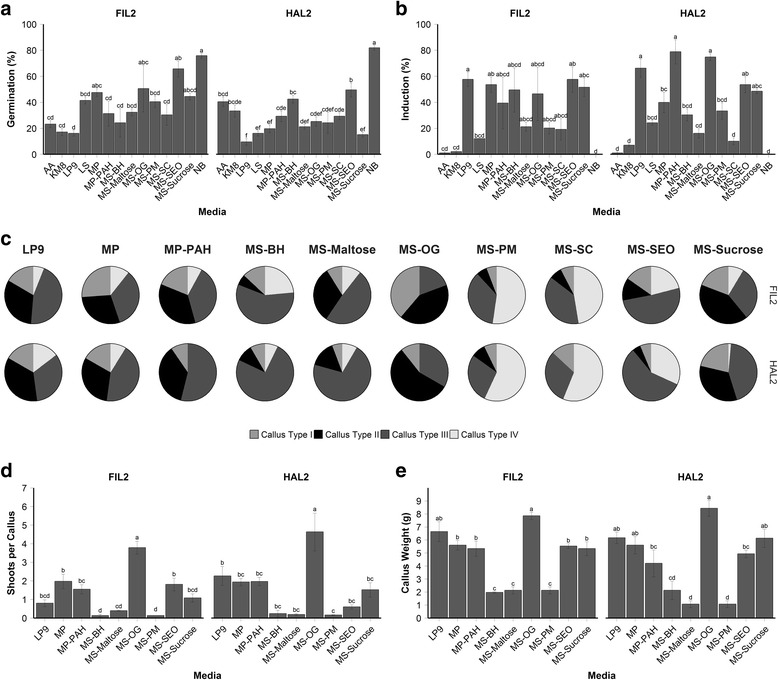
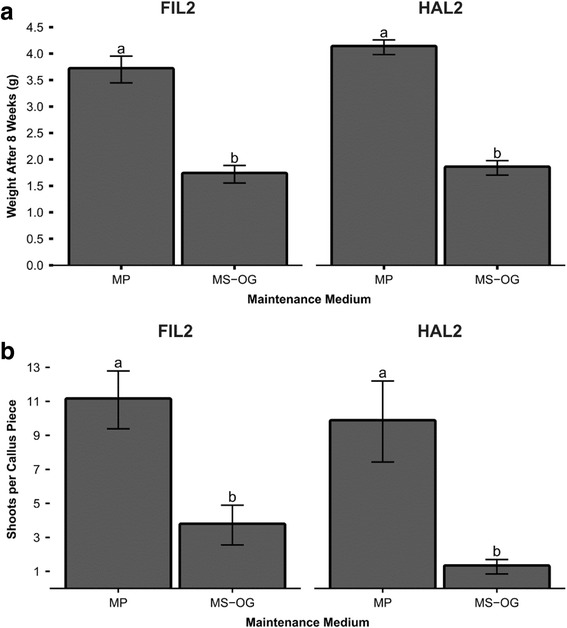
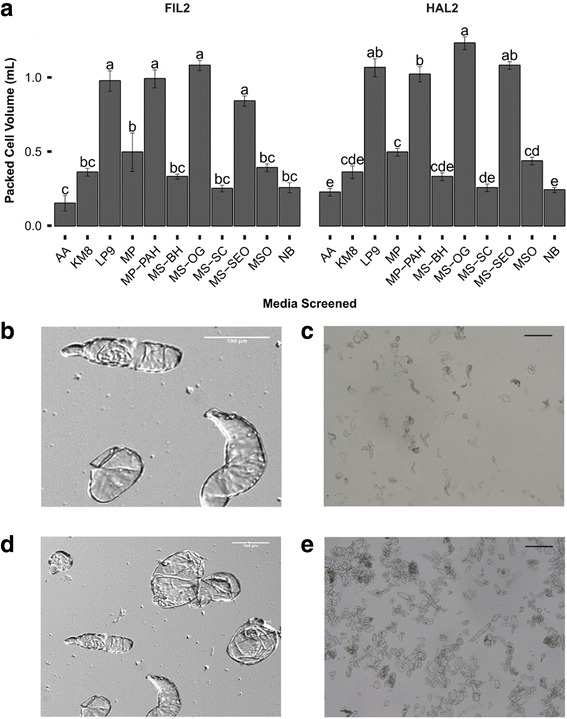
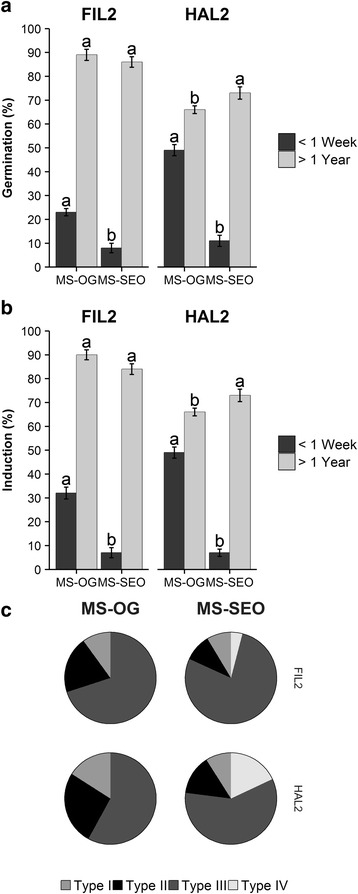
The optimal seed-derived callus induction medium was determined to be Murashige and Skoog (MS) medium supplemented with 40 mg L L-cysteine, 300 mg L L-proline, 3% sucrose, 1 g L casein hydrolysate, 3 mg L 2,4-dichlorophenoxyacetic acid (2,4-D), and 45 μg L 6-benzylaminopurine (BAP), which resulted in callus induction of 51 ± 29% for FIL2 and 81 ± 19% for HAL2. The optimal inflorescence-derived callus induction was observed on MP medium (MS medium supplemented with 2 g L L-proline, 3% maltose, 5 mg L 2,4-D, and 500 μg L BAP), resulting in callus induction of 100 ± 0.0% for FIL2 and 84 ± 2.4% for HAL2. Shoot regeneration rates of 11.5 ± 0.8 shoots/gram for FIL2 and 11.3 ± 0.6 shoots/gram for HAL2 were achieved using seed-induced callus, whereas shoot regeneration rates of 26.2 ± 2.6 shoots/gram for FIL2 and 29.3 ± 3.6 shoots/gram for HAL2 were achieved from inflorescence-induced callus. Further, cell suspension cultures of P. hallii were established from seed-derived callus, providing faster generation of callus tissue compared with culture using solidified media (1.41-fold increase for FIL2 and 3.00-fold increase for HAL2).
Aside from abbreviated tissue culture times from callus induction to plant regeneration for HAL2, we noted no apparent differences between FIL2 and HAL2 populations in tissue culture performance. For both populations, the cell suspension cultures outperformed tissue cultures on solidified media. Using the methods developed in this work, P. hallii callus was induced from seeds immediately after harvest in a shorter time and with higher frequencies than switchgrass. For clonal propagation, P. hallii callus was established from R1 inflorescences, similar to switchgrass, which further strengthens the potential of this plant as a C model for genetic studies. The rapid cycling (seed-to-seed time) and ease of culture, further demonstrate the potential utility of P. hallii as a C model plant.
哈利氏黍(Panicum hallii Vasey)是禾本科一种紧凑的多年生C4草本植物,具有推动柳枝稷(Panicum virgatum L.)生物能源研究的潜力。与哈利氏黍不同,柳枝稷基因组庞大、具有异源多倍体、自交不亲和、生命周期长且植株高大,这些都是不利于快速开展遗传学研究的性状。在此,我们改进了两个哈利氏黍自交系群体(FIL2和HAL2)的组织培养方法,以促进哈利氏黍作为模式C4植物的进一步发展。
确定最佳的种子愈伤组织诱导培养基为添加了40 mg/L L-半胱氨酸、300 mg/L L-脯氨酸、3%蔗糖、1 g/L水解酪蛋白、3 mg/L 2,4-二氯苯氧乙酸(2,4-D)和45 μg/L 6-苄基腺嘌呤(BAP)的Murashige和Skoog(MS)培养基,该培养基使FIL2的愈伤组织诱导率为51±29%,HAL2为81±19%。在MP培养基(添加了2 g/L L-脯氨酸、3%麦芽糖、5 mg/L 2,4-D和500 μg/L BAP的MS培养基)上观察到最佳的花序愈伤组织诱导效果,FIL2的愈伤组织诱导率为100±0.0%,HAL2为84±2.4%。使用种子诱导的愈伤组织,FIL2的芽再生率为11.5±0.8个芽/克,HAL2为11.3±0.6个芽/克;而从花序诱导的愈伤组织中,FIL2的芽再生率为26.2±2.6个芽/克,HAL2为29.3±3.6个芽/克。此外,从种子诱导的愈伤组织建立了哈利氏黍的细胞悬浮培养物,与使用固化培养基培养相比,愈伤组织的生成速度更快(FIL2增加了1.41倍,HAL2增加了3.00倍)。
除了HAL2从愈伤组织诱导到植株再生的组织培养时间缩短外,我们注意到FIL2和HAL2群体在组织培养性能上没有明显差异。对于这两个群体,细胞悬浮培养在性能上优于固化培养基上的组织培养。使用本研究中开发的方法,哈利氏黍种子在收获后能立即在更短时间内以更高频率诱导出愈伤组织,相比柳枝稷具有优势。对于克隆繁殖,与柳枝稷类似,从R1花序建立了哈利氏黍愈伤组织,这进一步增强了该植物作为遗传学研究C4模式植物的潜力。其快速的生长周期(从种子到种子的时间)和易于培养的特性,进一步证明了哈利氏黍作为C4模式植物的潜在实用性。