Sithole I, Lee L F, Velicer L F
Department of Microbiology and Public Health, Michigan State University, East Lansing 48824-1101.
J Virol. 1988 Nov;62(11):4270-9. doi: 10.1128/JVI.62.11.4270-4279.1988.
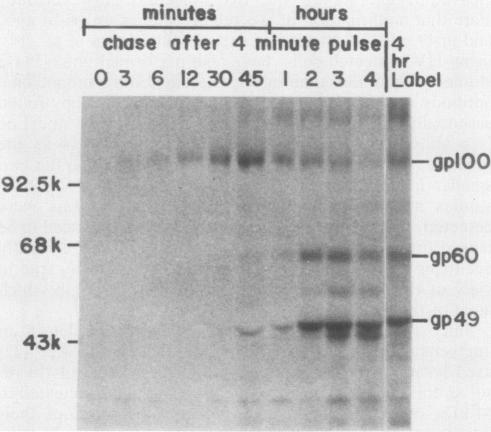
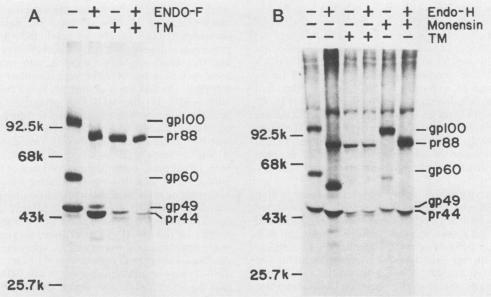
The Marek's disease herpesvirus B antigen (MDHV-B) complex was previously immunologically identified and molecularly characterized as a set of three glycoproteins designated gp100, gp60, and gp49 on the basis of apparent molecular weight and immunoprecipitation with both polyclonal and monoclonal antibodies. Immunoprecipitation analysis, previously with polyclonal and more recently with monoclonal antibodies, of infected cell lysates labeled with [35S]methionine in the presence of tunicamycin, an inhibitor of N-linked glycosylation, revealed two putative precursor molecules of 88,000 daltons (pr88) and 44,000 daltons (pr44). High-resolution pulse-chase studies revealed that gp100 was a glycosylated intermediate which was processed to yield gp60 and gp49. This cleavage was inhibited by monensin, an inhibitor of glycoprotein processing. Endo-beta-N-acetylglucosaminidases F and H (endo-F, endo-H) reduced gp100 to pr88, indicating that the latter is an intermediate in the biosynthetic pathway. These same enzymes reduced gp49, and to a lesser extent gp60, to pr44, suggesting that pr44 is their polypeptide backbone. Significant support for this concept is the fact that the same monoclonal antibody recognized all three molecules, gp60, gp49, and pr44. In the presence of monensin, terminal addition of complex sugars was also prevented, since gp60 was replaced by a slightly faster migrating component which was insensitive to both endo-F and endo-H. Cell-free translation of infected-cell mRNA, followed by immunoprecipitation analysis with either polyclonal or monoclonal antibody, resulted in detection of a putative unglycosylated precursor polypeptide of 44,000 daltons. Since pr88 was not the initial precursor polypeptide of the MDHV-B complex, its existence may have resulted from dimerization of pr44. Again, detection of both pr88 and pr44 with the same monoclonal antibody is consistent with this interpretation. These collective data obtained from the cell-free and in vivo studies with polyclonal and monoclonal antibodies reactive with MDHV-B are consistent with the concept that pr44, the initial gene product, dimerizes to form pr88 and demonstrate that pr88 is actually a processing intermediate glycosylated to gp100, another processing intermediate, which is then processed to gp60 and gp49.
马立克氏病疱疹病毒B抗原(MDHV - B)复合体先前已通过免疫学方法鉴定,并基于表观分子量以及用多克隆和单克隆抗体进行免疫沉淀,在分子水平上被表征为一组三种糖蛋白,分别命名为gp100、gp60和gp49。在衣霉素(一种N - 连接糖基化抑制剂)存在的情况下,对用[35S]甲硫氨酸标记的感染细胞裂解物进行免疫沉淀分析(先前用多克隆抗体,最近用单克隆抗体),揭示了两种假定的前体分子,分子量分别为88,000道尔顿(pr88)和44,000道尔顿(pr44)。高分辨率脉冲追踪研究表明,gp100是一种糖基化中间体,经加工后产生gp60和gp49。这种切割被莫能菌素(一种糖蛋白加工抑制剂)抑制。内切β - N - 乙酰葡糖胺糖苷酶F和H(内切F、内切H)将gp100降解为pr88,表明后者是生物合成途径中的中间体。这些相同的酶将gp49以及在较小程度上的gp60降解为pr44,这表明pr44是它们的多肽骨架。对这一概念的重要支持是,同一种单克隆抗体可识别所有三种分子,即gp60、gp49和pr44。在莫能菌素存在的情况下,复合糖的末端添加也被阻止,因为gp60被一个迁移速度稍快的组分所取代,该组分对内切F和内切H均不敏感。对感染细胞mRNA进行无细胞翻译,然后用多克隆或单克隆抗体进行免疫沉淀分析,结果检测到一种假定的44,000道尔顿的未糖基化前体多肽。由于pr88不是MDHV - B复合体的初始前体多肽,它的存在可能是由pr44二聚化导致的。同样,用同一种单克隆抗体检测到pr88和pr44也与这种解释一致。这些从使用与MDHV - B反应的多克隆和单克隆抗体进行的无细胞和体内研究中获得的综合数据与以下概念一致:初始基因产物pr44二聚化形成pr88,并证明pr88实际上是一个被糖基化为gp100的加工中间体,gp100是另一个加工中间体,然后被加工为gp60和gp49。