Qekwana Daniel N, Oguttu James W, Sithole Fortune, Odoi Agricola
Section of Veterinary Public Health, Department of Paraclinical Sciences, Faculty of Veterinary Science, University of Pretoria, Pretoria, South Africa.
Department of Agriculture and Animal Health, College of Agriculture and Environmental Sciences, University of South Africa, Johannesburg, South Africa.
BMC Vet Res. 2017 Apr 28;13(1):116. doi: 10.1186/s12917-017-1034-3.
Antimicrobial resistance in staphylococci, often associated with treatment failure, is increasingly reported in veterinary medicine. The aim of this study was to investigate patterns and predictors of antimicrobial resistance among Staphylococcus spp. isolates from canine samples submitted to the bacteriology laboratory at the University of Pretoria academic veterinary hospital between 2007 and 2012. Retrospective data of 334 Staphylococcus isolates were used to calculate the proportion of samples resistant to 15 antimicrobial agents. The Cochran-Armitage trend test was used to investigate temporal trends and logistic regression models were used to investigate predictors of antimicrobial resistance in Staphylococcus aureus and Staphylococcus pseudintermedius.
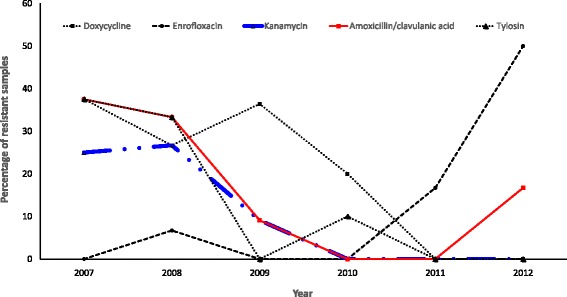
Results show that 98.2% (55/56) of the S. aureus isolates were resistant to at least one drug while 42.9% were multidrug resistant. Seventy-seven percent (214/278) of the S. pseudintermedius isolates were resistant to at least one drug and 25.9% (72/278) were multidrug resistant. Resistance to lincospectin was more common among S. aureus (64.3%) than S. pseudintermedius (38.9%). Similarly, resistance to clindamycin was higher in S. aureus (51.8%) than S. pseudintermedius (31.7%) isolates. There was a significant (p = 0.005) increase in S. aureus resistance to enrofloxacin over the study period. Similarly, S. pseudintermedius exhibited significant increasing temporal trend in resistance to trimethoprim-sulphamethoxazole (p = 0.004), clindamycin (p = 0.022) and orbifloxacin (p = 0.042). However, there was a significant decreasing temporal trend in the proportion of isolates resistant to doxycycline (p = 0.041), tylosin (p = 0.008), kanamycin (p = 0.017) and amoxicillin/clavulanic acid (p = 0.032).
High levels of multidrug resistance and the increasing levels of resistance to sulphonamides, lincosamides and fluoroquinolones among Staphylococcus spp. isolates in this study are concerning. Future studies will need to investigate local drivers of antimicrobial resistance to better guide control efforts to address the problem.
葡萄球菌的抗菌药物耐药性在兽医学中越来越多地被报道,这通常与治疗失败有关。本研究的目的是调查2007年至2012年提交给比勒陀利亚大学学术兽医医院细菌学实验室的犬类样本中葡萄球菌属分离株的抗菌药物耐药模式及预测因素。利用334株葡萄球菌分离株的回顾性数据来计算对15种抗菌药物耐药的样本比例。采用 Cochr an - Armitage趋势检验来研究时间趋势,使用逻辑回归模型来研究金黄色葡萄球菌和伪中间葡萄球菌抗菌药物耐药性的预测因素。
结果显示,98.2%(55/56)的金黄色葡萄球菌分离株对至少一种药物耐药,42.9%为多重耐药。77%(214/278)的伪中间葡萄球菌分离株对至少一种药物耐药,25.9%(72/278)为多重耐药。金黄色葡萄球菌(64.3%)对林可霉素的耐药性比伪中间葡萄球菌(38.9%)更常见。同样,金黄色葡萄球菌(51.8%)对克林霉素的耐药性高于伪中间葡萄球菌分离株(31.7%)。在研究期间,金黄色葡萄球菌对恩诺沙星的耐药性有显著增加(p = 0.005)。同样,伪中间葡萄球菌对甲氧苄啶 - 磺胺甲恶唑(p = 0.004)、克林霉素(p = 0.022)和奥比沙星(p = 0.042)的耐药性呈现出显著增加的时间趋势。然而,对多西环素(p = 0.041)、泰乐菌素(p = 0.008)、卡那霉素(p = 0.017)和阿莫西林/克拉维酸(p = 0.032)耐药的分离株比例呈现出显著下降的时间趋势。
本研究中葡萄球菌属分离株的高水平多重耐药性以及对磺胺类、林可酰胺类和氟喹诺酮类药物耐药性的增加令人担忧。未来的研究需要调查抗菌药物耐药性的当地驱动因素,以更好地指导控制措施来解决这一问题。