Department of Biomedical and Diagnostic Sciences, College of Veterinary Medicine, The University of Tennessee, Knoxville, TN, USA.
BMC Vet Res. 2022 Mar 8;18(1):91. doi: 10.1186/s12917-022-03185-9.
Multidrug- and methicillin-resistant staphylococci are both veterinary and public health concerns due to their zoonotic potential. Therefore, the objective of this study was to investigate patterns of antimicrobial, multidrug, and methicillin resistance among four Staphylococcus spp. commonly isolated from canine clinical specimens submitted to the Clinical Bacteriology Laboratory at the University of Tennessee College of Veterinary Medicine (UTCVM).
Results of antimicrobial susceptibility testing and mecA polymerase chain reaction (PCR) for isolates of four common Staphylococcus spp. isolates were obtained from the Bacteriology Laboratory at the UTCVM between 01/01/2006 and 12/31/2017. Cochran-Armitage trend test was used to assess temporal trends of antimicrobial resistance (AMR), multidrug resistance (MDR), and methicillin resistance. Kappa test of agreement was used to assess agreement between the results of PCR and disk diffusion tests.
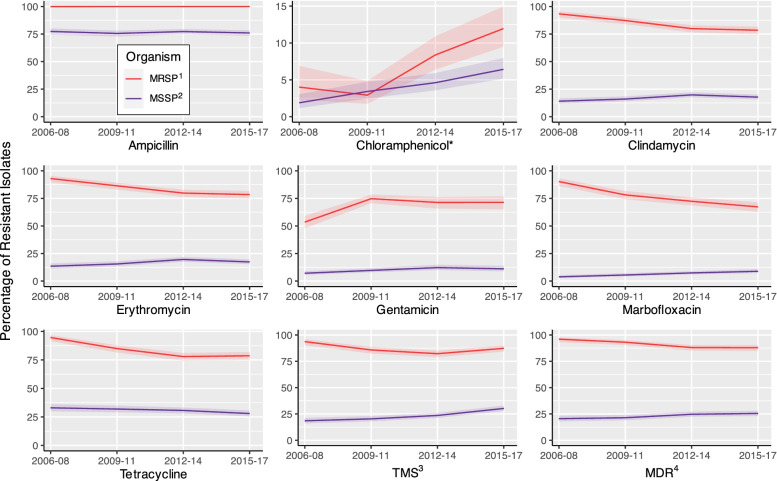
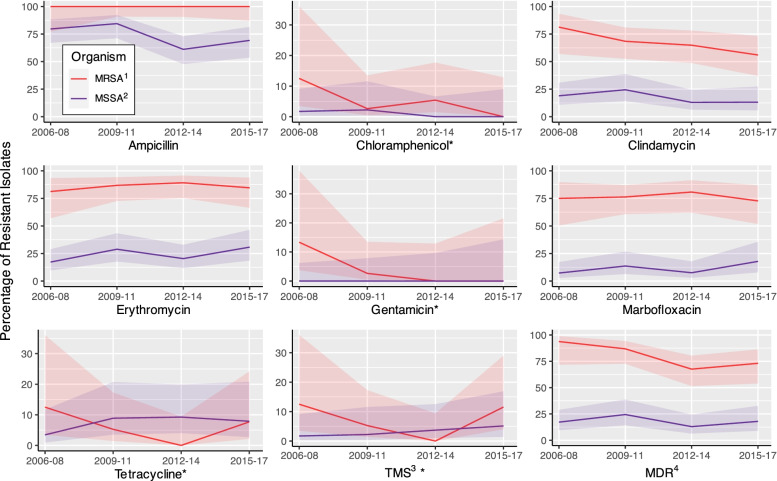
Most of the 7805 isolates were S. pseudintermedius (6453 isolates), followed by S. coagulans (860), S. aureus (330), and S. schleiferi (162). Among S. pseudintermedius isolates, 45.5% were MDR, and 30.8% were methicillin-resistant (MRSP). There was a significant temporal increase in MRSP (p = 0.017). Chloramphenicol resistance increased among both MRSP and methicillin-susceptible (MSSP) isolates (p < 0.0001). Among S. aureus isolates, 40.9% were MDR, 37.4% were methicillin-resistant (MRSA), and the proportion of MRSA isolates increased significantly (p = 0.0480) over time. There was an increasing temporal trend in the proportion of MDR isolates among MSSP (p = 0.0022), but a decrease among MRSP (p < 0.0001) and MRSA (p = 0.0298). S. schleiferi had the highest percentage (56.9%) of methicillin-resistant isolates. Oxacillin disk diffusion was superior to cefoxitin for the detection of mecA-mediated resistance and had almost perfect agreement with mecA PCR assay for S. pseudintermedius (95.4% agreement, kappa (κ) = 0.904; p < 0.0001), S. coagulans (95.6%, κ = 0.913; p < 0.0001) and S. schleiferi (97.7%, κ = 0.945; p < 0.0001). However, cefoxitin disk diffusion was superior to oxacillin disk diffusion and had almost perfect agreement with mecA PCR assay for S. aureus (95.3%, κ = 0.834; p < 0.0001).
The levels of resistance and increasing temporal trends are concerning. These findings have implications for treatment decisions and public health due to the zoonotic potential of staphylococci. Continued surveillance and use of antibiograms to guide clinical decisions will be critical.
耐多药和耐甲氧西林葡萄球菌因其潜在的人畜共患病风险,既是兽医也是公共卫生关注的问题。因此,本研究的目的是调查在田纳西大学兽医学院临床细菌学实验室从犬临床标本中分离出的四种常见葡萄球菌属(金黄色葡萄球菌、凝固酶阴性葡萄球菌、表皮葡萄球菌和中间葡萄球菌)中抗菌药物、多药和耐甲氧西林耐药的模式。
从 2006 年 1 月 1 日至 2017 年 12 月 31 日,从 UTCVM 临床细菌学实验室获得了四种常见葡萄球菌属分离株的抗菌药物敏感性试验和 mecA 聚合酶链反应(PCR)结果。Cochran-Armitage 趋势检验用于评估抗菌药物耐药性(AMR)、多药耐药性(MDR)和耐甲氧西林耐药性的时间趋势。Kappa 检验用于评估 PCR 和纸片扩散试验结果之间的一致性。
在 7805 株分离株中,大多数为中间葡萄球菌(6453 株),其次是凝固酶阴性葡萄球菌(860 株)、金黄色葡萄球菌(330 株)和施氏葡萄球菌(162 株)。在中间葡萄球菌分离株中,45.5%为多药耐药,30.8%为耐甲氧西林(MRSP)。MRSP 呈显著的时间性增加(p=0.017)。氯霉素耐药性在 MRSP 和甲氧西林敏感(MSSP)分离株中均增加(p<0.0001)。在金黄色葡萄球菌分离株中,40.9%为多药耐药,37.4%为耐甲氧西林(MRSA),MRSA 分离株的比例显著增加(p=0.0480)。MSSP 中 MDR 分离株的比例呈时间性增加趋势(p=0.0022),但 MRSP(p<0.0001)和 MRSA(p=0.0298)的比例下降。施氏葡萄球菌的耐甲氧西林分离株比例最高(56.9%)。与头孢西丁相比,苯唑西林纸片扩散法更能检测 mecA 介导的耐药性,并且与中间葡萄球菌的 mecA PCR 检测具有几乎完美的一致性(95.4%的一致性,kappa(κ)=0.904;p<0.0001)、凝固酶阴性葡萄球菌(95.6%,κ=0.913;p<0.0001)和施氏葡萄球菌(97.7%,κ=0.945;p<0.0001)。然而,头孢西丁纸片扩散法优于苯唑西林纸片扩散法,与 mecA PCR 检测在金黄色葡萄球菌中具有几乎完美的一致性(95.3%,κ=0.834;p<0.0001)。
耐药水平和时间趋势令人担忧。由于葡萄球菌属的人畜共患病潜力,这些发现对治疗决策和公共卫生具有重要意义。继续进行监测并使用抗生素谱来指导临床决策至关重要。