Ramkumar Vijayan Sri, Pugazhendhi Arivalagan, Gopalakrishnan Kumar, Sivagurunathan Periyasamy, Saratale Ganesh Dattatraya, Dung Thi Ngoc Bao, Kannapiran Ethiraj
Department of Environmental Biotechnology, School of Environmental Sciences, Bharathidasan University, Tiruchirappalli, 620024, Tamil Nadu, India.
Department of Environmental Engineering, Daegu University, Gyeongbuk 712-714, Republic of Korea.
Biotechnol Rep (Amst). 2017 Feb 10;14:1-7. doi: 10.1016/j.btre.2017.02.001. eCollection 2017 Mar.
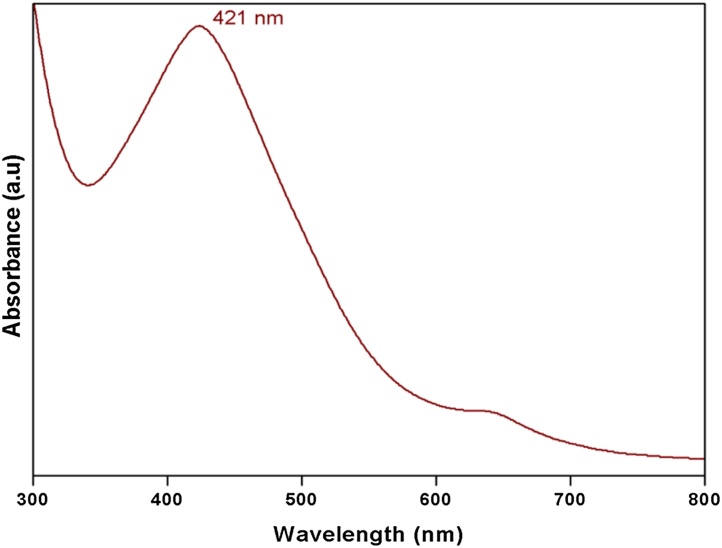
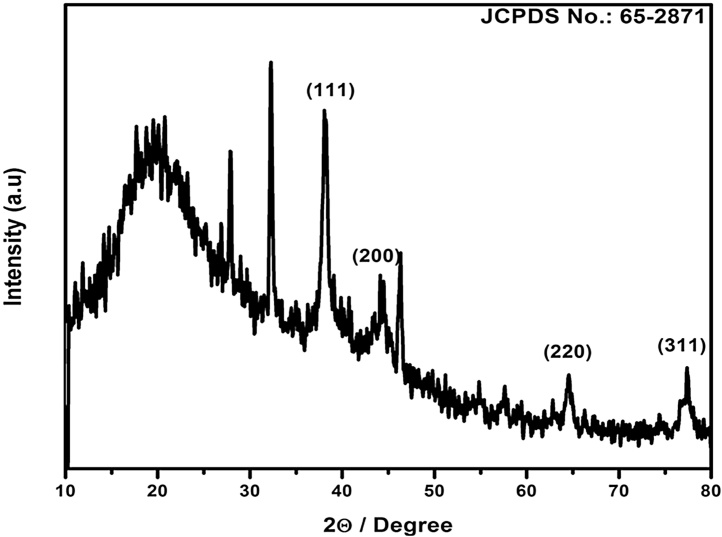
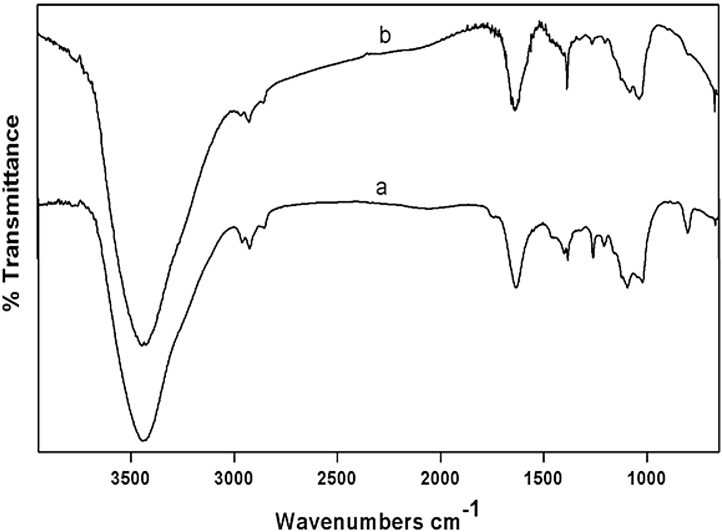
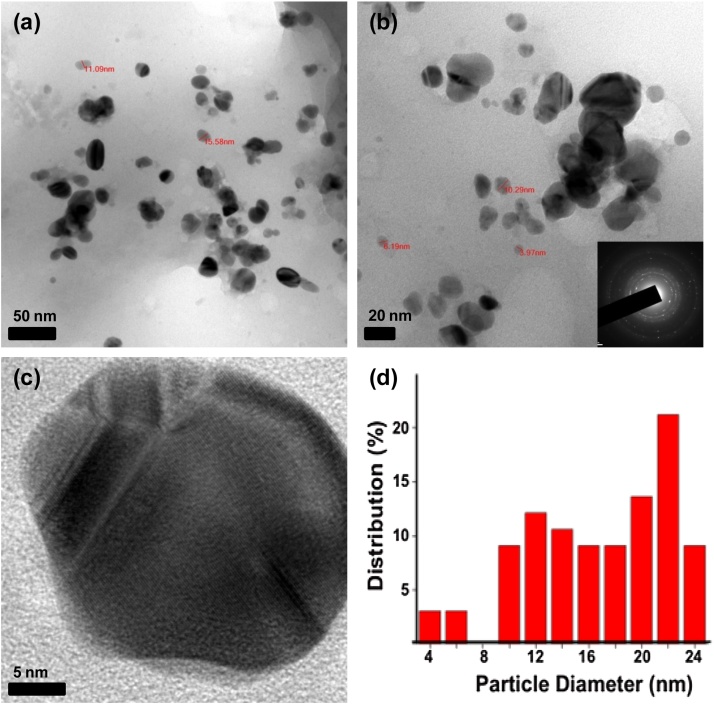
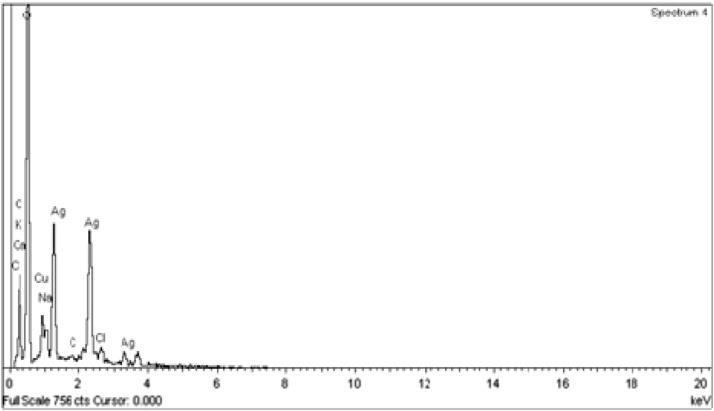
Green synthesis of nanoparticles using seaweeds are fascinating high research attention nowadays and also gaining center of attention in biomedical applications. In this work, we have synthesized biocompatible and functionalized silver nanoparticles using an aqueous extract of seaweed as a reducing as well as stabilizing agent and their efficient antimicrobial and anticancer activity are reported here. The UV-vis spectra of AgNPs showed the characteristics SPR absorption band at 421 nm. The chemical interaction and crystalline nature of the AgNPs were evaluated by FT-IR and XRD studies. The XRD result of AgNPs shows typical Ag reflection peaks at 38.1°, 44.2°, 64.4° and 77.1° corresponding to (111), (200), (220) and (311) Bragg's planes. The surface morphology and composition of the samples were observed by HRTEM, EDS and SAED pattern analyses. Spherical shaped Ag nano structures were observed in the size ranges between 4 and 24 nm with clear lattice fringes in the HRTEM image. This report reveals that seaweed mediated synthesis of AgNPs and sustained delivery of Ag ions to the bacterial and fungal surface have been reducing their growth rate which was evaluated by well diffusion assay. The synthesized AgNPs showed favorable cytotoxicity against Ehlrich Ascites Carcinoma (EAC) cells with IC value was recorded at 95.35 μg mL. This study showed cost effective silver nanoparticles synthesis with excellent biocompatibility and thus could potentially be utilized in biomedical and pharmaceutical applications.
利用海藻进行纳米粒子的绿色合成如今备受关注,在生物医学应用中也日益成为焦点。在这项工作中,我们使用海藻水提取物作为还原剂和稳定剂合成了具有生物相容性和功能化的银纳米粒子,并在此报告了它们高效的抗菌和抗癌活性。AgNPs的紫外可见光谱在421nm处显示出特征性的表面等离子体共振吸收带。通过傅里叶变换红外光谱(FT-IR)和X射线衍射(XRD)研究评估了AgNPs的化学相互作用和晶体性质。AgNPs的XRD结果显示在38.1°、44.2°、64.4°和77.1°处有典型的Ag反射峰,分别对应于(111)、(200)、(220)和(311)布拉格平面。通过高分辨率透射电子显微镜(HRTEM)、能谱仪(EDS)和选区电子衍射(SAED)图案分析观察了样品的表面形态和组成。在HRTEM图像中观察到尺寸范围在4至24nm之间的球形Ag纳米结构,具有清晰的晶格条纹。本报告表明,海藻介导的AgNPs合成以及Ag离子向细菌和真菌表面的持续递送降低了它们的生长速率,这通过琼脂扩散试验进行了评估。合成的AgNPs对艾氏腹水癌(EAC)细胞显示出良好的细胞毒性,IC值记录为95.35μg/mL。这项研究表明银纳米粒子的合成具有成本效益且具有优异的生物相容性,因此有可能用于生物医学和制药应用。