Viscardi Abbie V, Hunniford Michelle, Lawlis Penny, Leach Matthew, Turner Patricia V
Department of Pathobiology, University of Guelph, Guelph, ON, Canada.
Department of Animal Biosciences, University of Guelph, Guelph, ON, Canada.
Front Vet Sci. 2017 Apr 18;4:51. doi: 10.3389/fvets.2017.00051. eCollection 2017.
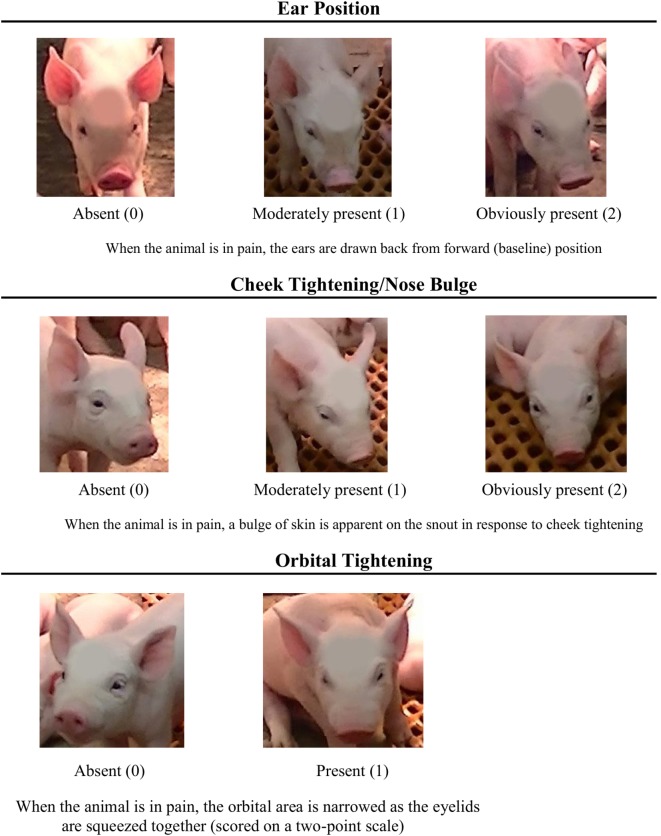
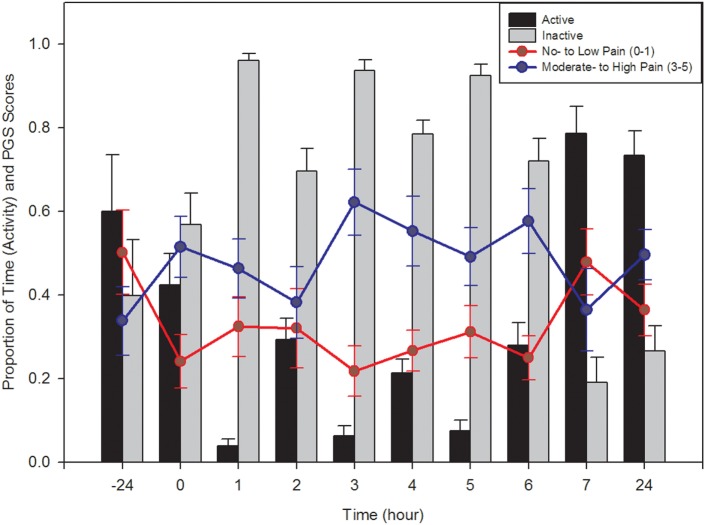
Facial expressions are increasingly being used to assess pain in non-human species, including rodents, horses, and lambs. The development of these species-specific grimace scales has allowed for more rapid pain detection, which can lead to better animal welfare if intervention promptly occurs. For grimace scales to ever be used as a stand-alone measure of pain, it is important they correlate with established pain assessment tools, such as behavioral analysis. This preliminary study aimed to determine whether piglets exhibit pain grimacing and if these facial expressions correlate with their behavior. It also assessed and compared the behavior of boar piglets given an analgesic and topical anesthetic prior to surgical castration and tail docking to piglets that did not receive anything for pain relief. Five-day-old male Yorkshire piglets ( = 19) from four pens were randomly assigned, within their pen, to one of five possible treatments: meloxicam (0.4 mg/kg, intramuscularly) + EMLA cream, meloxicam (0.4 mg/kg, intramuscularly) + non-medicated cream, saline (intramuscularly) + EMLA cream, saline (intramuscularly) + non-medicated cream, or no treatment prior to surgical castration and tail docking. Piglet behaviors were video recorded for 8 h immediately after castration, as well as for 1 h at 24 h pre- and post-castration. Their individual behaviors were scored continuously for the first 15 min of every hour of video collected. Facial images were also captured across all time points. A Piglet Grimace Scale (PGS) was developed and used by two observers blinded to treatment, time, and procedure to score over 600 piglet faces. All piglets displayed significant behavioral changes up to 7 h post-castration when compared to baseline, and the use of meloxicam and EMLA cream was not associated with a reduction in painful behaviors. Significantly higher PGS scores were noted at 0, 3, 4, and 5 h post-castration when compared to PGS scores at 7 h and there was no effect of treatment. PGS scores significantly correlated with piglet behavioral activity. The results suggest that the PGS may have utility for pain evaluation in neonatal pigs.
面部表情越来越多地被用于评估包括啮齿动物、马和羔羊在内的非人类物种的疼痛。这些针对特定物种的痛苦表情量表的开发使得能够更快地检测疼痛,如果能及时进行干预,这将有助于提高动物福利。为了使痛苦表情量表能够作为一种独立的疼痛测量方法,重要的是它们要与既定的疼痛评估工具(如行为分析)相关联。这项初步研究旨在确定仔猪是否会表现出痛苦的面部表情,以及这些面部表情是否与其行为相关。研究还评估并比较了在进行手术阉割和断尾前接受镇痛剂和局部麻醉剂的公猪仔猪与未接受任何疼痛缓解措施的仔猪的行为。来自四个猪栏的19头5日龄雄性约克夏仔猪在其猪栏内被随机分配到五种可能的处理之一:美洛昔康(0.4mg/kg,肌肉注射)+复方利多卡因乳膏,美洛昔康(0.4mg/kg,肌肉注射)+无药乳膏,生理盐水(肌肉注射)+复方利多卡因乳膏,生理盐水(肌肉注射)+无药乳膏,或在手术阉割和断尾前不进行处理。在阉割后立即对仔猪行为进行8小时的视频记录,并在阉割前24小时和阉割后1小时进行1小时的记录。在收集的每小时视频的前15分钟内对它们的个体行为进行连续评分。在所有时间点也采集了面部图像。由两名对处理、时间和程序不知情的观察者开发并使用仔猪痛苦表情量表(PGS)对600多张仔猪面部进行评分。与基线相比,所有仔猪在阉割后7小时内均表现出显著的行为变化,并且使用美洛昔康和复方利多卡因乳膏与疼痛行为的减少无关。与7小时时的PGS评分相比,在阉割后0、3、4和5小时时PGS评分显著更高,且处理没有影响。PGS评分与仔猪行为活动显著相关。结果表明,PGS可能对新生仔猪的疼痛评估有用。