Viscardi Abbie V, Turner Patricia V
Department of Pathobiology, University of Guelph, Guelph, ON, Canada.
Front Vet Sci. 2018 Nov 26;5:299. doi: 10.3389/fvets.2018.00299. eCollection 2018.
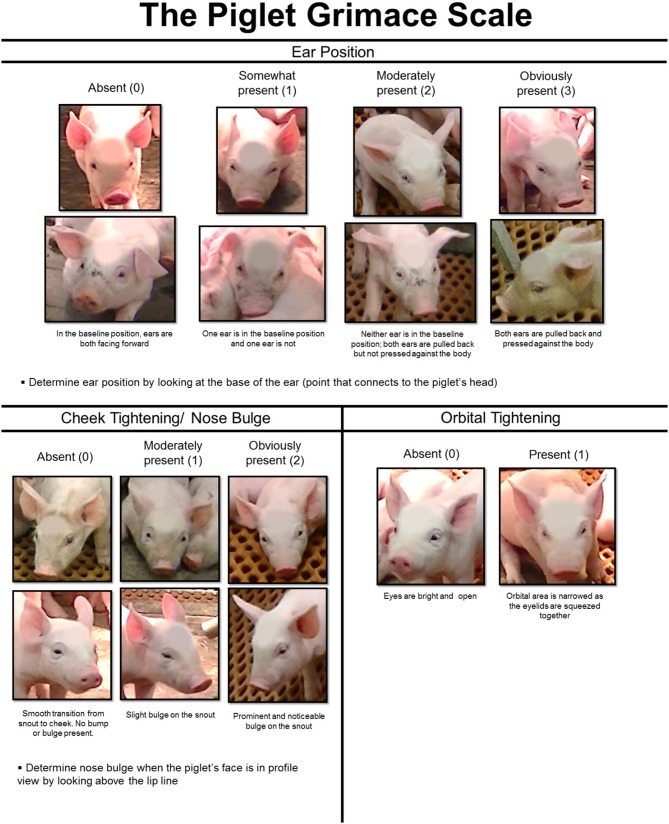
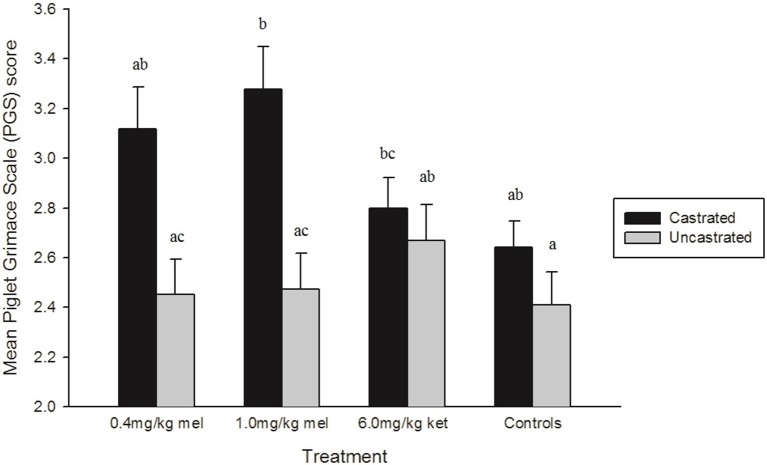
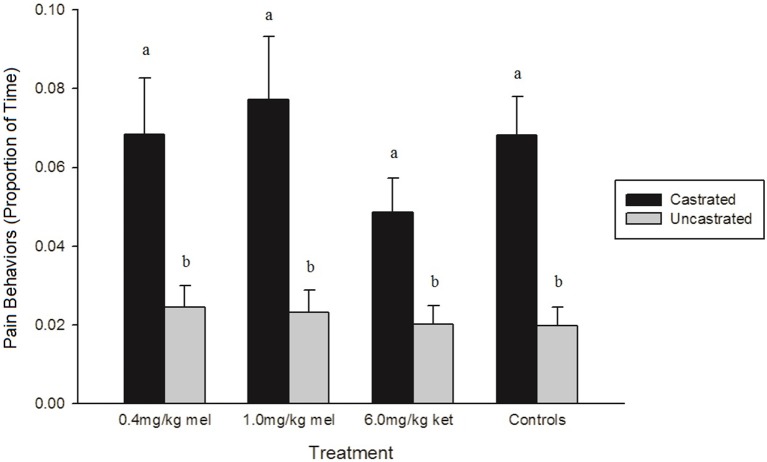
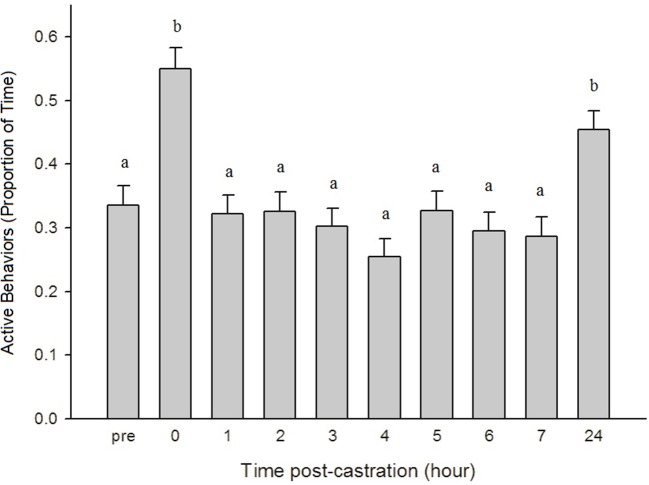
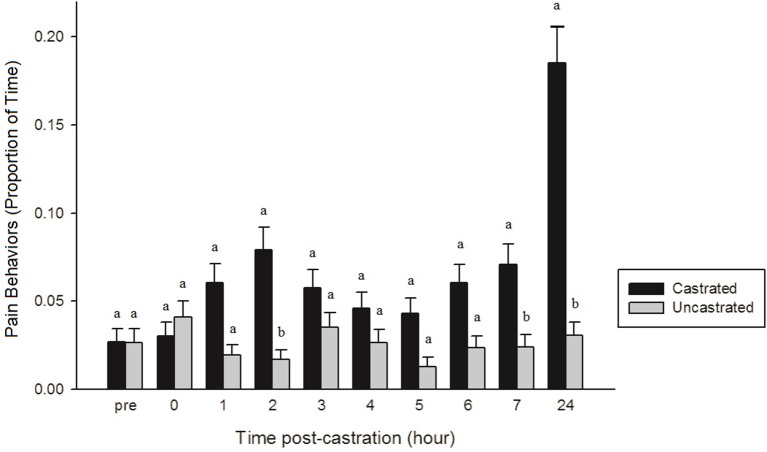
Surgical castration of piglets is performed routinely on commercial pig farms, to prevent boar taint and minimize aggression. While this procedure is known to be painful, piglets are generally not provided any analgesic for pain relief, leading to welfare concerns. The objectives of this study were to assess the efficacy of two non-steroidal anti-inflammatory drugs (NSAIDs), meloxicam (MEL) (0.4 mg/kg or 1.0 mg/kg) and ketoprofen (KET) (6.0 mg/kg) in reducing behavioral indicators of pain in castrated piglets. This study also examined the utility of the Piglet Grimace Scale (PGS) as a pain assessment tool. Nineteen litters of 5-days-old male piglets ( = 120) were used and piglets within a litter were randomly assigned to one of eight possible treatments: 0.4 mg/kg MEL-castrated or uncastrated, 1.0 mg/kg MEL-castrated or uncastrated, 6.0 mg/kg KET-castrated or uncastrated, saline (castrated control), or sham (uncastrated control). Treatments were administered intramuscularly (IM) 20 min prior to surgical castration. Piglets were video recorded for 1 h pre-procedure, for 8 h immediately post-castration and for another hour, 24 h post-procedure. Twenty-one behaviors and postures were scored continuously for the first 15 min of each hour and 1,156 still images of piglet faces were collected and scored using the PGS. Within each treatment group post-castration, castrated piglets displayed significantly more pain-related behaviors than uncastrated piglets (0.4 mg/kg MEL: = 0.0339, 1.0 mg/kg MEL: = 0.0079, 6.0 mg/kg KET: = 0.0034, Controls: < 0.0001). Castrated piglets also grimaced significantly more post-procedure than uncastrated piglets ( = 0.0061). Compared to the castrated control, none of the NSAID treatments significantly reduced piglet pain behaviors (0.4 mg/kg MEL: = 1.0000, 1.0 mg/kg MEL: = 0.9995, 6.0 mg/kg KET: = 0.4163) or facial grimacing. Piglets demonstrated significantly more pain behaviors 24 h post-castration than at all other time points ( < 0.0001). The PGS was a less effective measure to detect acute pain; however, our findings suggest it does have utility as a pain assessment tool in neonatal pigs. Our findings also indicate that the use of these NSAIDs were ineffective at alleviating castration-associated pain in piglets.
在商业养猪场,仔猪去势手术通常是常规操作,目的是防止公猪异味并尽量减少攻击行为。虽然已知该手术会带来疼痛,但仔猪一般未接受任何缓解疼痛的镇痛药物,这引发了对动物福利的关注。本研究的目的是评估两种非甾体抗炎药(NSAIDs),即美洛昔康(MEL)(0.4毫克/千克或1.0毫克/千克)和酮洛芬(KET)(6.0毫克/千克)在减轻去势仔猪疼痛行为指标方面的效果。本研究还考察了仔猪面部表情评分量表(PGS)作为疼痛评估工具的效用。使用了19窝5日龄雄性仔猪(n = 120),一窝内的仔猪被随机分配到八种可能的处理之一:0.4毫克/千克MEL - 去势或未去势、1.0毫克/千克MEL - 去势或未去势、6.0毫克/千克KET - 去势或未去势、生理盐水(去势对照)或假手术(未去势对照)。在手术去势前20分钟肌肉注射给药。在手术前1小时对仔猪进行视频记录,去势后立即记录8小时,手术后24小时再记录1小时。每小时的前15分钟连续对21种行为和姿势进行评分,并收集1156张仔猪面部静止图像,使用PGS进行评分。在每个处理组去势后,去势仔猪表现出的疼痛相关行为明显多于未去势仔猪(0.4毫克/千克MEL:P = 0.0339,1.0毫克/千克MEL:P = 0.0079,6.0毫克/千克KET:P = 0.0034,对照组:P < 0.0001)。去势仔猪在手术后的面部表情痛苦程度也明显高于未去势仔猪(P = 0.0061)。与去势对照组相比,没有一种NSAIDs处理能显著降低仔猪的疼痛行为(0.4毫克/千克MEL:P = 1.0000,1.0毫克/千克MEL:P = 0.9995,6.0毫克/千克KET:P = 0.4163)或面部痛苦表情。去势后24小时仔猪表现出的疼痛行为明显多于其他所有时间点(P < 0.0001)。PGS在检测急性疼痛方面效果较差;然而,我们的研究结果表明它在新生仔猪中作为疼痛评估工具确实有用。我们的研究结果还表明,使用这些NSAIDs在减轻仔猪去势相关疼痛方面无效。