Castro Lauren A, Fox Spencer J, Chen Xi, Liu Kai, Bellan Steven E, Dimitrov Nedialko B, Galvani Alison P, Meyers Lauren Ancel
Department of Integrative Biology, The University of Texas at Austin, Austin, TX, USA.
Graduate Program in Operations Research and Industrial Engineering, The University of Texas at Austin, Austin, TX, USA.
BMC Infect Dis. 2017 May 4;17(1):284. doi: 10.1186/s12879-017-2394-9.
Confirmed local transmission of Zika Virus (ZIKV) in Texas and Florida have heightened the need for early and accurate indicators of self-sustaining transmission in high risk areas across the southern United States. Given ZIKV's low reporting rates and the geographic variability in suitable conditions, a cluster of reported cases may reflect diverse scenarios, ranging from independent introductions to a self-sustaining local epidemic.
We present a quantitative framework for real-time ZIKV risk assessment that captures uncertainty in case reporting, importations, and vector-human transmission dynamics.
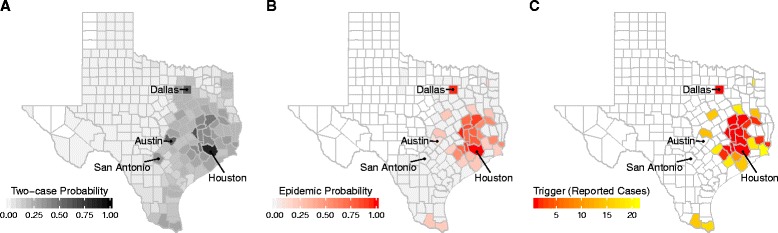
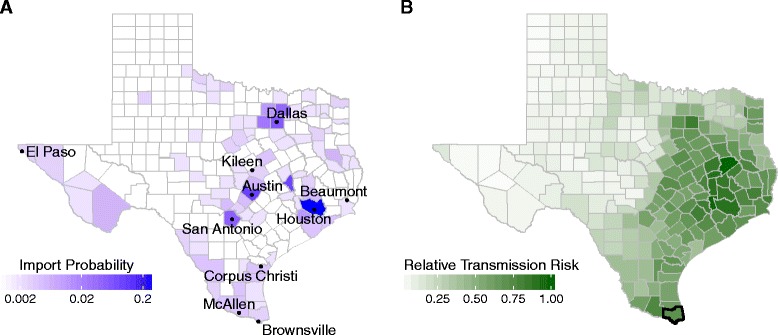
We assessed county-level risk throughout Texas, as of summer 2016, and found that importation risk was concentrated in large metropolitan regions, while sustained ZIKV transmission risk is concentrated in the southeastern counties including the Houston metropolitan region and the Texas-Mexico border (where the sole autochthonous cases have occurred in 2016). We found that counties most likely to detect cases are not necessarily the most likely to experience epidemics, and used our framework to identify triggers to signal the start of an epidemic based on a policymakers propensity for risk.
This framework can inform the strategic timing and spatial allocation of public health resources to combat ZIKV throughout the US, and highlights the need to develop methods to obtain reliable estimates of key epidemiological parameters.
寨卡病毒(ZIKV)在得克萨斯州和佛罗里达州的本地传播得到确认,这凸显了在美国南部高风险地区建立早期且准确的自我持续传播指标的必要性。鉴于寨卡病毒的低报告率以及适宜条件的地理变异性,一组报告病例可能反映出多种情况,从独立输入到自我持续的本地疫情。
我们提出了一个用于寨卡病毒实时风险评估的定量框架,该框架考虑了病例报告、输入以及病媒-人类传播动态中的不确定性。
我们评估了截至2016年夏季得克萨斯州各县的风险,发现输入风险集中在大型都市地区,而寨卡病毒的持续传播风险集中在包括休斯顿都市地区和得克萨斯-墨西哥边境在内的东南部各县(2016年唯一的本土病例就发生在此处)。我们发现最有可能检测到病例的县不一定是最有可能经历疫情的县,并利用我们的框架根据政策制定者的风险倾向确定了预示疫情开始的触发因素。
该框架可为美国各地抗击寨卡病毒的公共卫生资源的战略时机和空间分配提供参考,并突出了开发方法以获得关键流行病学参数可靠估计值的必要性。