Xiao Ting, Chen Li-Ping, Zhang Li-Hua, Lai Fu-Huang, Zhang Li, Qiu Qun-Feng, Que Rong-Liang, Xie SiSi, Wu Ding-Chang
Department of Clinical Laboratory Department of Neonatal Unit, Fujian Longyan First Hospital, Longyan First Affiliated Hospital of Fujian Medical University, Longyan, Fujian, China.
Medicine (Baltimore). 2017 May;96(18):e6823. doi: 10.1097/MD.0000000000006823.
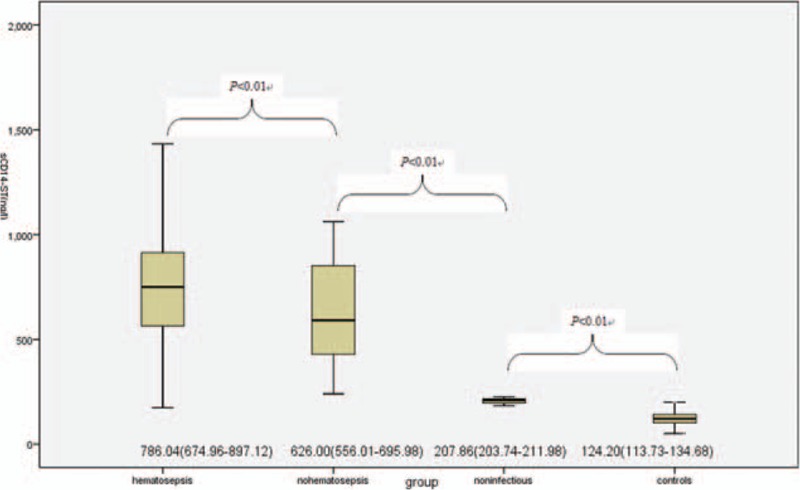
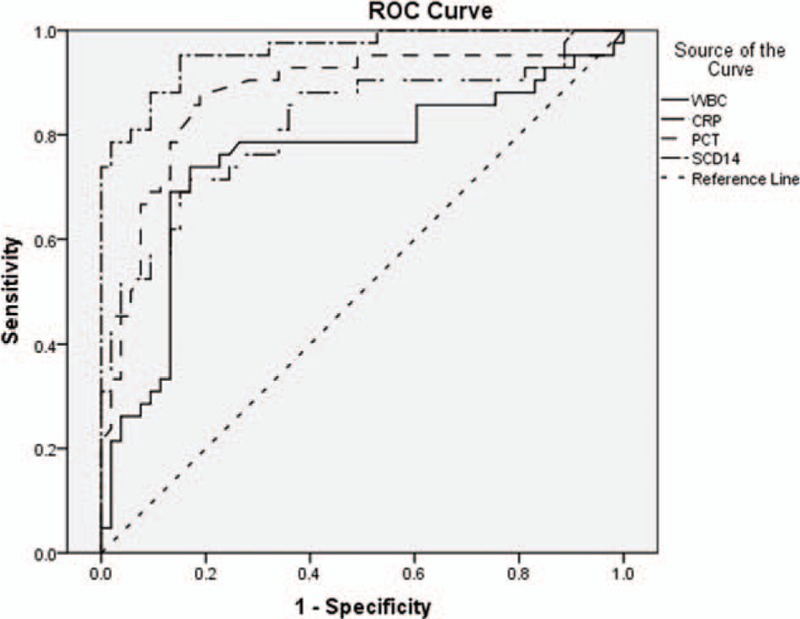
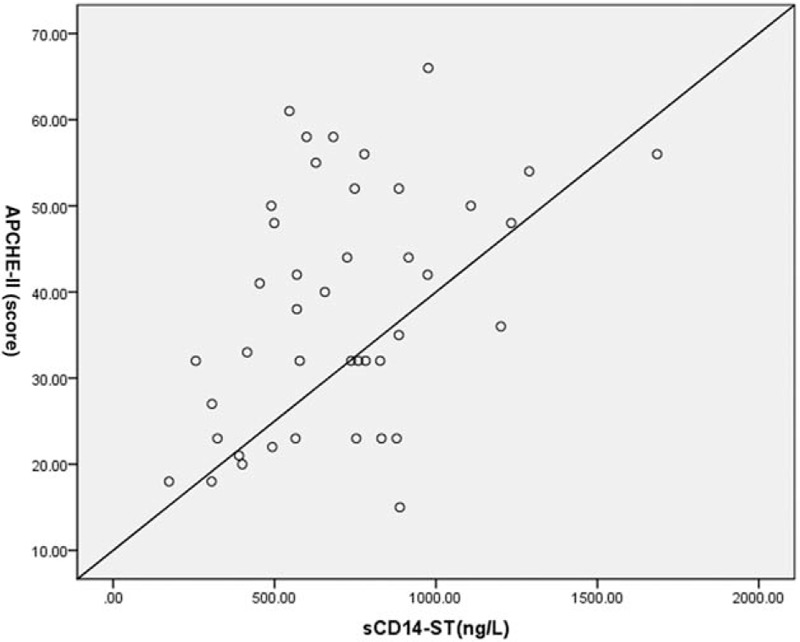
Hematosepsis is a systemic inflammatory response syndrome (SIRS) with suspected or confirmed infection, which is the most common infectious disease in clinical neonatal intensive care unit. As the rapid development of neonatal hematosepsis caused by various basic diseases, the mortality rate is high, and there are some sequelae.We report the lasted study to date with 96 cases from Fujian Longyan First Hospital between 2013 and 2015. The aim of our study is to explore the value of soluble cluster of differentiation 14 subtype (sCD14-ST) in whole blood for differential diagnosis of neonatal hematosepsis at an early stage, and used in evaluation of the severity about sepsis combined with acute physiology and chronic health evaluation II (APACHE-II) score, procalcitonin (PCT), C reactive protein (CRP), and leukocyte (WBC).In our cohort, all cases met the diagnostic criteria for hematosepsis specific for newborns. We selected 42 neonates with hematosepsis, 54 neonates with nonhematosepsis, 44 noninfectious SIRS neonates, and 53 healthy neonatal controls. Which were determined the sCD14-ST, PCT, CRP, and WBC of all samples before treatment. Then assign the APACHE-II score for the all samples before and after treatment.The study shows, sCD14-ST levels were significantly higher in hematosepsis than nonhematosepsis group (t = -2.112, P = .041). Meanwhile, sCD14-ST levels were significantly higher in neonatal hematosepsis than in noninfectious SIRS group and controls (χ = 57.812, 68.944, P < .01). However, sCD14-ST in hematosepsis group was positively correlated with APACHE-II score (R-value = 0.415, P < .01). During treatment, the sCD14-ST level was decreased obviously along with APACHE-II score, PCT, CRP, and WBC (χ = 35.019, 78.399, 52.363, 25.912, 7.252, all P values <.01). The area under the curve (AUC) of sCD14-ST was 0.942. The differences in ROC of sCD14-ST compared with PCT, CRP, and WBC were statistically significant (Z = -6.034, -4.474, -5.722, all P values <.01). The sensitivity and specificity of sCD14-ST were 95.2% and 84.9%, respectively.sCD14-ST could be a blood biomarker for early identification and disease valuation in newborns hematosepsis infection; and its diagnostic value is superior to other laboratory indexes.
血液感染是一种伴有疑似或确诊感染的全身炎症反应综合征(SIRS),是临床新生儿重症监护病房中最常见的感染性疾病。随着由各种基础疾病引起的新生儿血液感染迅速发展,其死亡率很高,并且存在一些后遗症。我们报告了迄今为止对2013年至2015年间福建龙岩市第一医院96例病例的最新研究。我们研究的目的是探讨全血中可溶性分化簇14亚型(sCD14-ST)在早期鉴别诊断新生儿血液感染中的价值,并将其用于联合急性生理学与慢性健康状况评价II(APACHE-II)评分、降钙素原(PCT)、C反应蛋白(CRP)和白细胞(WBC)评估败血症的严重程度。在我们的队列中,所有病例均符合新生儿血液感染的诊断标准。我们选取了42例血液感染新生儿、54例非血液感染新生儿、44例非感染性SIRS新生儿和53例健康新生儿对照。在治疗前测定所有样本的sCD14-ST、PCT、CRP和WBC。然后对所有样本在治疗前后进行APACHE-II评分。研究表明,血液感染组的sCD14-ST水平显著高于非血液感染组(t = -2.112,P = 0.041)。同时,新生儿血液感染组的sCD14-ST水平显著高于非感染性SIRS组和对照组(χ = 57.812,68.944,P < 0.01)。然而,血液感染组的sCD14-ST与APACHE-II评分呈正相关(R值 = 0.415,P < 0.01)。在治疗期间,sCD14-ST水平随着APACHE-II评分、PCT、CRP和WBC明显下降(χ = 35.019,78.399,52.363,25.912,7.252,所有P值 < 0.01)。sCD14-ST的曲线下面积(AUC)为0.942。sCD14-ST与PCT、CRP和WBC的ROC曲线差异具有统计学意义(Z = -6.034,-4.474,-5.722,所有P值 < 0.01)。sCD14-ST的敏感性和特异性分别为95.2%和84.9%。sCD14-ST可能是新生儿血液感染性疾病早期识别和病情评估的血液生物标志物;并且其诊断价值优于其他实验室指标。