Noguerales Víctor, Cordero Pedro J, Ortego Joaquín
Grupo de Investigación de la Biodiversidad Genética y Cultural Instituto de Investigación en Recursos Cinegéticos - IREC (CSIC, UCLM, JCCM) Ciudad Real Spain.
Department of Integrative Ecology Estación Biológica de Doñana (EBD-CSIC) Seville Spain.
Ecol Evol. 2017 Mar 30;7(9):3110-3122. doi: 10.1002/ece3.2810. eCollection 2017 May.
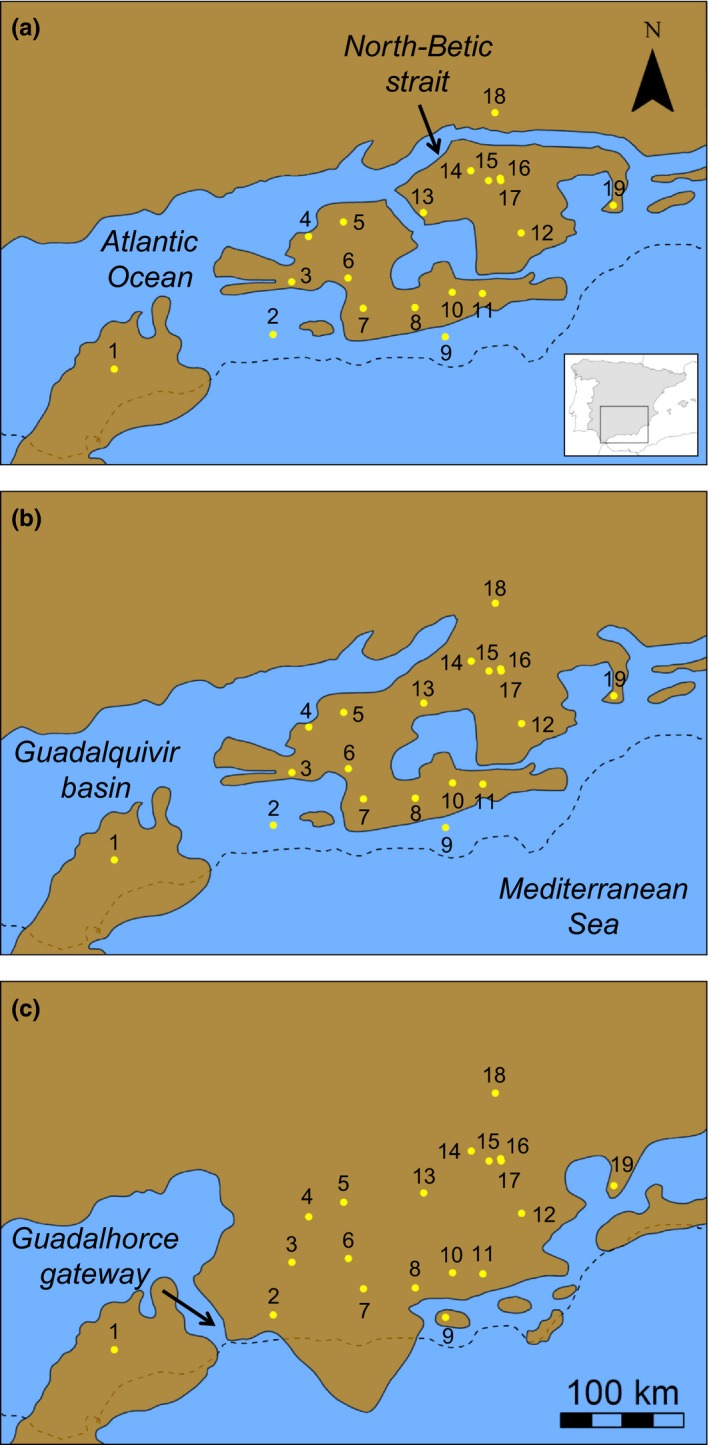
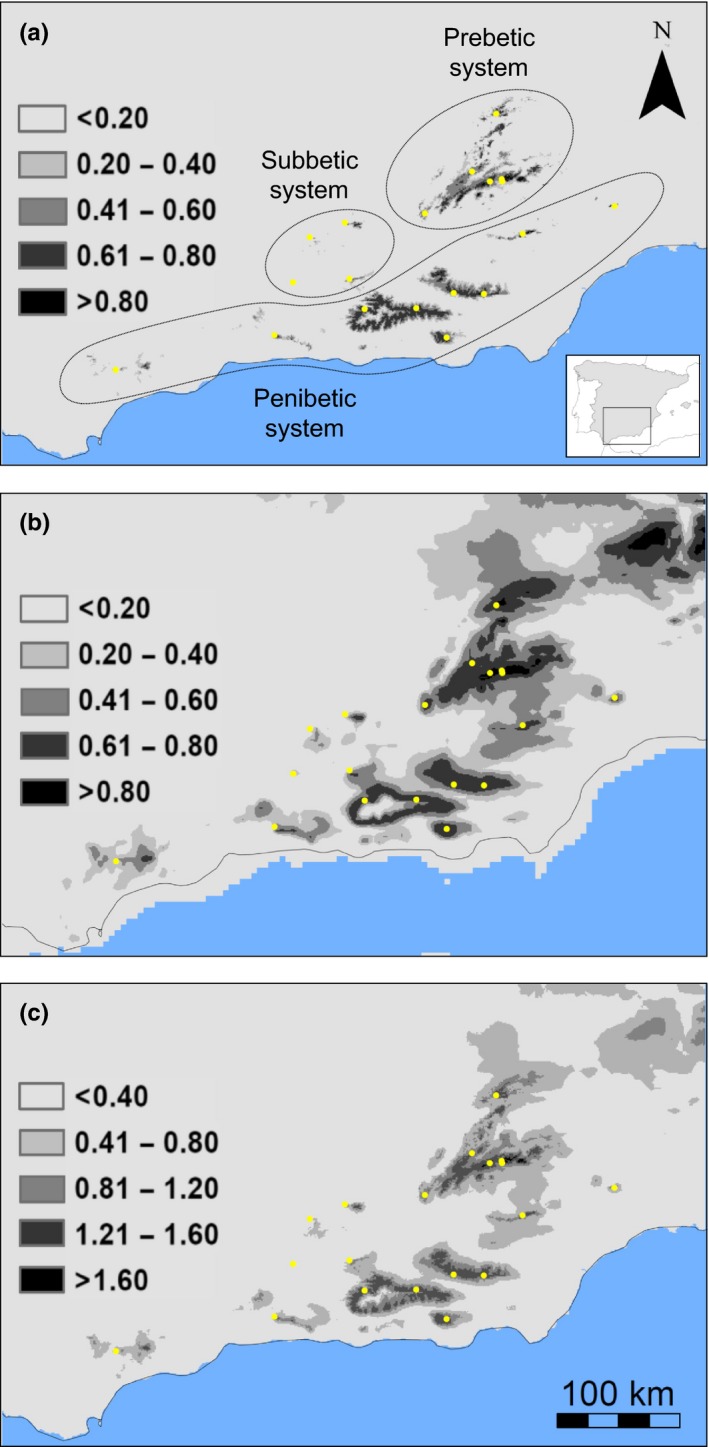
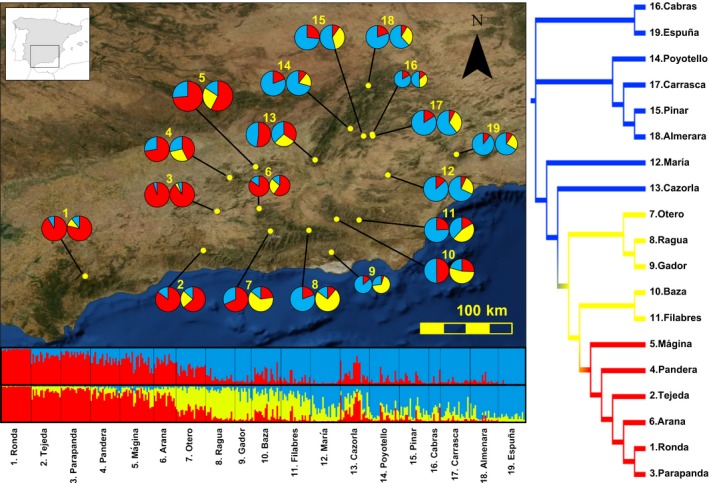
Understanding the processes underlying spatial patterns of genetic diversity and structure of natural populations is a central topic in evolutionary biogeography. In this study, we combine data on ancient and contemporary landscape composition to get a comprehensive view of the factors shaping genetic variation across the populations of the scrub-legume grasshopper () from the biogeographically complex region of southeast Iberia. First, we examined geographical patterns of genetic structure and employed an approximate Bayesian computation (ABC) approach to compare different plausible scenarios of population divergence. Second, we used a landscape genetic framework to test for the effects of (1) Late Miocene paleogeography, (2) Pleistocene climate fluctuations, and (3) contemporary topographic complexity on the spatial patterns of population genetic differentiation. Genetic structure and ABC analyses supported the presence of three genetic clusters and a sequential west-to-east splitting model that predated the last glacial maximum (LGM, . 21 Kya). Landscape genetic analyses revealed that population genetic differentiation was primarily shaped by contemporary topographic complexity, but was not explained by any paleogeographic scenario or resistance distances based on climate suitability in the present or during the LGM. Overall, this study emphasizes the need of integrating information on ancient and contemporary landscape composition to get a comprehensive view of their relative importance to explain spatial patterns of genetic variation in organisms inhabiting regions with complex biogeographical histories.
理解自然种群遗传多样性和结构的空间模式背后的过程是进化生物地理学的核心主题。在本研究中,我们结合古代和当代景观组成的数据,以全面了解塑造伊比利亚东南部生物地理复杂地区豆科灌丛蝗虫()种群间遗传变异的因素。首先,我们研究了遗传结构的地理模式,并采用近似贝叶斯计算(ABC)方法来比较种群分化的不同合理情景。其次,我们使用景观遗传学框架来测试(1)晚中新世古地理学、(2)更新世气候波动和(3)当代地形复杂性对种群遗传分化空间模式的影响。遗传结构和ABC分析支持存在三个遗传簇以及一个早于末次盛冰期(LGM,约21千年前)的从西到东的连续分裂模型。景观遗传学分析表明,种群遗传分化主要受当代地形复杂性的影响,但不受任何古地理情景或基于当前或末次盛冰期气候适宜性的抗性距离的影响。总体而言,本研究强调需要整合古代和当代景观组成的信息,以全面了解它们对于解释具有复杂生物地理历史地区生物遗传变异空间模式的相对重要性。