Lehrstuhl für Physikalische Chemie 2, Ruhr-Universität Bochum, 44801, Bochum, Germany.
Angew Chem Int Ed Engl. 2017 Aug 7;56(33):9981-9985. doi: 10.1002/anie.201612162. Epub 2017 Jul 13.
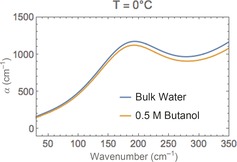
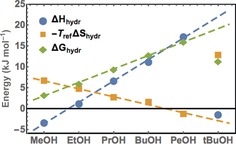
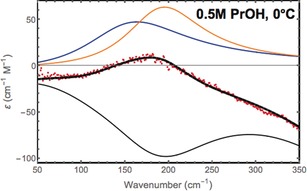
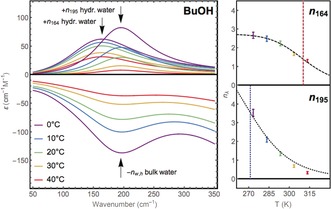
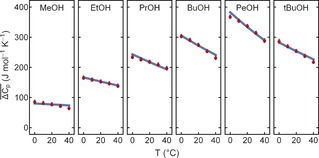
THz spectroscopy was used to probe changes that occur in the dynamics of the hydrogen bond network upon solvation of alcohol chains. The THz spectra can be decomposed into the spectrum of bulk water, tetrahedral hydration water, and more disordered (or interstitial) hydration water. The tetrahedrally ordered hydration water exhibits a band at 195 cm and is localized around the hydrophobic moiety of the alcohol. The interstitial component yields a band at 164 cm which is associated with hydration water in the first hydration shell. These temperature-dependent changes in the low-frequency spectrum of solvated alcohol chains can be correlated with changes of heat capacity, entropy, and free energy upon solvation. Surprisingly, not the tetrahedrally ordered component but the interstitial hydration water is found to be mainly responsible for the temperature-dependent change in ΔC and ΔG. The solute-specific offset in free energy is attributed to void formation and scales linearly with the chain length.
太赫兹光谱被用于探测在醇链溶剂化过程中氢键网络动力学发生的变化。太赫兹光谱可以分解为体相水、四面体形水合水和更无序(或间隙)水合水的光谱。四面体有序水合水在 195 cm 处表现出一个谱带,并且定位于醇的疏水性部分周围。间隙成分在 164 cm 处产生一个谱带,该谱带与第一水合壳层中的水合水有关。溶剂化醇链低频光谱的这些随温度的变化可以与溶剂化过程中热容、熵和自由能的变化相关联。令人惊讶的是,不是四面体有序的成分,而是间隙水合水被发现主要负责 ΔC 和 ΔG 的随温度的变化。自由能的溶质特异性偏移归因于空穴形成,并与链长呈线性关系。