Hong Jeana, Chang Ju Young, Shin Sue, Oh Sohee
Department of Pediatrics, Seoul National University College of Medicine, Seoul, Korea.
Department of Pediatrics, Kangwon National University School of Medicine, Chuncheon, Korea.
J Korean Med Sci. 2017 Jun;32(6):974-984. doi: 10.3346/jkms.2017.32.6.974.
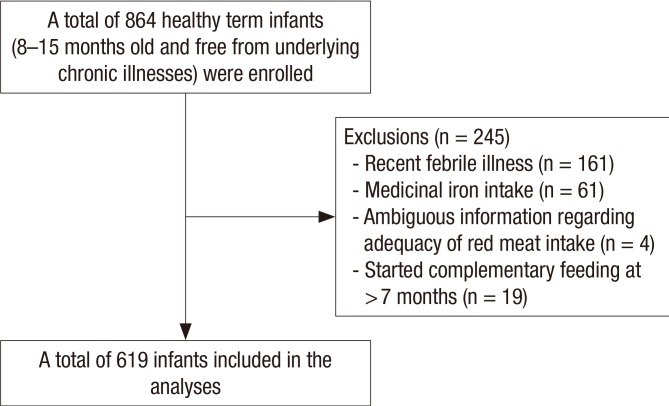
The present study investigated risk factors for iron deficiency (ID) and iron deficiency anemia (IDA) during late infancy, including feeding type and complementary feeding (CF) practice. Healthy term Korean infants (8-15 months) were weighed, and questionnaires regarding delivery, feeding, and weaning were completed by their caregivers. We also examined levels of hemoglobin, serum iron/total iron-binding capacity, serum ferritin, and mean corpuscular volume (MCV). Among 619 infants, ID and IDA were present in 174 infants (28.1%) and 87 infants (14.0%), respectively. The 288 infants with exclusively/mostly breastfeeding until late infancy (BFL) were most likely to exhibit ID (53.1%) and IDA (28.1%). The risk of ID was independently associated with BFL (adjusted odds ratio [aOR], 47.5; 95% confidence interval [CI], 18.3-122.9), male sex (aOR, 1.9; 95% CI, 1.2-2.9), fold weight gain (aOR, 2.6; 95% CI, 1.5-4.6), and perceived inadequacy of red meat intake (aOR, 1.7; 95% CI, 1.0-2.7). In addition to the risk factors for ID, Cesarean section delivery (aOR, 1.9; 95% CI, 1.1-3.2) and low parental CF-related knowledge (aOR, 2.8; 95% CI, 1.5-5.2) were risk factors for IDA. In conclusion, prolonged breastfeeding and perceived inadequacy of red meat intake may be among the important feeding-related risk factors of ID and IDA. Therefore, more meticulous education and monitoring of iron-rich food intake, such as red meat, with iron supplementation or iron status testing during late infancy if necessary, should be considered for breastfed Korean infants, especially for those with additional risk factors for ID or IDA.
本研究调查了婴儿晚期缺铁(ID)和缺铁性贫血(IDA)的风险因素,包括喂养方式和辅食添加情况。对健康足月的韩国婴儿(8 - 15个月)进行称重,并由其照顾者完成有关分娩、喂养和断奶的问卷调查。我们还检测了血红蛋白、血清铁/总铁结合力、血清铁蛋白和平均红细胞体积(MCV)水平。在619名婴儿中,分别有174名婴儿(28.1%)存在ID,87名婴儿(14.0%)存在IDA。288名直到婴儿晚期一直纯母乳喂养/主要母乳喂养(BFL)的婴儿最易出现ID(53.1%)和IDA(28.1%)。ID的风险与BFL独立相关(校正优势比[aOR]为47.5;95%置信区间[CI]为18.3 - 122.9)、男性(aOR为1.9;95% CI为1.2 - 2.9)、体重增加倍数(aOR为2.6;95% CI为1.5 - 4.6)以及认为红肉摄入量不足(aOR为1.7;95% CI为1.0 - 2.7)。除ID的风险因素外,剖宫产分娩(aOR为1.9;95% CI为1.1 - 3.2)和父母辅食添加相关知识水平低(aOR为2.8;95% CI为1.5 - 5.2)是IDA的风险因素。总之,延长母乳喂养时间和认为红肉摄入量不足可能是ID和IDA重要的与喂养相关的风险因素。因此,对于韩国母乳喂养婴儿,尤其是那些有ID或IDA额外风险因素的婴儿,应考虑进行更细致的教育并监测富含铁食物(如红肉)的摄入量,必要时在婴儿晚期进行铁补充或铁状态检测。