Lee Hu Suk, Khong Nguyen Viet, Xuan Huyen Nguyen, Nghia Vuong Bui, Nguyen-Viet Hung, Grace Delia
International Livestock Research Institute, Regional Office for East and Southeast Asia, Room 301-302, B1 Building, Van Phuc Diplomatic Compound, 298 Kim Ma Street, Ba Dinh District, Hanoi, Vietnam.
National Institute of Veterinary Research, 86 Truong Chinh, Phuong Mai, Dong Da, Hanoi, Vietnam.
BMC Vet Res. 2017 May 8;13(1):125. doi: 10.1186/s12917-017-1044-1.
Leptospirosis is a zoonotic bacterial disease with a worldwide distribution. In Vietnam, leptospirosis is considered endemic. In pigs, leptospirosis can result in reproductive problems (such as abortion and infertility) which lead to economic loss. In addition, transmission to people presents a public health risk. In Vietnam, few national studies have been conducted on sero-prevalence of leptospirosis in pigs. The main objective of this study was to evaluate the sero-prevalence and incidence of presumptive infective leptospira serovars in fattening pigs from 5 provinces in Vietnam.
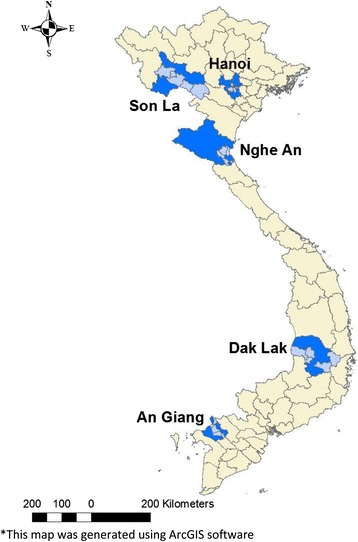
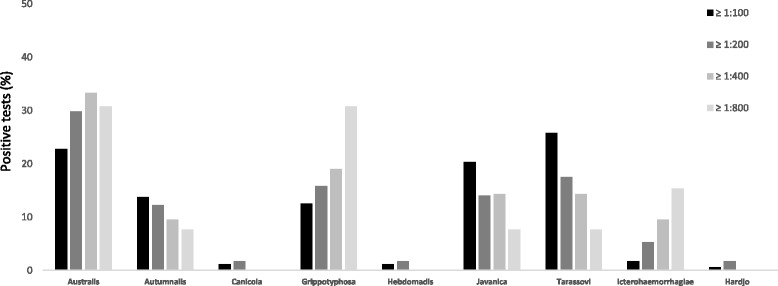
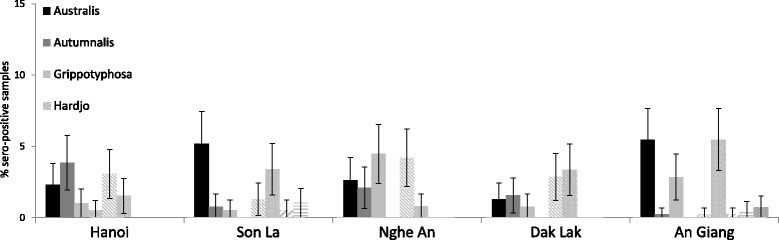
Blood samples from fattening pigs were randomly collected at slaughterhouses. We collected 1959 sera samples from 5 provinces (Son La, Hanoi, Nghe An, Dak Lak and An Giang) between January and early June 2016. The microscopic agglutination test (MAT) was used to identify the serogroups/serovars. Overall, the sero-prevalence was 8.17% (95% CI: 6.99-9.47) and serovar Tarassovi Mitis (2.19%) had the highest prevalence followed by Australis (1.94%), Javanica (1.68%) and Autumnalis (1.17%) using a cutoff (≥ 1:100). The sero-prevalence among female pigs (5.28%, 95% CI: 3.94-6.93) was slightly higher than among male pigs (4.88%, 95% CI: 3.51-6.58), but this difference was not statistically significant.
Leptospirosis in pigs may be a useful indicator of the human/animal burden in Vietnam and a risk assessment tool. The presence of some of the identified serovars suggests that wildlife may play an important role in the transmission of leptospirosis to domesticated pigs in Vietnam. Therefore, strengthened monitoring and surveillance systems are needed to better understand the epidemiology of the disease and prevent or reduce infection in humans and animals.
钩端螺旋体病是一种分布于全球的人畜共患细菌性疾病。在越南,钩端螺旋体病被视为地方病。在猪身上,钩端螺旋体病可导致繁殖问题(如流产和不育),从而造成经济损失。此外,该病传播给人类还会带来公共卫生风险。在越南,针对猪群钩端螺旋体病血清流行率的全国性研究较少。本研究的主要目的是评估越南5个省份育肥猪中推定感染性钩端螺旋体血清型的血清流行率和发病率。
在屠宰场随机采集育肥猪的血液样本。2016年1月至6月初,我们从5个省份(山萝省、河内市、义安省、多乐省和安江省)采集了1959份血清样本。采用显微镜凝集试验(MAT)鉴定血清群/血清型。总体而言,血清流行率为8.17%(95%置信区间:6.99 - 9.47),使用截断值(≥1:100)时,塔拉索夫米提斯血清型(2.19%)的流行率最高,其次是澳洲型(1.94%)、爪哇型(1.68%)和秋季型(1.17%)。母猪的血清流行率(5.28%,95%置信区间:3.94 - 6.93)略高于公猪(4.88%,95%置信区间:3.51 - 6.58),但差异无统计学意义。
猪的钩端螺旋体病可能是越南人畜负担的一个有用指标和风险评估工具。某些已鉴定血清型的存在表明,野生动物可能在越南钩端螺旋体病传播到家养猪的过程中起重要作用。因此,需要加强监测和监督系统,以更好地了解该病的流行病学情况,并预防或减少人类和动物的感染。