Harris Claire, Allen Kelly, Waller Cara, Brooke Vanessa
School of Public Health and Preventive Medicine, Monash University, Victoria, Australia.
Centre for Clinical Effectiveness, Monash Health, Victoria, Australia.
BMC Health Serv Res. 2017 May 9;17(1):340. doi: 10.1186/s12913-017-2207-2.
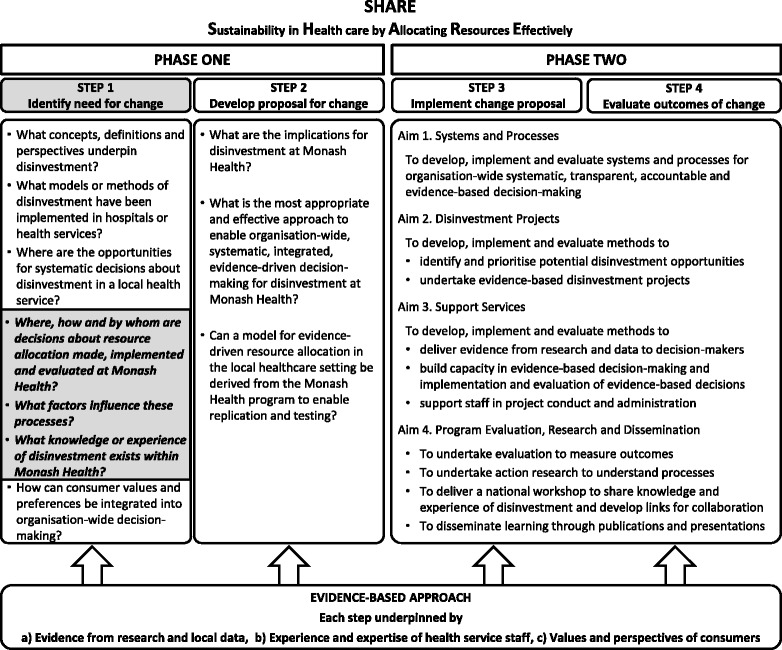
This is the third in a series of papers reporting a program of Sustainability in Health care by Allocating Resources Effectively (SHARE) in a local healthcare setting. Leaders in a large Australian health service planned to establish an organisation-wide, systematic, integrated, evidence-based approach to disinvestment. In order to introduce new systems and processes for disinvestment into existing decision-making infrastructure, we aimed to understand where, how and by whom resource allocation decisions were made, implemented and evaluated. We also sought the knowledge and experience of staff regarding previous disinvestment activities.
Structured interviews, workshops and document analysis were used to collect information from multiple sources in an environmental scan of decision-making systems and processes. Findings were synthesised using a theoretical framework.
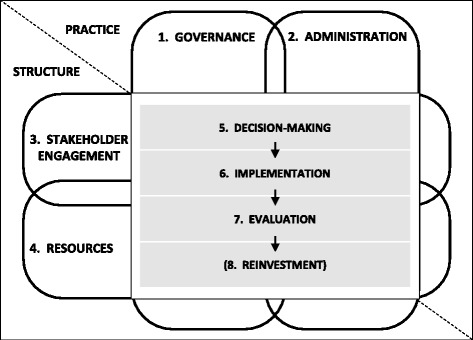
Sixty-eight respondents participated in interviews and workshops. Eight components in the process of resource allocation were identified: Governance, Administration, Stakeholder engagement, Resources, Decision-making, Implementation, Evaluation and, where appropriate, Reinvestment of savings. Elements of structure and practice for each component are described and a new framework was developed to capture the relationships between them. A range of decision-makers, decision-making settings, type and scope of decisions, criteria used, and strengths, weaknesses, barriers and enablers are outlined. The term 'disinvestment' was not used in health service decision-making. Previous projects that involved removal, reduction or restriction of current practices were driven by quality and safety issues, evidence-based practice or a need to find resource savings and not by initiatives where the primary aim was to disinvest. Measuring resource savings is difficult, in some situations impossible. Savings are often only theoretical as resources released may be utilised immediately by patients waiting for beds, clinic appointments or surgery. Decision-making systems and processes for resource allocation are more complex than assumed in previous studies.
There is a wide range of decision-makers, settings, scope and type of decisions, and criteria used for allocating resources within a single institution. To our knowledge, this is the first paper to report this level of detail and to introduce eight components of the resource allocation process identified within a local health service.
这是一系列论文中的第三篇,报道了在当地医疗环境中通过有效分配资源实现医疗保健可持续性(SHARE)的项目。澳大利亚一家大型医疗服务机构的领导者计划建立一种全组织范围的、系统的、综合的、基于证据的撤资方法。为了将新的撤资系统和流程引入现有的决策基础设施,我们旨在了解资源分配决策在何处、如何做出以及由谁做出、实施和评估。我们还寻求员工关于以往撤资活动的知识和经验。
通过结构化访谈、研讨会和文件分析,在对决策系统和流程的环境扫描中从多个来源收集信息。研究结果使用理论框架进行综合。
68名受访者参与了访谈和研讨会。确定了资源分配过程中的八个组成部分:治理、管理、利益相关者参与、资源、决策、实施、评估,以及在适当情况下节约资金的再投资。描述了每个组成部分的结构和实践要素,并开发了一个新框架来捕捉它们之间的关系。概述了一系列决策者、决策环境、决策类型和范围、使用的标准,以及优势、劣势、障碍和促成因素。“撤资”一词在医疗服务决策中未被使用。以往涉及取消、减少或限制当前做法的项目是由质量和安全问题、循证实践或节约资源的需求驱动的,而不是由主要目的是撤资的倡议驱动的。衡量资源节约很困难,在某些情况下甚至不可能。节约往往只是理论上的,因为释放的资源可能会立即被等待床位、门诊预约或手术的患者使用。资源分配的决策系统和流程比以往研究中假设的更为复杂。
在一个单一机构内,有各种各样的决策者、决策环境、决策范围和类型,以及用于分配资源的标准。据我们所知,这是第一篇报告如此详细程度并介绍在当地医疗服务机构中确定的资源分配过程八个组成部分的论文。