Harris Claire, Allen Kelly, Waller Cara, Green Sally, King Richard, Ramsey Wayne, Kelly Cate, Thiagarajan Malar
School of Public Health and Preventive Medicine, Monash University, Victoria, Australia.
Centre for Clinical Effectiveness, Monash Health, Victoria, Australia.
BMC Health Serv Res. 2017 May 10;17(1):342. doi: 10.1186/s12913-017-2208-1.
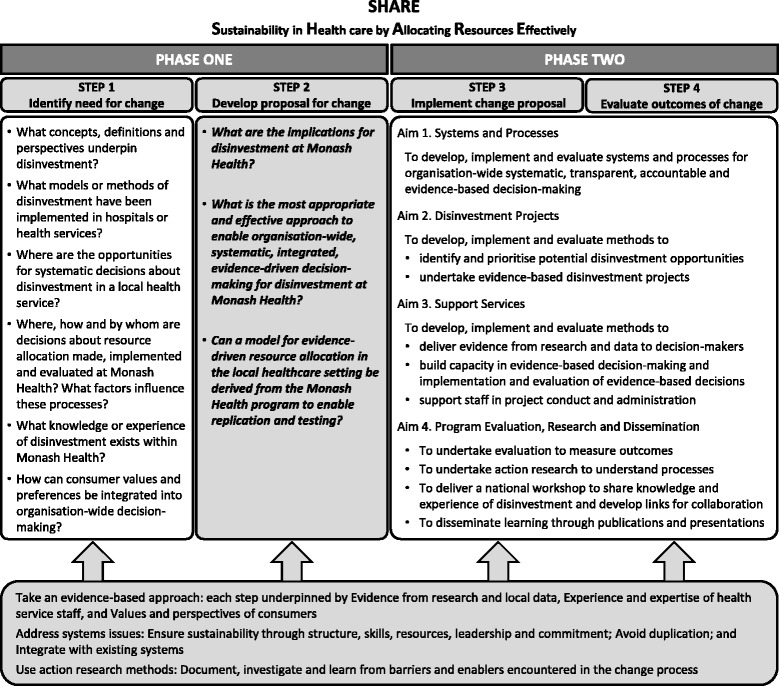
This is the fifth in a series of papers reporting Sustainability in Health care by Allocating Resources Effectively (SHARE) in a local healthcare setting. This paper synthesises the findings from Phase One of the SHARE Program and presents a model to be implemented and evaluated in Phase Two. Monash Health, a large healthcare network in Melbourne Australia, sought to establish an organisation-wide systematic evidence-based program for disinvestment. In the absence of guidance from the literature, the Centre for Clinical Effectiveness, an in-house 'Evidence Based Practice Support Unit', was asked to explore concepts and practices related to disinvestment, consider the implications for a local health service and identify potential settings and methods for decision-making.
Mixed methods were used to capture the relevant information. These included literature reviews; online questionnaire, interviews and structured workshops with a range of stakeholders; and consultation with experts in disinvestment, health economics and health program evaluation. Using the principles of evidence-based change, the project team worked with health service staff, consumers and external experts to synthesise the findings from published literature and local research and develop proposals, frameworks and plans.
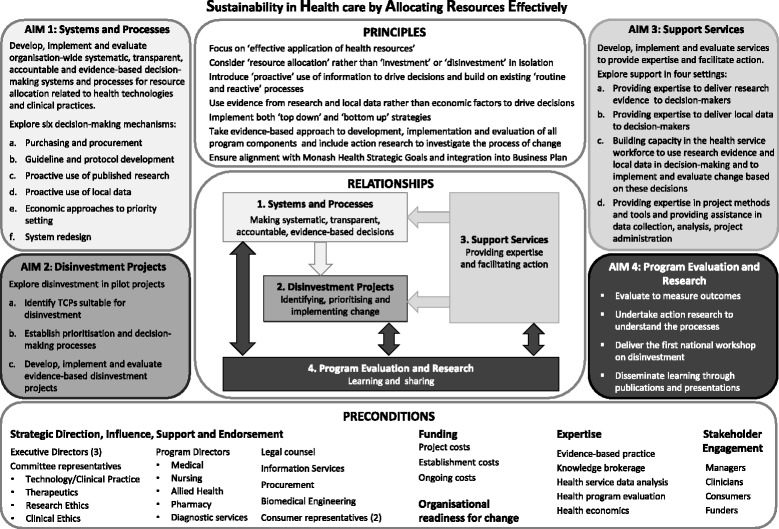
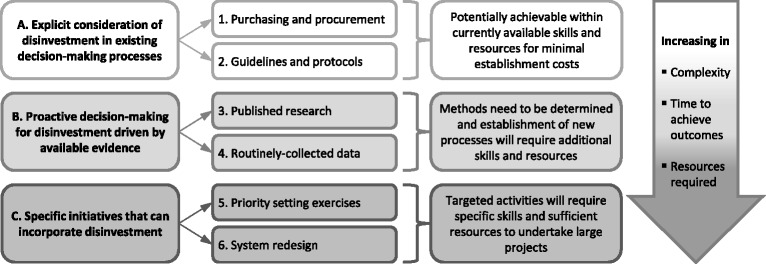
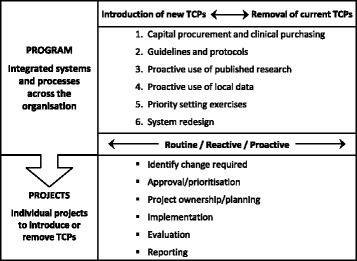
Multiple influencing factors were extracted from these findings. The implications were both positive and negative and addressed aspects of the internal and external environments, human factors, empirical decision-making, and practical applications. These factors were considered in establishment of the new program; decisions reached through consultation with stakeholders were used to define four program components, their aims and objectives, relationships between components, principles that underpin the program, implementation and evaluation plans, and preconditions for success and sustainability. The components were Systems and processes, Disinvestment projects, Support services, and Program evaluation and research. A model for a systematic approach to evidence-based resource allocation in a local health service was developed.
A robust evidence-based investigation of the research literature and local knowledge with a range of stakeholders resulted in rich information with strong consistent messages. At the completion of Phase One, synthesis of the findings enabled development of frameworks and plans and all preconditions for exploration of the four main aims in Phase Two were met.
本文是一系列论文中的第五篇,报道了在当地医疗环境中通过有效分配资源实现医疗保健可持续性(SHARE)的情况。本文综合了SHARE项目第一阶段的研究结果,并提出了一个将在第二阶段实施和评估的模型。澳大利亚墨尔本的大型医疗网络莫纳什健康中心,试图建立一个全组织范围的基于系统证据的撤资计划。由于缺乏文献指导,内部的“循证实践支持单位”临床有效性中心被要求探索与撤资相关的概念和实践,考虑对当地卫生服务的影响,并确定决策的潜在环境和方法。
采用混合方法获取相关信息。这些方法包括文献综述;在线问卷调查、与一系列利益相关者进行访谈和结构化研讨会;以及咨询撤资、卫生经济学和卫生项目评估方面的专家。项目团队运用循证变革原则,与卫生服务人员、消费者和外部专家合作,综合已发表文献和当地研究的结果,制定提案、框架和计划。
从这些研究结果中提取了多个影响因素。这些影响既有积极的也有消极的,涉及内部和外部环境、人为因素、实证决策和实际应用等方面。在建立新计划时考虑了这些因素;通过与利益相关者协商达成的决策被用于定义四个计划组成部分、它们的目标、组成部分之间的关系、支撑该计划的原则、实施和评估计划,以及成功和可持续性的先决条件。这些组成部分是系统与流程、撤资项目、支持服务以及项目评估与研究。开发了一个在当地卫生服务中基于系统方法进行循证资源分配的模型。
对研究文献和当地知识与一系列利益相关者进行的有力的循证调查产生了丰富的信息,且信息具有强烈的一致性。在第一阶段结束时,研究结果的综合使得框架和计划得以制定,并且满足了在第二阶段探索四个主要目标的所有先决条件。