Bally Michèle, Dendukuri Nandini, Rich Benjamin, Nadeau Lyne, Helin-Salmivaara Arja, Garbe Edeltraut, Brophy James M
Department of Pharmacy and Research Centre, Centre hospitalier de l'Université de Montréal, Montreal, H2X 1N4, Canada
Department of Epidemiology, Biostatistics and Occupational Health, McGill University, Montreal, Canada.
BMJ. 2017 May 9;357:j1909. doi: 10.1136/bmj.j1909.
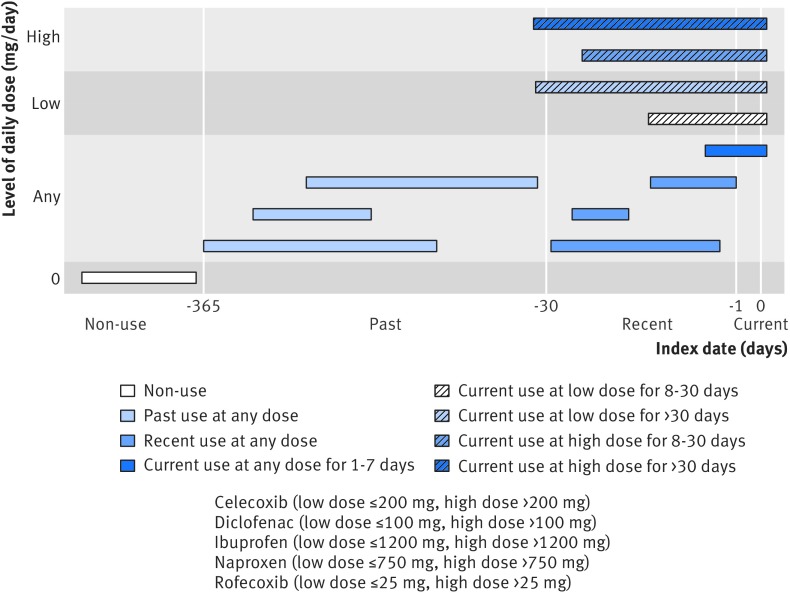
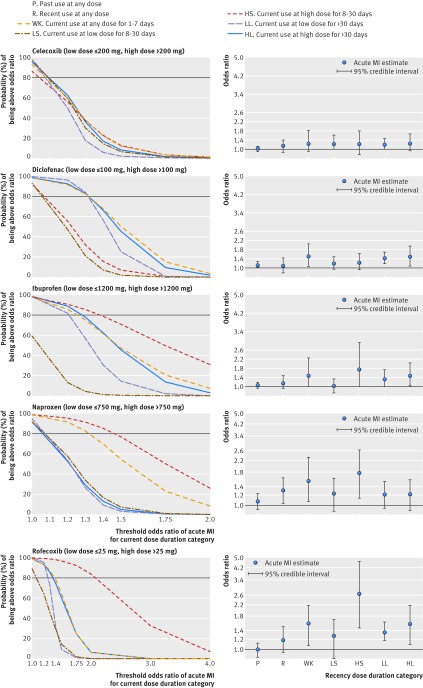
To characterise the determinants, time course, and risks of acute myocardial infarction associated with use of oral non-steroidal anti-inflammatory drugs (NSAIDs). Systematic review followed by a one stage bayesian individual patient data meta-analysis. Studies from Canadian and European healthcare databases. Eligible studies were sourced from computerised drug prescription or medical databases, conducted in the general or an elderly population, documented acute myocardial infarction as specific outcome, studied selective cyclo-oxygenase-2 inhibitors (including rofecoxib) and traditional NSAIDs, compared risk of acute myocardial infarction in NSAID users with non-users, allowed for time dependent analyses, and minimised effects of confounding and misclassification bias. Drug exposure was modelled as an indicator variable incorporating the specific NSAID, its recency, duration of use, and dose. The outcome measures were the summary adjusted odds ratios of first acute myocardial infarction after study entry for each category of NSAID use at index date (date of acute myocardial infarction for cases, matched date for controls) versus non-use in the preceding year and the posterior probability of acute myocardial infarction. A cohort of 446 763 individuals including 61 460 with acute myocardial infarction was acquired. Taking any dose of NSAIDs for one week, one month, or more than a month was associated with an increased risk of myocardial infarction. With use for one to seven days the probability of increased myocardial infarction risk (posterior probability of odds ratio >1.0) was 92% for celecoxib, 97% for ibuprofen, and 99% for diclofenac, naproxen, and rofecoxib. The corresponding odds ratios (95% credible intervals) were 1.24 (0.91 to 1.82) for celecoxib, 1.48 (1.00 to 2.26) for ibuprofen, 1.50 (1.06 to 2.04) for diclofenac, 1.53 (1.07 to 2.33) for naproxen, and 1.58 (1.07 to 2.17) for rofecoxib. Greater risk of myocardial infarction was documented for higher dose of NSAIDs. With use for longer than one month, risks did not appear to exceed those associated with shorter durations. All NSAIDs, including naproxen, were found to be associated with an increased risk of acute myocardial infarction. Risk of myocardial infarction with celecoxib was comparable to that of traditional NSAIDS and was lower than for rofecoxib. Risk was greatest during the first month of NSAID use and with higher doses.
旨在明确与使用口服非甾体抗炎药(NSAIDs)相关的急性心肌梗死的决定因素、时间进程及风险。进行系统评价,随后开展单阶段贝叶斯个体患者数据荟萃分析。研究来自加拿大和欧洲的医疗保健数据库。符合条件的研究源自计算机化的药物处方或医疗数据库,在普通人群或老年人群中开展,将急性心肌梗死记录为特定结局,研究选择性环氧化酶-2抑制剂(包括罗非昔布)和传统NSAIDs,比较NSAIDs使用者与非使用者发生急性心肌梗死的风险,允许进行时间依赖性分析,并尽量减少混杂因素和错误分类偏倚的影响。药物暴露被建模为一个指标变量,纳入特定的NSAID、其近期使用情况、使用持续时间和剂量。结局指标为在索引日期(病例的急性心肌梗死日期,对照的匹配日期)每种NSAID使用类别相对于前一年未使用时首次急性心肌梗死的汇总调整比值比,以及急性心肌梗死的后验概率。纳入了一个由446,763名个体组成的队列,其中包括61,460例急性心肌梗死患者。服用任何剂量的NSAIDs一周、一个月或一个月以上均与心肌梗死风险增加相关。使用1至7天时,塞来昔布发生心肌梗死风险增加的概率(比值比>1.0的后验概率)为92%,布洛芬为97%,双氯芬酸、萘普生和罗非昔布为99%。相应的比值比(95%可信区间)分别为:塞来昔布1.24(0.91至1.82),布洛芬1.48(1.00至2.26),双氯芬酸1.50(1.06至2.04),萘普生1.53(1.07至2.33),罗非昔布1.58(1.07至2.17)。NSAIDs剂量越高,心肌梗死风险越大。使用超过一个月时,风险似乎并未超过使用较短时间的情况。所有NSAIDs,包括萘普生,均被发现与急性心肌梗死风险增加相关。塞来昔布导致心肌梗死的风险与传统NSAIDs相当,且低于罗非昔布。NSAIDs使用的第一个月及高剂量时风险最大。