Marcano-Belisario José S, Gupta Ajay K, O'Donoghue John, Ramchandani Paul, Morrison Cecily, Car Josip
Global eHealth Unit, Department of Primary Care and Public Health, School of Public Health, Imperial College London, London, UK.
Faculty of Medicine, National Heart and Lung Institute, Imperial College London, London, UK.
BMC Med Inform Decis Mak. 2017 May 10;17(1):59. doi: 10.1186/s12911-017-0459-8.
Mobile devices may facilitate depression screening in the waiting area of antenatal clinics. This can present implementation challenges, of which we focused on survey layout and technology deployment.
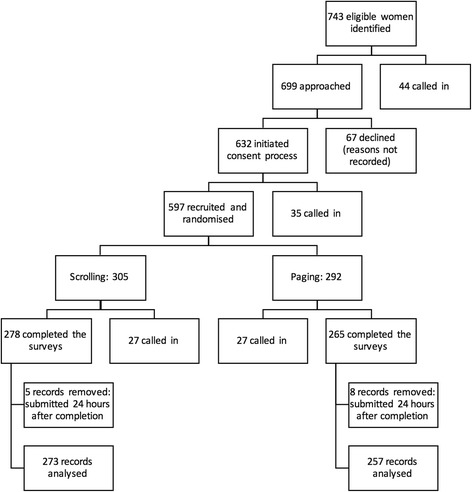
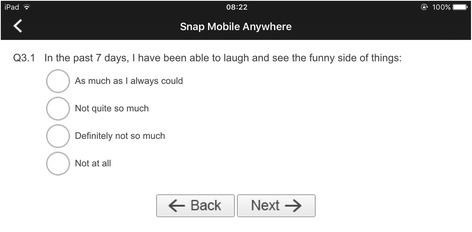
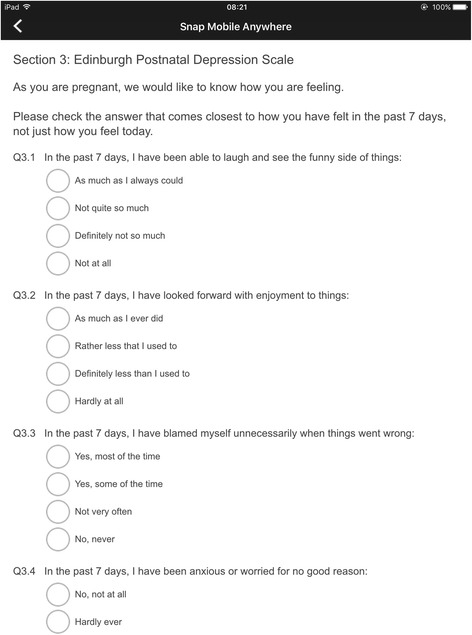
We assessed the feasibility of using tablet computers to administer a socio-demographic survey, the Whooley questions and the Edinburgh Postnatal Depression Scale (EPDS) to 530 pregnant women attending National Health Service (NHS) antenatal clinics across England. We randomised participants to one of two layout versions of these surveys: (i) a scrolling layout where each survey was presented on a single screen; or (ii) a paging layout where only one question appeared on the screen at any given time.
Overall, 85.10% of eligible pregnant women agreed to take part. Of these, 90.95% completed the study procedures. Approximately 23% of participants answered Yes to at least one Whooley question, and approximately 13% of them scored 10 points of more on the EPDS. We observed no association between survey layout and the responses given to the Whooley questions, the median EPDS scores, the number of participants at increased risk of self-harm, and the number of participants asking for technical assistance. However, we observed a difference in the number of participants at each EPDS scoring interval (p = 0.008), which provide an indication of a woman's risk of depression. A scrolling layout resulted in faster completion times (median = 4 min 46 s) than a paging layout (median = 5 min 33 s) (p = 0.024). However, the clinical significance of this difference (47.5 s) is yet to be determined.
Tablet computers can be used for depression screening in the waiting area of antenatal clinics. This requires the careful consideration of clinical workflows, and technology-related issues such as connectivity and security. An association between survey layout and EPDS scoring intervals needs to be explored further to determine if it corresponds to a survey layout effect. Future research needs to evaluate the effect of this type of antenatal depression screening on clinical outcomes and clinic workflows.
This study was registered in ClinicalTrials.gov under the identifier NCT02516982 on 20 July 2015.
移动设备可能有助于在产前诊所候诊区进行抑郁症筛查。这可能带来实施方面的挑战,我们重点关注了调查问卷布局和技术部署。
我们评估了使用平板电脑对英格兰各地国民健康服务体系(NHS)产前诊所的530名孕妇进行社会人口学调查、Whooley问题调查以及爱丁堡产后抑郁量表(EPDS)测评的可行性。我们将参与者随机分为两种调查问卷布局版本之一:(i)滚动布局,即每份调查问卷在单个屏幕上呈现;或(ii)分页布局,即在任何给定时间屏幕上仅显示一个问题。
总体而言,85.10%符合条件的孕妇同意参与。其中,90.95%完成了研究程序。约23%的参与者对至少一个Whooley问题回答“是”,约13%的参与者在EPDS上得分达到10分及以上。我们未观察到调查问卷布局与对Whooley问题的回答、EPDS中位数得分、自我伤害风险增加的参与者数量以及寻求技术帮助的参与者数量之间存在关联。然而,我们观察到每个EPDS评分区间的参与者数量存在差异(p = 0.008),这表明了女性的抑郁风险。滚动布局的完成时间(中位数 = 4分46秒)比分页布局(中位数 = 5分33秒)更快(p = 0.024)。然而,这种差异(47.5秒)的临床意义尚待确定。
平板电脑可用于产前诊所候诊区的抑郁症筛查。这需要仔细考虑临床工作流程以及与技术相关的问题,如连接性和安全性。需要进一步探索调查问卷布局与EPDS评分区间之间的关联,以确定其是否对应于一种调查问卷布局效应。未来的研究需要评估这种产前抑郁症筛查对临床结局和诊所工作流程的影响。
本研究于2015年7月20日在ClinicalTrials.gov上注册,标识符为NCT02516982。