Seo Min-Goo, Ouh In-Ohk, Lee Seung-Hun, Kim Jong Wan, Rhee Man Hee, Kwon Oh-Deog, Kim Tae-Hwan, Kwak Dongmi
College of Veterinary Medicine, Kyungpook National University, Daegu, South Korea.
Animal and Plant Quarantine Agency, Gimcheon, South Korea.
PLoS One. 2017 May 11;12(5):e0177478. doi: 10.1371/journal.pone.0177478. eCollection 2017.
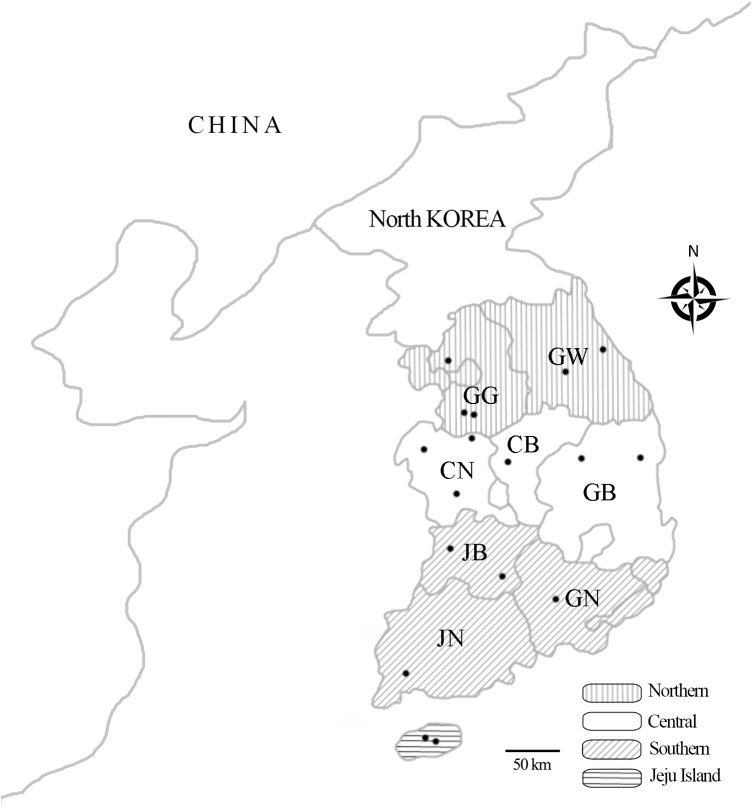
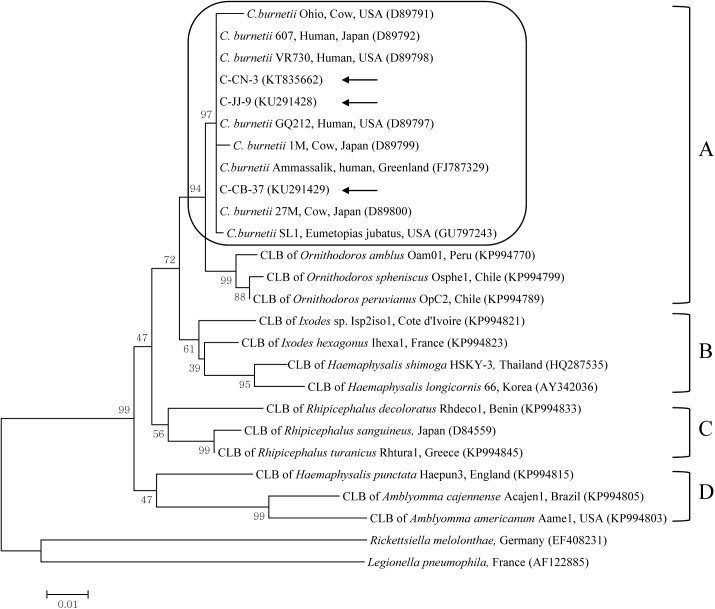
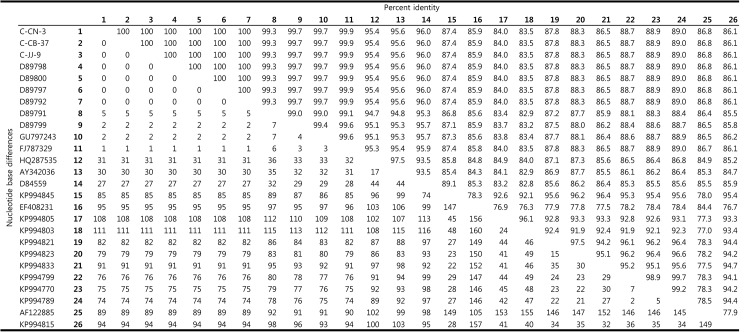
This is the first study to evaluate the serologic and molecular prevalence of Coxiella burnetii in cattle at national breeding stock farms in South Korea. These government farms have well-organized biosecurity and management systems to prevent livestock diseases. Of the 736 cattle in this study, 77 tested positive for antibodies against C. burnetii antigens (10.5%, 95% CI: 8.3-12.7) and 11 were positive for a C. burnetti infection on PCR analysis (1.5%, 95% CI: 0.6-2.4). Since the 16S rRNA sequences of C. burnetii from all 11 PCR-positive samples were identical, three representative samples (C-CN-3 from the southern region, C-JJ-9 from Jeju Island, and C-CB-37 from the central region) are described in this paper. These three sequences had 99.3-100% identity to those of C. burnetii deposited in GenBank. These sequences clustered with those from USA, Japan, and Greenland, underscoring the sequence similarity among C. burnetii isolates in these countries. Because C. burnetii was detected in cattle at well-managed national breeding stock farms, cattle at non-government operated farms may be more likely to be exposed to C. burnetii in South Korea. Thus, continuous surveillance and control strategies in animals and humans are required to prevent the transmission of C. burnetii to humans.
这是第一项评估韩国国家种畜场牛群中伯氏考克斯体血清学和分子流行情况的研究。这些国营农场拥有组织完善的生物安全和管理系统以预防家畜疾病。在本研究的736头牛中,77头针对伯氏考克斯体抗原的抗体检测呈阳性(10.5%,95%置信区间:8.3 - 12.7),11头经PCR分析伯氏考克斯体感染呈阳性(1.5%,95%置信区间:0.6 - 2.4)。由于所有11个PCR阳性样本的伯氏考克斯体16S rRNA序列相同,本文描述了三个代表性样本(南部地区的C - CN - 3、济州岛的C - JJ - 9和中部地区的C - CB - 37)。这三个序列与GenBank中伯氏考克斯体的序列具有99.3 - 100%的同一性。这些序列与来自美国、日本和格陵兰岛的序列聚类,突出了这些国家伯氏考克斯体分离株之间的序列相似性。由于在管理良好的国家种畜场的牛中检测到了伯氏考克斯体,韩国非国营农场的牛可能更易接触到伯氏考克斯体。因此,需要对动物和人类采取持续监测和控制策略以防止伯氏考克斯体传播给人类。