Aron Miles, Browning Richard, Carugo Dario, Sezgin Erdinc, Bernardino de la Serna Jorge, Eggeling Christian, Stride Eleanor
Department of Engineering Science, Institute of Biomedical Engineering, University of Oxford, Oxford, OX3 7DQ, UK.
Faculty of Engineering and The Environment, University of Southampton, Southampton, SO17 1BJ, UK.
BMC Bioinformatics. 2017 May 12;18(1):254. doi: 10.1186/s12859-017-1656-2.
Spectral imaging with polarity-sensitive fluorescent probes enables the quantification of cell and model membrane physical properties, including local hydration, fluidity, and lateral lipid packing, usually characterized by the generalized polarization (GP) parameter. With the development of commercial microscopes equipped with spectral detectors, spectral imaging has become a convenient and powerful technique for measuring GP and other membrane properties. The existing tools for spectral image processing, however, are insufficient for processing the large data sets afforded by this technological advancement, and are unsuitable for processing images acquired with rapidly internalized fluorescent probes.
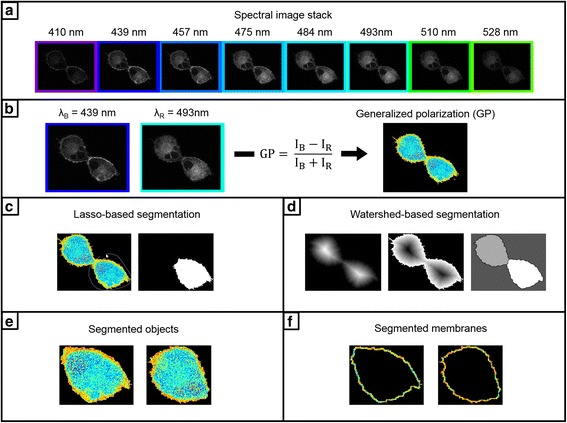
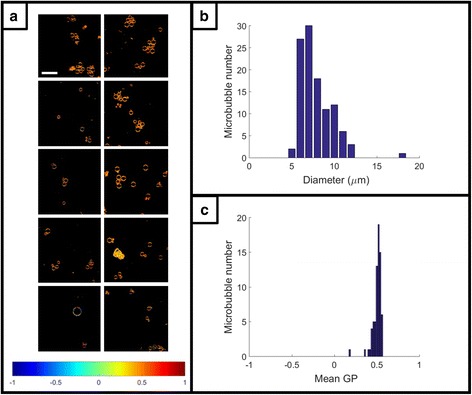
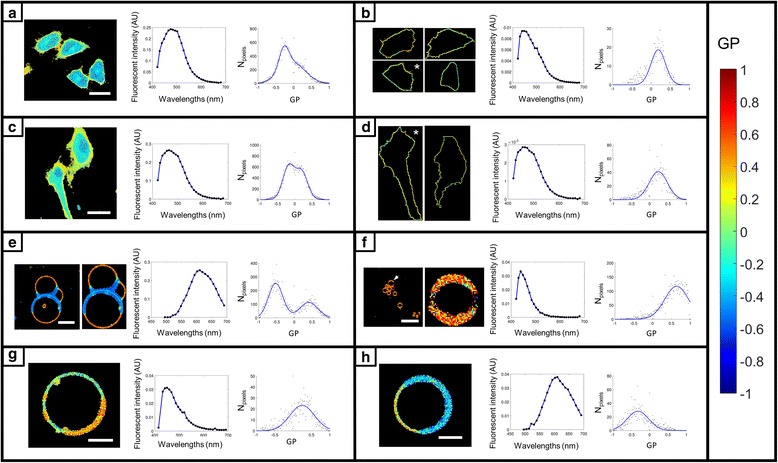
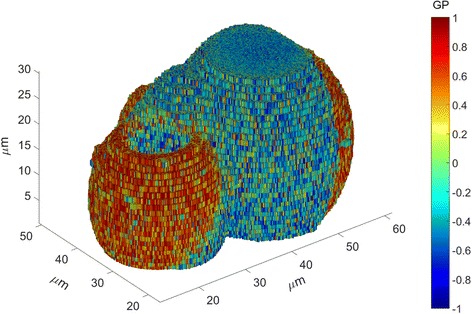
Here we present a MATLAB spectral imaging toolbox with the aim of overcoming these limitations. In addition to common operations, such as the calculation of distributions of GP values, generation of pseudo-colored GP maps, and spectral analysis, a key highlight of this tool is reliable membrane segmentation for probes that are rapidly internalized. Furthermore, handling for hyperstacks, 3D reconstruction and batch processing facilitates analysis of data sets generated by time series, z-stack, and area scan microscope operations. Finally, the object size distribution is determined, which can provide insight into the mechanisms underlying changes in membrane properties and is desirable for e.g. studies involving model membranes and surfactant coated particles. Analysis is demonstrated for cell membranes, cell-derived vesicles, model membranes, and microbubbles with environmentally-sensitive probes Laurdan, carboxyl-modified Laurdan (C-Laurdan), Di-4-ANEPPDHQ, and Di-4-AN(F)EPPTEA (FE), for quantification of the local lateral density of lipids or lipid packing.
The Spectral Imaging Toolbox is a powerful tool for the segmentation and processing of large spectral imaging datasets with a reliable method for membrane segmentation and no ability in programming required. The Spectral Imaging Toolbox can be downloaded from https://uk.mathworks.com/matlabcentral/fileexchange/62617-spectral-imaging-toolbox .
使用极性敏感荧光探针进行光谱成像能够量化细胞和模型膜的物理性质,包括局部水合作用、流动性和横向脂质堆积,通常用广义极化(GP)参数来表征。随着配备光谱探测器的商用显微镜的发展,光谱成像已成为测量GP和其他膜性质的便捷且强大的技术。然而,现有的光谱图像处理工具不足以处理这项技术进步所带来的大量数据集,并且不适用于处理使用快速内化荧光探针获取的图像。
在此,我们展示了一个MATLAB光谱成像工具箱,旨在克服这些限制。除了常见操作,如计算GP值分布、生成伪彩色GP图和光谱分析外,该工具的一个关键亮点是对快速内化探针进行可靠的膜分割。此外,对超堆栈的处理、三维重建和批处理有助于分析由时间序列、z堆栈和面积扫描显微镜操作生成的数据集。最后,确定对象大小分布,这可以深入了解膜性质变化的潜在机制,并且对于例如涉及模型膜和表面活性剂包被颗粒的研究很有必要。使用对环境敏感的探针Laurdan、羧基修饰的Laurdan(C-Laurdan)、Di-4-ANEPPDHQ和Di-4-AN(F)EPPTEA(FE)对细胞膜、细胞衍生囊泡、模型膜和微泡进行分析,以量化脂质的局部横向密度或脂质堆积。
光谱成像工具箱是用于分割和处理大型光谱成像数据集的强大工具,具有可靠的膜分割方法且无需编程能力。光谱成像工具箱可从https://uk.mathworks.com/matlabcentral/fileexchange/62617-spectral-imaging-toolbox下载。