Mauri Giovanni, Nicosia L, Varano G M, Bonomo G, Della Vigna P, Monfardini L, Orsi F
Divisione di Radiologia Interventistica, Istituto Europeo di Oncologia, Via Ripamonti 435, 20141, Milan, Italy.
Servizio di Radiologia, IRCCS Policlinico San Donato, Piazza Edmondo Malan, San Donato Milanese, Italy.
Insights Imaging. 2017 Jun;8(3):357-363. doi: 10.1007/s13244-017-0555-4. Epub 2017 May 12.
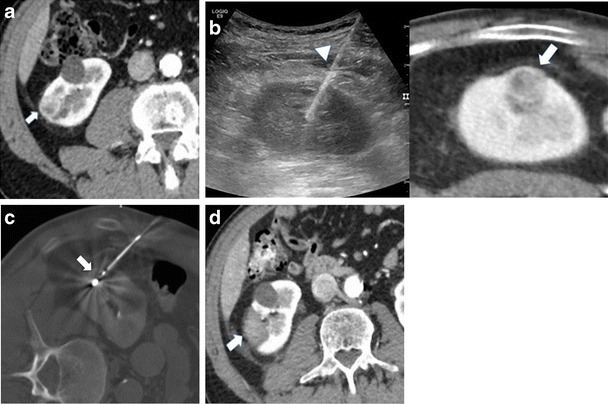
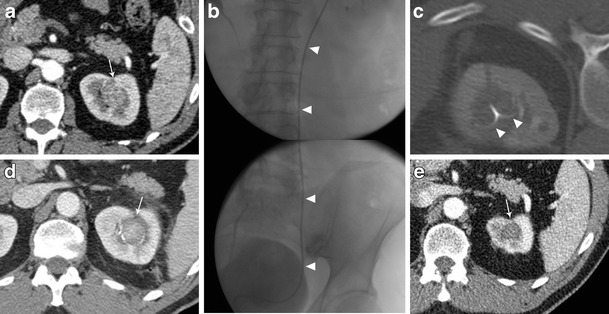
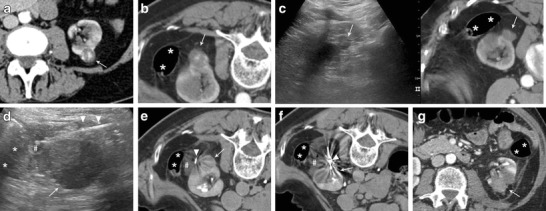
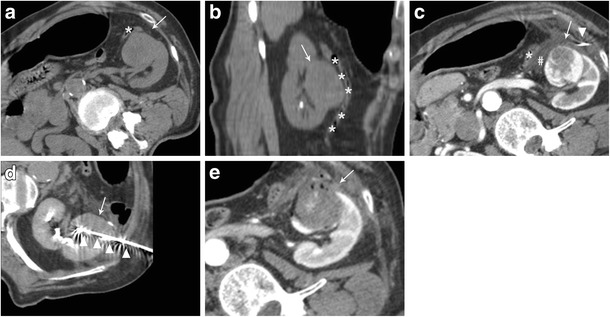
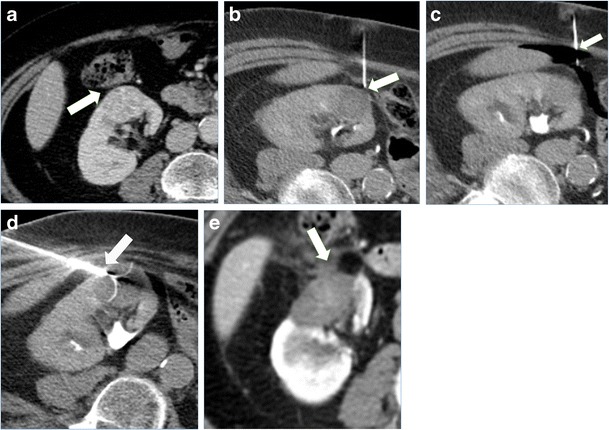
Image-guide thermal ablations are nowadays increasingly used to provide a minimally invasive treatment to patients with renal tumours, with reported good clinical results and low complications rate. Different ablative techniques can be applied, each with some advantages and disadvantages according to the clinical situation. Moreover, percutaneous ablation of renal tumours might be complex in cases where there is limited access for image guidance or a close proximity to critical structures, which can be unintentionally injured during treatment. In the present paper we offer an overview of the most commonly used ablative techniques and of the most important manoeuvres that can be applied to enhance the safety and effectiveness of percutaneous image-guided renal ablation. Emphasis is given to the different technical aspects of cryoablation, radiofrequency ablation, and microwave ablation, on the ideal operating room setting, optimal image guidance, application of fusion imaging and virtual navigation, and contrast enhanced ultrasound in the guidance and monitoring of the procedure. Moreover, a series of protective manoeuvre that can be used to avoid damage to surrounding sensitive structures is presented. A selection of cases of image-guided thermal ablation of renal tumours in which the discussed technique were used is presented and illustrated.
• Cryoablation, radiofrequency and microwave ablation have different advantages and disadvantages. • US, CT, fusion imaging, and CEUS increase an effective image-guidance. • Different patient positioning and external compression may increase procedure feasibility. • Hydrodissection and gas insufflation are useful to displace surrounding critical structures. • Cold pyeloperfusion can reduce the thermal damage to the collecting system.
如今,图像引导下的热消融术越来越多地用于为肾肿瘤患者提供微创治疗,临床结果良好,并发症发生率低。可以应用不同的消融技术,每种技术根据临床情况都有一些优缺点。此外,在图像引导受限或靠近关键结构的情况下,经皮肾肿瘤消融可能很复杂,在治疗过程中可能会意外损伤这些结构。在本文中,我们概述了最常用的消融技术以及可用于提高经皮图像引导肾消融安全性和有效性的最重要操作。重点介绍了冷冻消融、射频消融和微波消融的不同技术方面、理想的手术室设置、最佳图像引导、融合成像和虚拟导航的应用以及超声造影在手术引导和监测中的应用。此外,还介绍了一系列可用于避免损伤周围敏感结构的保护措施。展示并举例说明了一系列使用所讨论技术进行图像引导下肾肿瘤热消融的病例。
• 冷冻消融、射频消融和微波消融各有优缺点。• 超声、CT、融合成像和超声造影可增强有效的图像引导。• 不同的患者体位和外部压迫可提高手术可行性。• 水分离和气体注入有助于移位周围关键结构。• 冷肾盂灌注可减少对集合系统的热损伤。