Millenson Marisa E, Braun Joseph M, Calafat Antonia M, Barr Dana Boyd, Huang Yen-Tsung, Chen Aimin, Lanphear Bruce P, Yolton Kimberly
Department of Epidemiology, Brown University, Providence, RI 02912, USA.
Department of Epidemiology, Brown University, Providence, RI 02912, USA.
Environ Res. 2017 Aug;157:9-16. doi: 10.1016/j.envres.2017.05.008. Epub 2017 May 11.
Prenatal exposure to organophosphate insecticides may be associated with autism spectrum disorders and related behaviors. This association may be modified by single nucleotide polymorphisms in the paraoxonase (PON1) enzyme.
We examined the relationship of prenatal organophosphate insecticide biomarkers with reciprocal social, repetitive, and stereotypic behaviors in 8-year old children, and modification of this relationship by child PON1 polymorphisms.
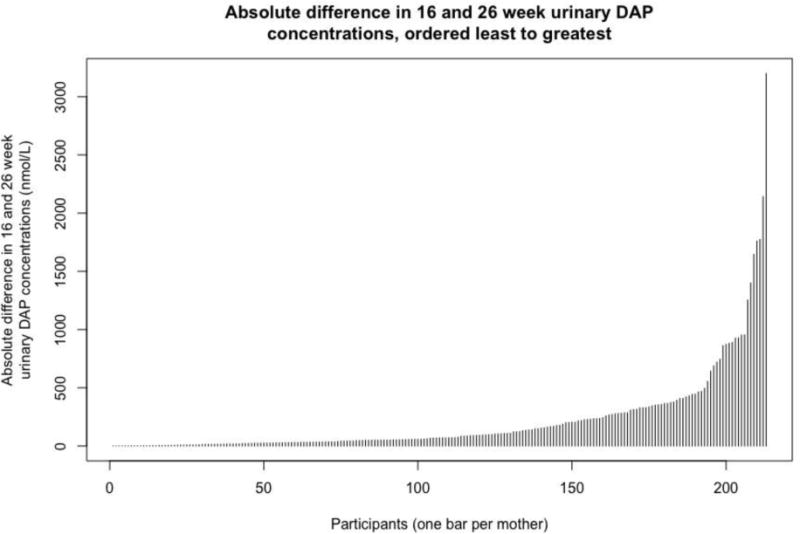
Among 224 pregnant women, we quantified concentrations of six nonspecific dialkyl phosphate (DAP) metabolites of organophosphate insecticides in two urine samples collected at ~16 and ~26 weeks gestation. When children were eight years old, we administered the Social Responsiveness Scale (SRS), a continuous measure of various dimensions of interpersonal behavior, communication, and repetitive/stereotypic behaviors. We estimated the association between a 10-fold increase in the sum of six DAP concentrations (ΣDAP) and SRS scores. We examined whether child PON1 and PON1 genotypes modified this association.
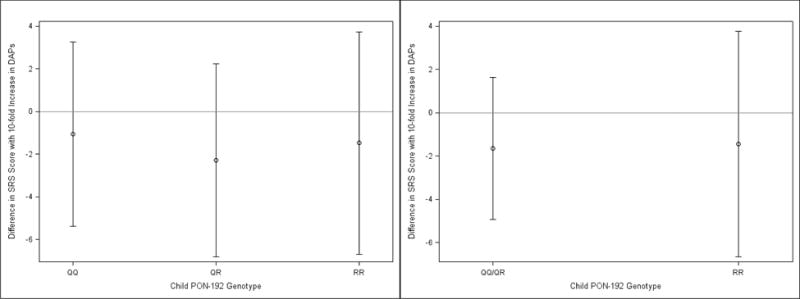
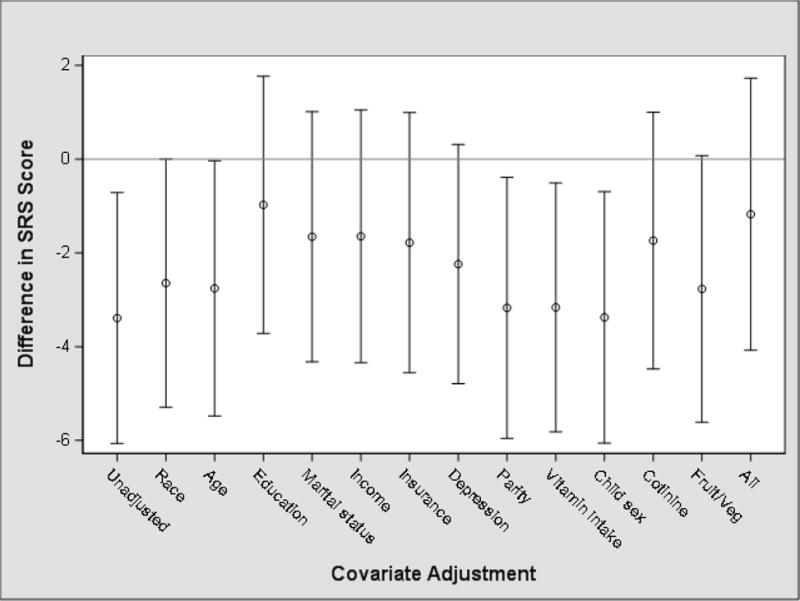
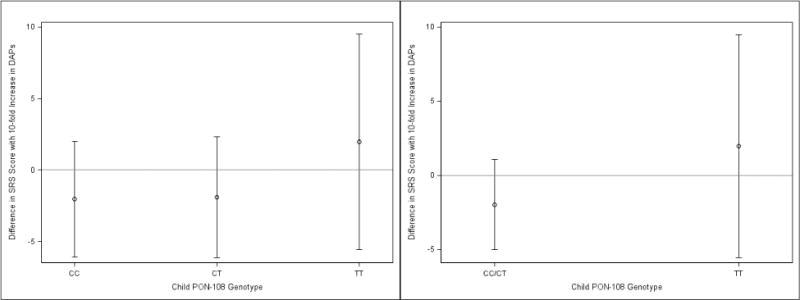
After covariate adjustment, ΣDAP concentrations were not associated with SRS scores [β=-1.2; 95% confidence interval (CI): -4.0, 1.6]. Among children with the PON1 genotype, ΣDAP concentrations were associated with 2.5-point higher (95% CI: -4.9, 9.8) SRS scores; however, the association was not different from the 1.8-point decrease (95% CI: -5.8, 2.2) among children with PON1 genotypes (ΣDAP × PON1 p-value =0.54). The association between ΣDAP concentrations and SRS scores was not modified by PON1 (ΣDAP × PON1 p-value =0.89).
In this cohort, prenatal urinary DAP concentrations were not associated with children's social behaviors; these associations were not modified by child PON1 genotype.
孕期接触有机磷杀虫剂可能与自闭症谱系障碍及相关行为有关。对氧磷酶(PON1)酶中的单核苷酸多态性可能会改变这种关联。
我们研究了孕期有机磷杀虫剂生物标志物与8岁儿童的双向社交、重复及刻板行为之间的关系,以及儿童PON1多态性对这种关系的影响。
在224名孕妇中,我们对妊娠约16周和26周时采集的两份尿液样本中六种有机磷杀虫剂的非特异性二烷基磷酸酯(DAP)代谢物浓度进行了量化。当儿童8岁时,我们使用了社会反应量表(SRS),这是一种对人际行为、沟通及重复/刻板行为的各个维度进行的连续性测量。我们估计了六种DAP浓度总和(ΣDAP)增加10倍与SRS评分之间的关联。我们研究了儿童PON1和PON1基因型是否会改变这种关联。
经过协变量调整后,ΣDAP浓度与SRS评分无关[β=-1.2;95%置信区间(CI):-4.0,1.6]。在具有PON1基因型的儿童中,ΣDAP浓度与SRS评分高2.5分相关(95%CI:-4.9,9.8);然而,这种关联与具有PON1基因型的儿童中降低1.8分(95%CI:-5.8,2.2)并无差异(ΣDAP×PON1 p值=0.54)。ΣDAP浓度与SRS评分之间的关联未被PON1改变(ΣDAP×PON1 p值=0.89)。
在这个队列中,孕期尿DAP浓度与儿童社交行为无关;这些关联未被儿童PON1基因型改变。