Department of Psychology.
Neuroscience and Cognitive Sciences Program, University of Maryland, College Park, MD, USA.
Soc Cogn Affect Neurosci. 2017 Sep 1;12(9):1402-1413. doi: 10.1093/scan/nsx067.
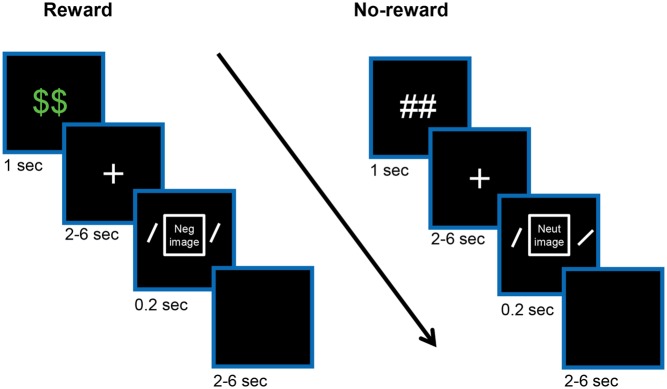
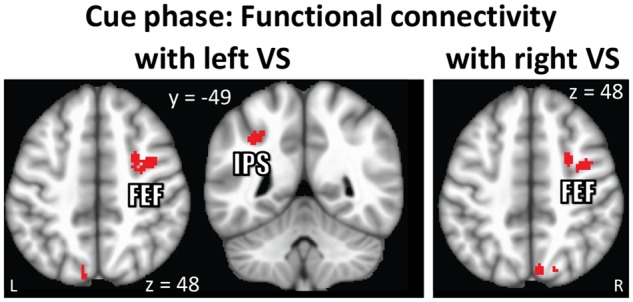
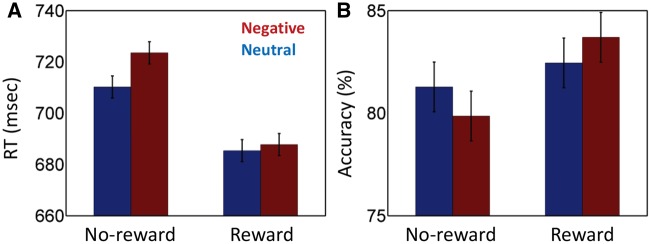
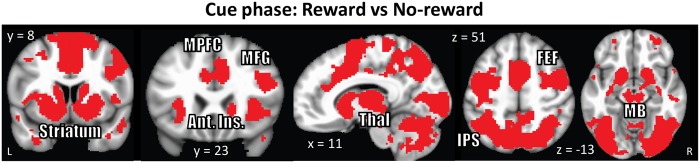
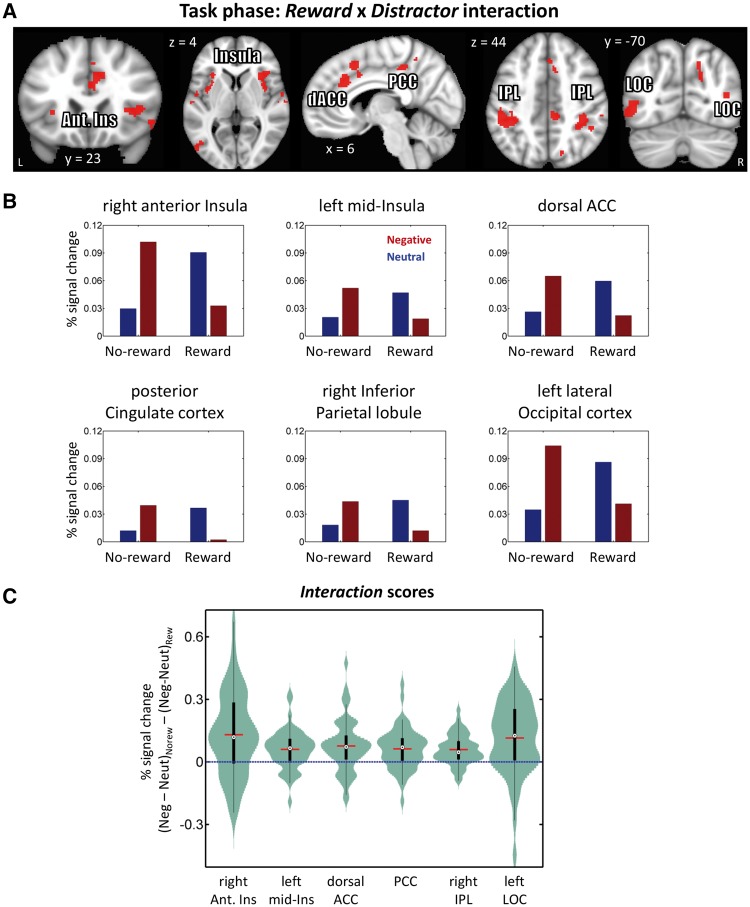
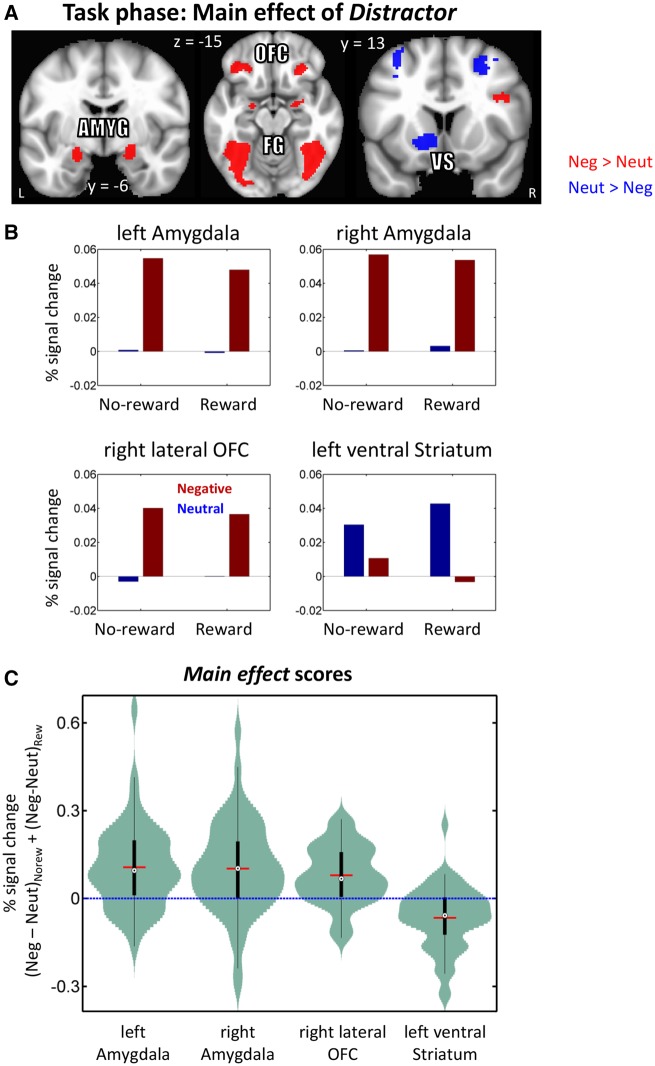
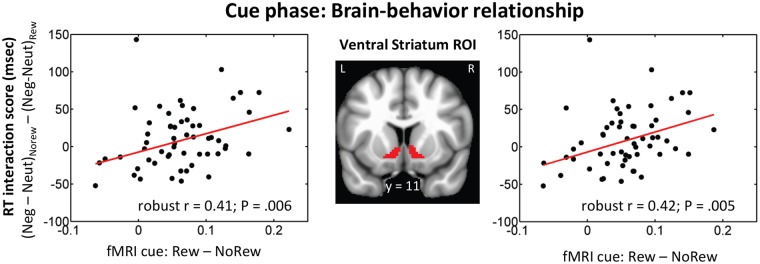
Knowledge about interactions between reward and negative processing is rudimentary. Here, we employed functional MRI to probe how potential reward signaled by advance cues alters aversive distractor processing during perception. Behaviorally, the influence of aversive stimuli on task performance was reduced during the reward compared to no-reward condition. In the brain, at the task phase, paralleling the observed behavioral pattern, we observed significant interactions in the anterior insula and dorsal anterior cingulate cortex, such that responses during the negative (vs neutral) condition were reduced during the reward compared to no-reward condition. Notably, negative distractor processing in the amygdala appeared to be independent of the reward manipulation. During the initial cue phase, we observed increased reward-related responses in the ventral striatum/accumbens, which were correlated with behavioral interference scores at the subsequent task phase, revealing that participants with increased reward-related responses exhibited a greater behavioral benefit of reward in reducing the adverse effect of negative images. Furthermore, during processing of reward (vs no-reward) cues, the ventral striatum exhibited stronger functional connectivity with fronto-parietal regions important for attentional control. Together, our findings contribute to the understanding of how potential reward influences attentional control and reduces negative distractor processing in the human brain.
关于奖励和负面处理之间相互作用的知识还很基础。在这里,我们采用功能磁共振成像技术来探究预先提示的潜在奖励如何改变感知过程中对厌恶分心物的处理。行为上,与无奖励条件相比,奖励条件下厌恶刺激对任务表现的影响降低了。在大脑中,在任务阶段,与观察到的行为模式平行,我们在前脑岛和背侧前扣带皮层中观察到显著的相互作用,使得在消极(与中性)条件下的反应在奖励条件下比无奖励条件下减少。值得注意的是,杏仁核中的负面分心物处理似乎与奖励操作无关。在初始提示阶段,我们观察到腹侧纹状体/伏隔核中与奖励相关的反应增加,这与随后任务阶段的行为干扰分数相关,表明具有增加的与奖励相关的反应的参与者在减少负面图像的不利影响方面表现出更大的行为益处。此外,在处理奖励(与无奖励)提示时,腹侧纹状体与注意力控制中重要的额顶叶区域表现出更强的功能连接。总之,我们的发现有助于理解潜在奖励如何影响注意力控制,并减少人类大脑中的负面分心物处理。