Baharom Faezzah, Rankin Gregory, Blomberg Anders, Smed-Sörensen Anna
Immunology and Allergy Unit, Department of Medicine Solna, Karolinska Institutet, Karolinska University Hospital Solna, Stockholm, Sweden.
Department of Public Health and Clinical Medicine, Division of Medicine, Umeå University, Umeå, Sweden.
Front Immunol. 2017 May 1;8:499. doi: 10.3389/fimmu.2017.00499. eCollection 2017.
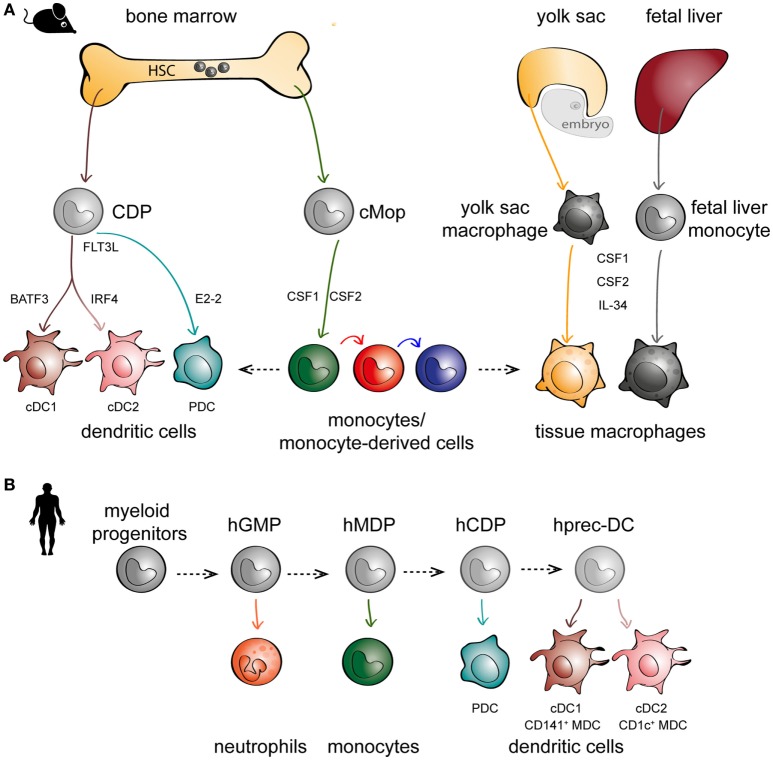
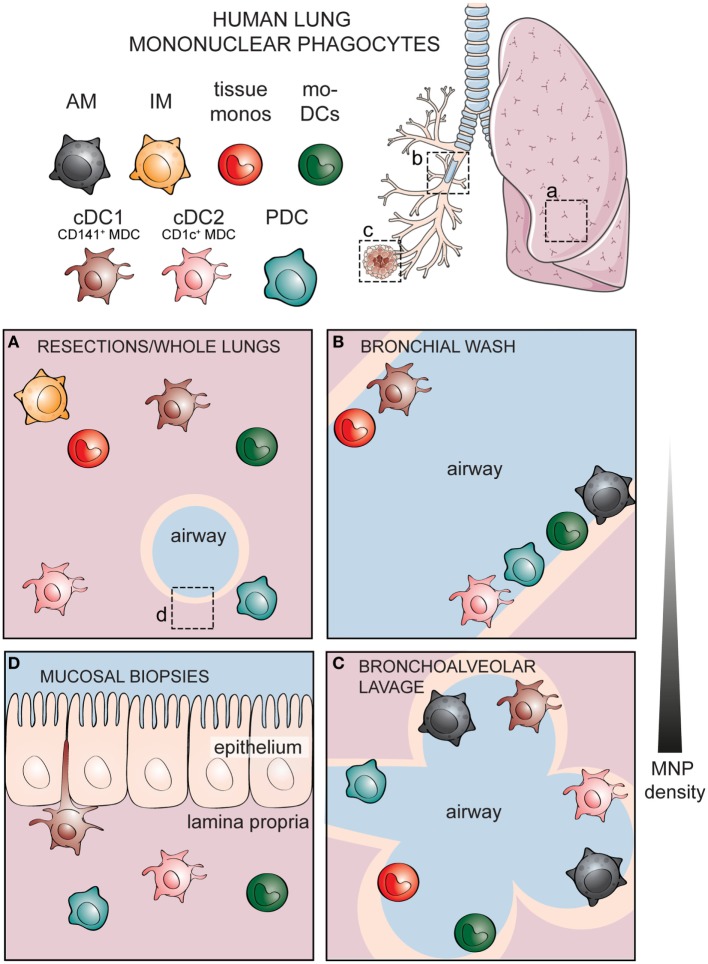
The lungs are vulnerable to attack by respiratory insults such as toxins, allergens, and pathogens, given their continuous exposure to the air we breathe. Our immune system has evolved to provide protection against an array of potential threats without causing collateral damage to the lung tissue. In order to swiftly detect invading pathogens, monocytes, macrophages, and dendritic cells (DCs)-together termed mononuclear phagocytes (MNPs)-line the respiratory tract with the key task of surveying the lung microenvironment in order to discriminate between harmless and harmful antigens and initiate immune responses when necessary. Each cell type excels at specific tasks: monocytes produce large amounts of cytokines, macrophages are highly phagocytic, whereas DCs excel at activating naïve T cells. Extensive studies in murine models have established a division of labor between the different populations of MNPs at steady state and during infection or inflammation. However, a translation of important findings in mice is only beginning to be explored in humans, given the challenge of working with rare cells in inaccessible human tissues. Important progress has been made in recent years on the phenotype and function of human lung MNPs. In addition to a substantial population of alveolar macrophages, three subsets of DCs have been identified in the human airways at steady state. More recently, monocyte-derived cells have also been described in healthy human lungs. Depending on the source of samples, such as lung tissue resections or bronchoalveolar lavage, the specific subsets of MNPs recovered may differ. This review provides an update on existing studies investigating human respiratory MNP populations during health and disease. Often, inflammatory MNPs are found to accumulate in the lungs of patients with pulmonary conditions. In respiratory infections or inflammatory diseases, this may contribute to disease severity, but in cancer patients this may improve clinical outcomes. By expanding on this knowledge, specific lung MNPs may be targeted or modulated in order to attain favorable responses that can improve preventive or treatment strategies against respiratory infections, lung cancer, or lung inflammatory diseases.
鉴于肺部持续暴露于我们所呼吸的空气中,它们很容易受到毒素、过敏原和病原体等呼吸道损伤因素的攻击。我们的免疫系统已经进化到能够抵御一系列潜在威胁,同时又不会对肺组织造成附带损害。为了迅速检测入侵的病原体,单核细胞、巨噬细胞和树突状细胞(DCs)——统称为单核吞噬细胞(MNPs)——排列在呼吸道中,其关键任务是监测肺微环境,以便区分无害和有害抗原,并在必要时启动免疫反应。每种细胞类型都擅长特定的任务:单核细胞产生大量细胞因子,巨噬细胞具有高度吞噬作用,而DCs则擅长激活幼稚T细胞。对小鼠模型的广泛研究已经确定了在稳态以及感染或炎症期间不同MNPs群体之间的分工。然而,鉴于在难以获取的人体组织中处理稀有细胞具有挑战性,小鼠重要研究成果在人类中的转化才刚刚开始探索。近年来,关于人类肺MNPs的表型和功能已经取得了重要进展。除了大量的肺泡巨噬细胞外,在稳态下的人类气道中还鉴定出了三个DCs亚群。最近,在健康人肺中也描述了单核细胞衍生细胞。根据样本来源,如肺组织切除术或支气管肺泡灌洗,回收的MNPs的特定亚群可能会有所不同。本综述提供了关于健康和疾病期间研究人类呼吸道MNP群体的现有研究的最新情况。通常,炎症性MNPs会在肺部疾病患者的肺中积聚。在呼吸道感染或炎症性疾病中,这可能会导致疾病严重程度增加,但在癌症患者中,这可能会改善临床结果。通过扩展这方面的知识,可以针对或调节特定的肺MNPs,以获得有利的反应,从而改善针对呼吸道感染、肺癌或肺部炎症性疾病的预防或治疗策略。