Department of Orthopaedics and Traumatology, Zhengzhou Orthopaedics Hospital, Zhengzhou, China.
Department of Orthopaedics and Traumatology, Nanfang Hospital, Southern Medical University, Nanfang, China.
Sci Rep. 2017 May 16;7(1):1977. doi: 10.1038/s41598-017-02126-z.
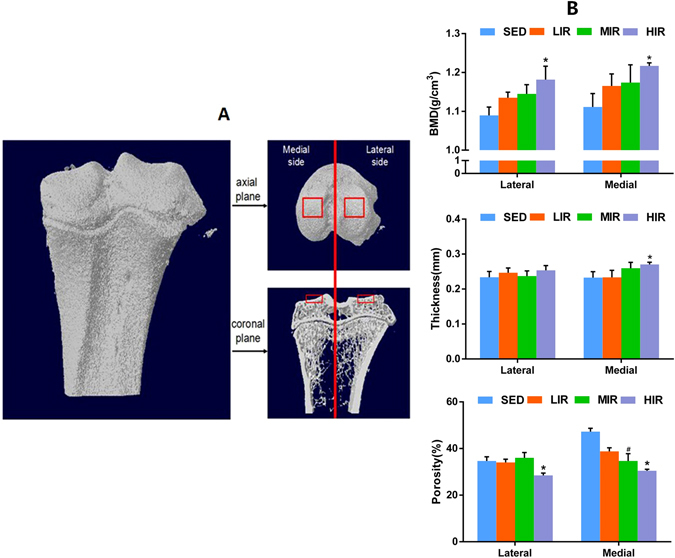
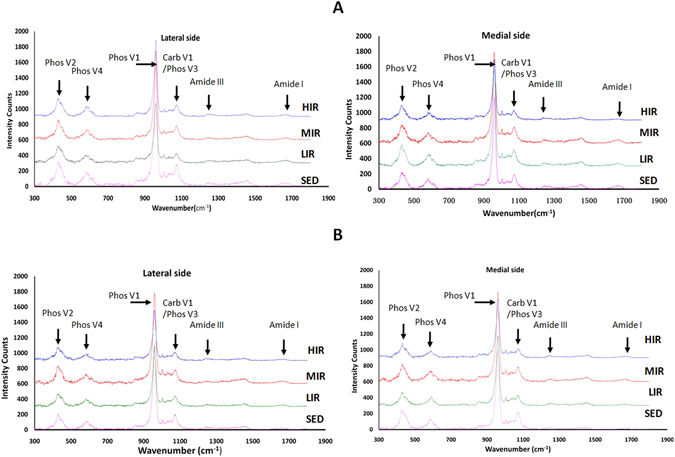
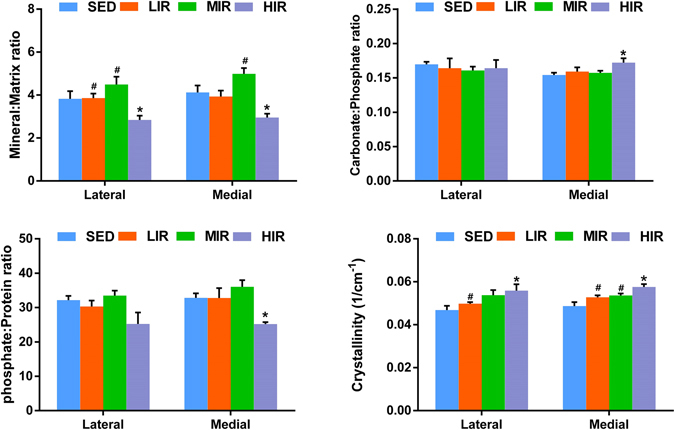
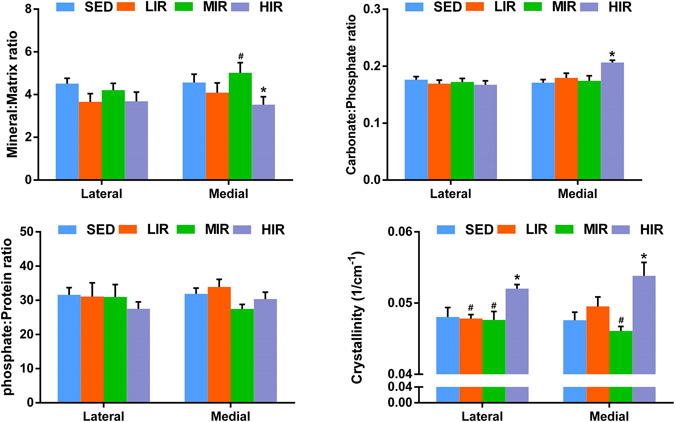
Subchondral bone (SB) is recognized as a key factor in normal joint protection, not only does it provide a shock absorbing and supportive function for the cartilage, but it may also be important for cartilage metabolism. Mechanical loading is considered to be a critical regulator of skeletal homeostasis, including bone and cartilage. It is suggested that both cartilage and bone may respond to mechanical loading in an intensity-dependent manner. In this report, we have discovered that the subchondral plate became thicker with higher bone mineral density (BMD) and lower porosity, while trabecular bone became more plate-like and denser with higher BMD in high-intensity running (HIR) group. Further, HIR led to highly remodeled, less mineralized, and stiffer subchondral plate and trabecular bone. On the contrary, low-intensity running and moderate-intensity running failed to result in considerable changes in microstructure, composition and hardness. Our findings suggested that running affects SB in an intensity-dependent manner. In addition, HIR may induce change in organization and composition of SB, and consequently alter its mechanical properties. HIR-induced "brittle and stiff" SB may adversely affect the overlying articular cartilage.
软骨下骨(SB)被认为是正常关节保护的关键因素,它不仅为软骨提供了减震和支撑功能,而且可能对软骨代谢也很重要。机械负荷被认为是骨骼内稳态的关键调节剂,包括骨骼和软骨。有研究表明,软骨和骨骼可能以强度依赖性的方式对机械负荷做出反应。在本报告中,我们发现,在高强度跑步(HIR)组中,随着骨密度(BMD)的增加和孔隙率的降低,软骨下板变得更厚;而随着 BMD 的增加,小梁骨变得更像板状且密度更大。此外,HIR 导致软骨下板和小梁骨的重塑程度更高、矿化程度更低、硬度更大。相反,低强度跑步和中等强度跑步未能导致微结构、成分和硬度发生显著变化。我们的研究结果表明,跑步以强度依赖性的方式影响 SB。此外,HIR 可能会引起 SB 组织和成分的变化,从而改变其力学性能。HIR 引起的“脆弱和僵硬”的 SB 可能会对覆盖的关节软骨产生不利影响。