Fernandez-Mendoza Julio, He Fan, LaGrotte Caitlin, Vgontzas Alexandros N, Liao Duanping, Bixler Edward O
Sleep Research & Treatment Center, Penn State Milton S. Hershey Medical Center, Pennsylvania State University College of Medicine, Hershey, PA
Department of Public Health Sciences, Pennsylvania State University College of Medicine, Hershey, PA.
J Am Heart Assoc. 2017 May 17;6(5):e005479. doi: 10.1161/JAHA.117.005479.
To examine whether objective sleep duration is an effect modifier of the impact of metabolic syndrome (MetS) on all-cause and cardiovascular disease/cerebrovascular mortality.
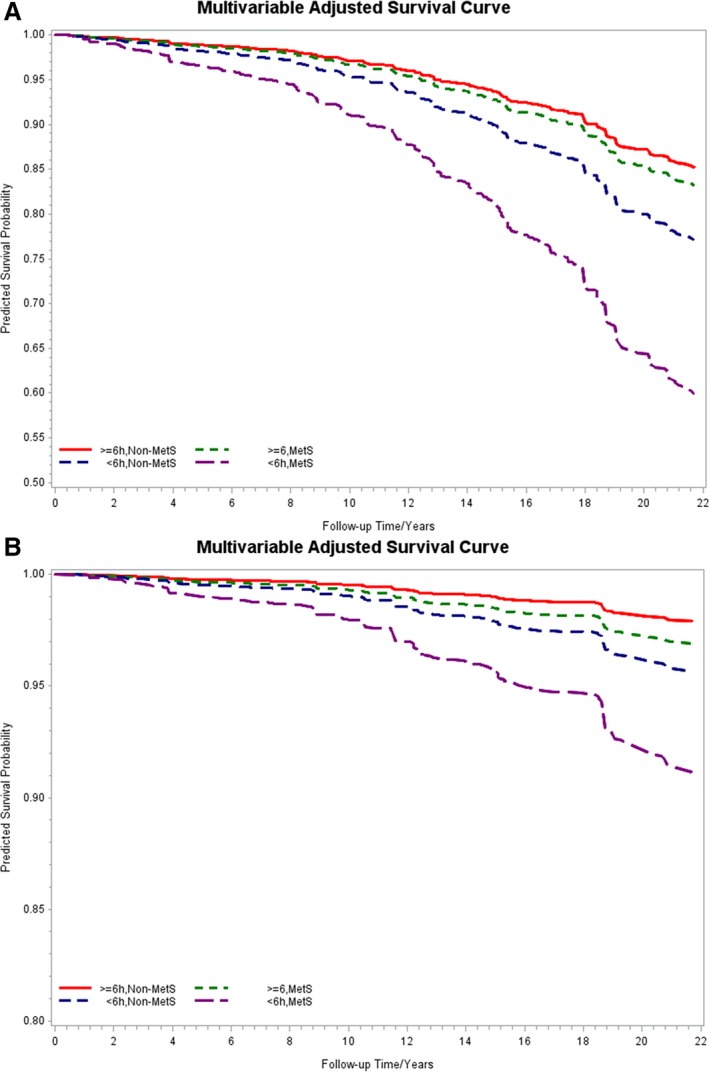
We addressed this question in the Penn State Adult Cohort, a random, general population sample of 1344 men and women (48.8±14.2 years) who were studied in the sleep laboratory and followed up for 16.6±4.2 years. MetS was defined by the presence of 3 or more of obesity (≥30 kg/m), elevated total cholesterol (≥200 mg/dL), triglycerides (≥150 mg/dL), fasting glucose (≥100 mg/dL), and blood pressure (≥130/85 mm Hg). Polysomnographic sleep duration was classified into clinically meaningful categories. Among the 1344 participants, 22.0% of them died during the follow-up. We tested the interaction between MetS and polysomnographic sleep duration on mortality using Cox proportional hazard models controlling for multiple potential confounders (<0.05). The hazard ratios (95% CI) of all-cause and cardiovascular disease/cerebrovascular mortality associated with MetS were 1.29 (0.89-1.87) and 1.49 (0.75-2.97) for individuals who slept ≥6 hours and 1.99 (1.53-2.59) and 2.10 (1.39-3.16) for individuals who slept <6 hours. Interestingly, this effect modification was primarily driven by the elevated blood pressure and glucose dysregulation components of MetS.
The risk of mortality associated with MetS is increased in those with short sleep duration. Short sleep in individuals with MetS may be linked to greater central autonomic and metabolic dysfunction. Future clinical trials should examine whether lengthening sleep improves the prognosis of individuals with MetS.
探讨客观睡眠时间是否为代谢综合征(MetS)对全因死亡率及心血管疾病/脑血管疾病死亡率影响的效应修饰因素。
我们在宾夕法尼亚州立大学成人队列中研究了这个问题,该队列是一个由1344名男性和女性组成的随机的一般人群样本(年龄48.8±14.2岁),他们在睡眠实验室接受研究,并随访了16.6±4.2年。MetS的定义为存在3种或更多以下情况:肥胖(≥30kg/m²)、总胆固醇升高(≥200mg/dL)、甘油三酯升高(≥150mg/dL)、空腹血糖升高(≥100mg/dL)和血压升高(≥130/85mmHg)。多导睡眠图睡眠时间被分类为具有临床意义的类别。在1344名参与者中,22.0%在随访期间死亡。我们使用Cox比例风险模型控制多个潜在混杂因素(P<0.05),测试了MetS与多导睡眠图睡眠时间对死亡率的交互作用。睡眠时间≥6小时的个体,与MetS相关的全因死亡率和心血管疾病/脑血管疾病死亡率的风险比(95%CI)分别为1.29(0.89 - 1.87)和1.49(0.75 - 2.97);睡眠时间<6小时的个体,相应的风险比分别为1.99(1.53 - 2.59)和2.10(1.39 - 3.16)。有趣的是,这种效应修饰主要由MetS的血压升高和血糖失调成分驱动。
睡眠时间短的个体中,与MetS相关的死亡风险增加。MetS个体的短睡眠可能与更严重的中枢自主神经和代谢功能障碍有关。未来的临床试验应研究延长睡眠时间是否能改善MetS个体的预后。