McQuilken Molly, Jentzsch Maximilian S, Verma Amitabh, Mehta Shalin B, Oldenbourg Rudolf, Gladfelter Amy S
Department of Biology, University of North Carolina at Chapel HillChapel Hill, NC, USA.
Department of Biological Sciences, Dartmouth CollegeHanover, NH, USA.
Front Cell Dev Biol. 2017 May 3;5:42. doi: 10.3389/fcell.2017.00042. eCollection 2017.
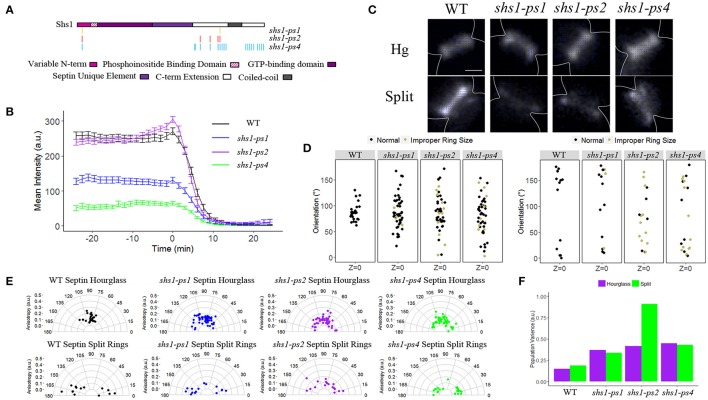
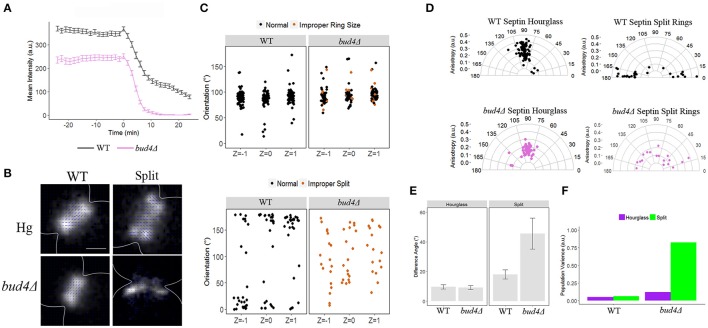
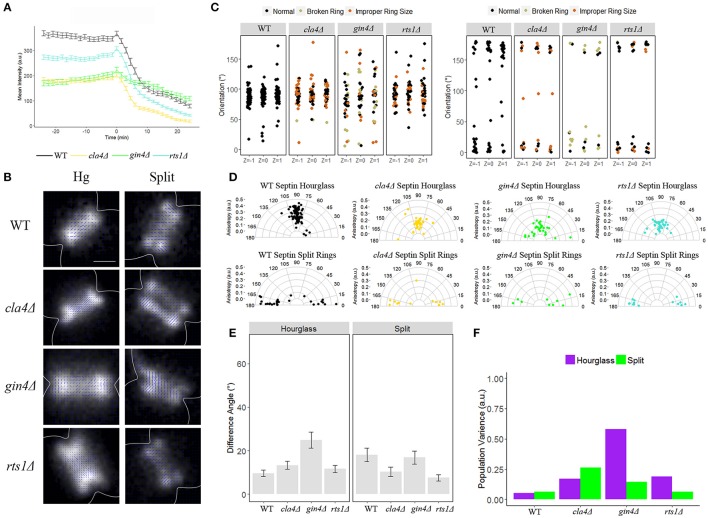
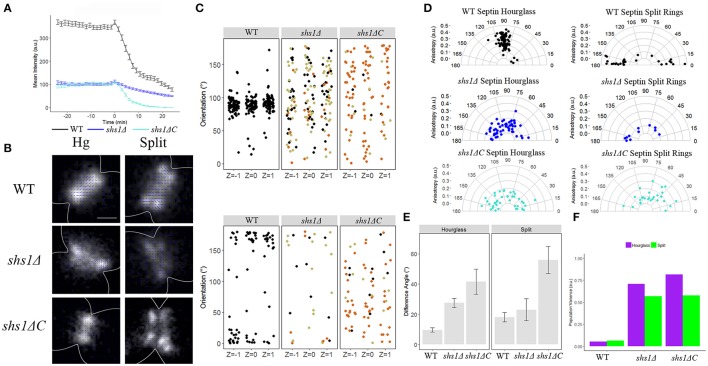
Septins are conserved filament-forming proteins that act in diverse cellular processes. They closely associate with membranes and, in some systems, components of the cytoskeleton. It is not well understood how filaments assemble into higher-order structures or how they are remodeled throughout the cell cycle. In the budding yeast , septins are found through most of the cell cycle in an hourglass organization at the mother-bud neck until cytokinesis when the collar splits into two rings that disassemble prior to the next cell cycle. Experiments using polarized fluorescence microscopy have suggested that septins are arranged in ordered, paired filaments in the hourglass and undergo a coordinated 90° reorientation during splitting at cytokinesis. This apparent reorganization could be due to two orthogonal populations of filaments disassembling and reassembling or being preferentially retained at cytokinesis. In support of this idea, we report a decrease in septin concentration at the mother-bud neck during cytokinesis consistent with other reports and the timing of the decrease depends on known septin regulators including the Gin4 kinase. We took a candidate-based approach to examine what factors control reorientation during splitting and used polarized fluorescence microscopy to screen mutant yeast strains deficient in septin interacting proteins. Using this method, we have linked known septin regulators to different aspects of the assembly, stability, and reorganization of septin assemblies. The data support that ring splitting requires Gin4 activity and an anillin-like protein Bud4, and normal accumulation of septins at the ring requires phosphorylation of Shs1. We found distinct regulatory requirements for septin organization in the hourglass compared to split rings. We propose that septin subpopulations can vary in their localization and assembly/disassembly behavior in a cell-cycle dependent manner at cytokinesis.
Septins是保守的丝状形成蛋白,在多种细胞过程中发挥作用。它们与膜紧密结合,在某些系统中还与细胞骨架成分结合。目前尚不清楚丝状结构如何组装成高阶结构,以及它们在整个细胞周期中如何重塑。在出芽酵母中,Septins在细胞周期的大部分时间里以沙漏状结构存在于母细胞与芽的颈部,直到胞质分裂时,环分裂成两个环,在下一个细胞周期之前解体。使用偏振荧光显微镜的实验表明,Septins在沙漏状结构中排列成有序的成对丝状,并在胞质分裂时分裂过程中经历90°的协调重新定向。这种明显的重组可能是由于两个正交的丝状群体解体和重新组装,或者在胞质分裂时被优先保留。支持这一观点的是,我们报告了胞质分裂期间母细胞与芽颈部的Septins浓度下降,这与其他报告一致,且下降的时间取决于已知的Septins调节因子,包括Gin4激酶。我们采用基于候选的方法来研究在分裂过程中控制重新定向的因素,并使用偏振荧光显微镜筛选缺乏Septins相互作用蛋白的突变酵母菌株。使用这种方法,我们将已知的Septins调节因子与Septins组装体的组装、稳定性和重组的不同方面联系起来。数据支持环分裂需要Gin4活性和一种类膜收缩蛋白Bud4,并且Septins在环处的正常积累需要Shs1的磷酸化。我们发现与分裂环相比,沙漏状结构中Septins组织的调节要求不同。我们提出,在胞质分裂时,Septins亚群在定位和组装/解体行为上可以以细胞周期依赖性方式变化。