Croydon Abigail, Karaminis Themelis, Neil Louise, Burr David, Pellicano Elizabeth
Centre for Research in Autism and Education (CRAE), Department of Psychology and Human Development, UCL Institute of Education, University College London, London WC1H 0NU, UK.
Centre for Research in Autism and Education (CRAE), Department of Psychology and Human Development, UCL Institute of Education, University College London, London WC1H 0NU, UK; Centre for Language Studies, Radboud University, Erasmusplein 1, 6525 HT Nijmegen, The Netherlands.
J Exp Child Psychol. 2017 Sep;161:113-125. doi: 10.1016/j.jecp.2017.04.005. Epub 2017 May 15.
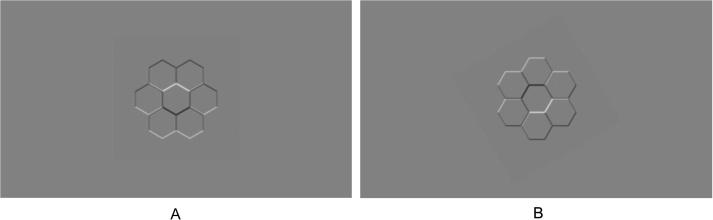
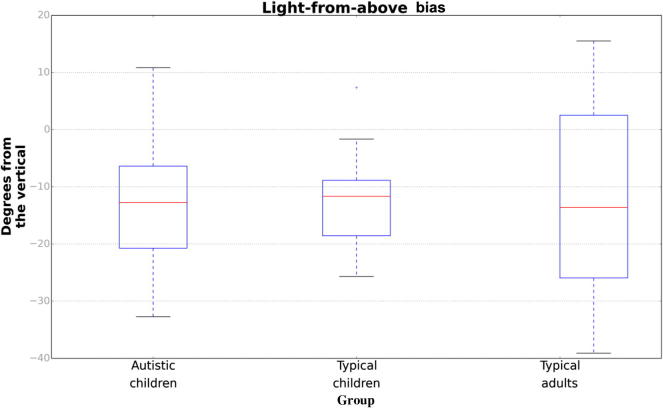
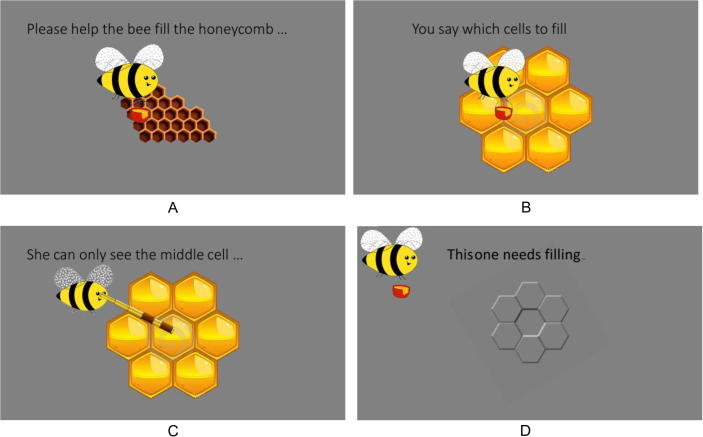
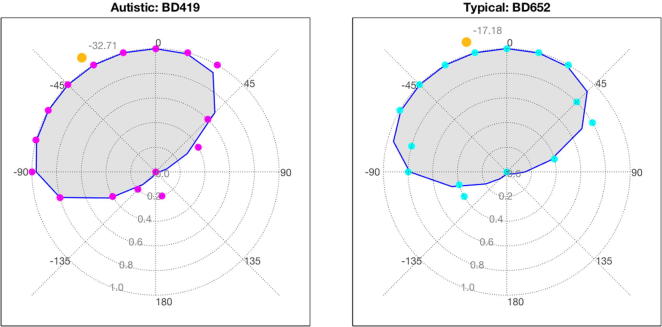
Sensory information is inherently ambiguous. The brain disambiguates this information by anticipating or predicting the sensory environment based on prior knowledge. Pellicano and Burr (2012) proposed that this process may be atypical in autism and that internal assumptions, or "priors," may be underweighted or less used than in typical individuals. A robust internal assumption used by adults is the "light-from-above" prior, a bias to interpret ambiguous shading patterns as if formed by a light source located above (and slightly to the left) of the scene. We investigated whether autistic children (n=18) use this prior to the same degree as typical children of similar age and intellectual ability (n=18). Children were asked to judge the shape (concave or convex) of a shaded hexagon stimulus presented in 24 rotations. We estimated the relation between the proportion of convex judgments and stimulus orientation for each child and calculated the light source location most consistent with those judgments. Children behaved similarly to adults in this task, preferring to assume that the light source was from above left, when other interpretations were compatible with the shading evidence. Autistic and typical children used prior assumptions to the same extent to make sense of shading patterns. Future research should examine whether this prior is as adaptable (i.e., modifiable with training) in autistic children as it is in typical adults.
感官信息本质上是模糊不清的。大脑会根据先前的知识对感官环境进行预测,从而消除这些信息的模糊性。佩利卡诺和伯尔(2012年)提出,在自闭症患者中,这一过程可能存在异常,与正常个体相比,内在假设或“先验”的权重可能较低或较少被使用。成年人常用的一种强大的内在假设是“上方光”先验,即倾向于将模糊的阴影模式解释为由位于场景上方(略偏左)的光源形成的。我们调查了18名自闭症儿童是否与18名年龄和智力水平相仿的正常儿童一样程度地使用这种先验。要求儿童判断在24种旋转角度下呈现的阴影六边形刺激物(图形)的形状(凹形或凸形)。我们估计了每个儿童的凸形判断比例与刺激物方向之间的关系,并计算出与这些判断最一致的光源位置。在这项任务中,儿童的表现与成年人相似,当其他解释与阴影证据相符时,他们更倾向于假设光源来自左上方。自闭症儿童和正常儿童在利用先验假设来理解阴影模式方面的程度相同。未来的研究应该考察这种先验在自闭症儿童中是否与在正常成年人中一样具有适应性(即可以通过训练进行修改)。